

Nepal UK
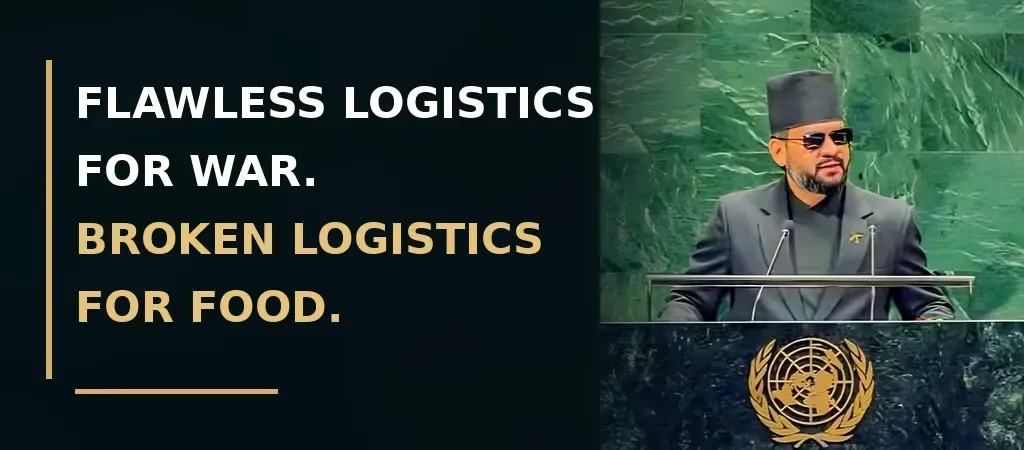
In his first address to the UN General Assembly, Nepal's Prime Minister turned a disaster appeal into a systemic indictment of global priorities, arguing that a world which can deliver weapons in 72 hours has no excuse for leaving farmers without fertiliser — a line landing squarely on Nepal's own experience of the 2026 West Asia war's fallout.
Prime Minister Balendra Shah used his address to the 81st UN General Assembly on 25 September to deliver one of the sharpest rebukes of global governance heard from a South Asian leader in recent years, telling delegates: "We have built a world with flawless logistics for war and broken logistics for food." Speaking weeks after the Bhotekoshi-Trishuli floods killed at least 1,400 people and left over 6,000 missing, Shah extended his argument well beyond climate policy, accusing the international system of moving "inter-continental missiles" and "rifles and ammunition" across borders "on time" and "clear every bottleneck," while "a peasant in Nepal cannot procure his fertilizer or fuel at market price at a time of need." For Nepal and its South Asian neighbours, the line was not rhetorical flourish — it described a lived economic shock.
The Real Shortage Behind the Metaphor
Shah's claim about fertiliser and fuel scarcity has a concrete, verifiable basis. Nepal faced a serious fertiliser shortfall ahead of its 2026 paddy season: against a plantation-season requirement of roughly 250,000 tonnes, the country held only around 171,000 tonnes in stock, with contracts for a further 94,450 tonnes at risk of falling through after supplier delivery failures, according to Kathmandu Post reporting from May 2026. The government was forced into an emergency government-to-government arrangement with India for 80,000 tonnes of urea and DAP fertiliser. Nepal also rationed cooking gas earlier in the year amid a separate supply panic. The immediate trigger for both crises, per multiple outlets including the IMF and UN News, was the 2026 Iran war and the wider Middle East conflict, which disrupted global energy markets, shipping routes and fertiliser supply chains — the same conflict Shah alluded to when he spoke of being "hit by the wars we did not start." Rice supplies over half of Nepal's calorie intake, making a fertiliser shortfall a food-security issue, not merely an agricultural inconvenience.
A Regional, Not Just National, Complaint
Shah deliberately widened the charge beyond Nepal, telling the Assembly: "Ask Bangladesh. Ask Bhutan. Ask India. Ask the Maldives. Ask Pakistan. Ask Sri Lanka. Ask any other country in our region and you will hear the same account: hit by the climate we did not warm, and hit again by the wars we did not start." This framing positions Nepal not as an isolated supplicant but as a spokesperson for South Asian vulnerability more broadly — a rhetorical strategy that Kathmandu Post columnist Anil Giri, writing the same day, characterised as Shah "fundamentally challenging international power structures" and invoking the UN's founding promise that "sovereignty would matter, international law would matter, human dignity would matter."
Praise and Pushback at Home
The speech drew a mixed but largely positive domestic reception. Kathmandu Post columnist Sajal Mani Dhital called it "one of the most effective speeches Nepal has given in recent times on climate change," crediting Shah's "political acumen and courage." But Dhital also delivered a pointed caveat that cuts against Shah's framing: he argued climate change risks becoming "a blanket excuse for poor planning," noting that the Bhotekoshi disaster exposed institutional failures — settlements and infrastructure approved in disaster-prone areas without resilient design or early-warning systems — that predate and sit alongside the climate story. In other words, even sympathetic domestic commentary is warning that a powerful line about global injustice must not substitute for accountability on planning failures at home.
What Remains Unverified
No official response from India, China, the United States or any other named government to Shah's specific war-versus-food framing had been published at the time of writing. It is Shah's own characterisation that global logistics for weapons are "flawless" — a rhetorical claim, not a sourced statistic, and should be reported as his assertion rather than as an independently verified fact.


