

By NepalUK Newsroom Investigations Desk
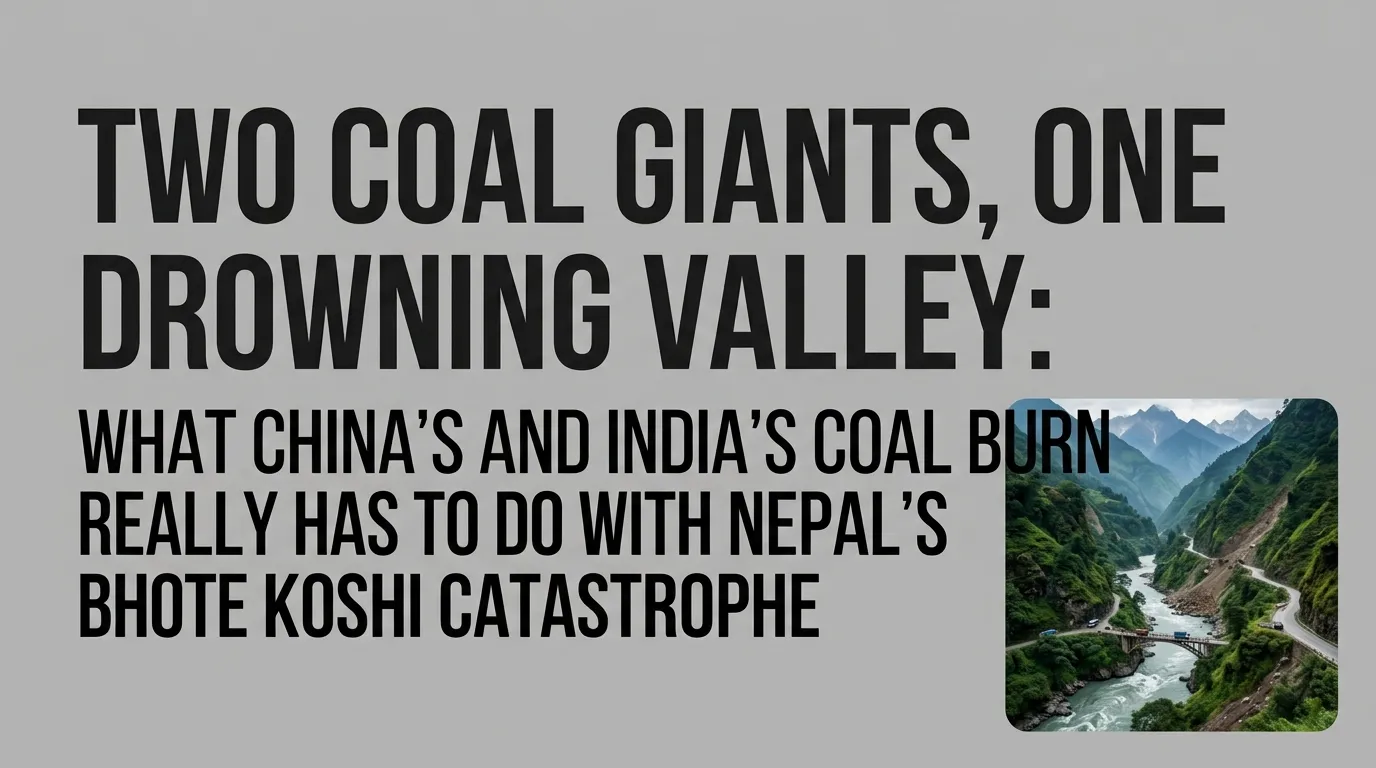
China burns roughly 4.95 billion tonnes of coal a year and India roughly 1.27 billion tonnes — together nearly two-thirds of all coal consumed on Earth. Neither figure directly "caused" the flash flood that has now killed at least 987 people and left roughly 3,900 more missing in Nepal's Bhote Koshi valley since 26 August 2026. The immediate trigger was a specific, localized event: a massive ice-and-rock collapse into a glacial lake system upstream. But the broader warming trend that scientists say made such a collapse more likely is driven by the same accumulated greenhouse gas emissions to which China and India — as today's two largest annual coal-burning nations — are the biggest current contributors. This analysis separates what is verified fact from what remains scientifically probabilistic, and lays out exactly where the coal-to-catastrophe chain holds up and where it doesn't.
The coal numbers, country by country
China — approximately 4.95 billion tonnes burnt annually
According to the International Energy Agency's Coal 2025 market report, China's coal consumption held roughly steady at 4,953 million tonnes (essentially 4.95 billion tonnes) in 2025. That is separate from production: Chinese domestic coal output hit a record of roughly 4.83 billion tonnes in 2025, up 1.2% on the prior year, even as the country's coal-fired power generation fell an estimated 1% — the first annual decline in thermal generation in a decade, reflecting China's simultaneous, and enormous, build-out of solar, wind and battery capacity. China's use of coal specifically for electricity generation is expected to remain near 3 billion tonnes a year, still the largest single slice of global coal-fired power generation by a wide margin.
India — approximately 1.27 billion tonnes burnt annually
India's coal consumption reached approximately 1,270 million tonnes (1.27 billion tonnes) in fiscal year 2025, according to Indian government and industry data reviewed for this analysis, representing roughly 14% of world coal consumption and continued year-on-year growth. On the production side, India's Ministry of Coal confirmed domestic output crossed the 1-billion-tonne mark for the first time in FY2025, with official forecasts projecting output will reach approximately 1.15 billion tonnes in FY2026. Of the two countries, India is the one the IEA expects to drive most of the world's coal demand growth through 2030, at roughly 3% annual growth, even as China's demand plateaus.
Reading the numbers honestly
Combined, China and India account for over 6.2 billion tonnes of the roughly 8.8–8.9 billion tonnes of coal the world consumes annually — meaning these two countries alone burn close to 70% of all the coal used on the planet each year. That is an extraordinary concentration, and it is the correct, verifiable starting point for any climate story involving these two economies. But two caveats matter for accuracy: first, annual consumption is not the same as historical cumulative emissions — the United States, the European Union and other early-industrializing economies remain responsible for the largest share of the CO2 already accumulated in the atmosphere since 1750, which is what actually drives long-term warming, even though China and India are now the largest current annual emitters. Second, coal consumption figures measure fuel burnt, not emissions per person: China's and India's enormous populations mean per-capita coal use and per-capita emissions remain far below those of the US, Australia or the Gulf states. Both facts are true simultaneously, and neither cancels the other out; a rigorous analysis reports both.
What actually happened at Bhote Koshi
On the morning of 26 August 2026, a catastrophic flash flood tore down the Bhote Koshi and Trishuli river systems in north-central Nepal, devastating communities in Rasuwa, Nuwakot, Dhading, Gorkha, Chitwan and Nawalparasi districts. As of the most recent official tally reviewed for this report — a National Disaster Risk Reduction and Management Authority (NDRRMA) update reported by Nepalnews on 1 September 2026 — the confirmed death toll stood at 987, with roughly 3,916 people still listed as missing, including Nepal Police, Nepali Army and Armed Police Force personnel, customs and immigration staff, hydropower workers, mountain guides and 583 foreign nationals. Nepal's Ministry of Foreign Affairs, in its own sequential updates (27–28 August), had separately confirmed hundreds of foreign nationals from 33 countries among the missing, with the numbers of both recovered and missing revised upward almost daily as search operations continued — a reminder that these figures, while official, remain provisional and should be treated as a moving target rather than a final count.
Preliminary scientific reconstruction, reported by Nature and corroborated by additional outlets including PBS NewsHour and Forbes, points to a specific proximate cause: a large mass of ice and rock, originating from roughly 5,200 metres elevation, collapsed into the Lhende Khola, a tributary feeding the Bhote Koshi, in territory on the Tibetan (Chinese) side of the border. The collapse displaced a glacial lake's water and mobilized huge volumes of loose sediment and boulders, generating a debris-and-water surge that reportedly raised river levels at Galchhi by as much as nine metres within 30 minutes, before travelling over 170 kilometres downstream into Nepal. A Chinese climate body separately confirmed the role of Tibetan glacial lake drainage in triggering the event, according to reporting reviewed for this analysis.
The economic toll is severe and still being assessed. Nepal's Finance Minister, Swarnim Wagle, has put preliminary reconstruction costs at USD 4–5 billion — equivalent to roughly one-tenth of Nepal's entire economy. The country's electricity authority reports that 12 operating hydropower plants (431.1 MW combined capacity) and 15 under-construction projects (470 MW) were damaged or destroyed, together representing more than 12% of Nepal's total generating capacity; Nepal's Physical Infrastructure Ministry has estimated preliminary road and bridge damage alone at roughly Rs 200 billion (Nepali rupees), covering an estimated 40 kilometres of destroyed roads, 19 motorable bridges and 45 suspension bridges.
Where the coal numbers and the flood genuinely connect — and where they don't
This is the section where journalistic rigor matters most, because it would be easy — and inaccurate — to draw a straight line from "China and India burn the most coal" to "China and India caused this flood." The honest picture is more layered.
What is well-established science: the Hindu Kush Himalaya region, which spans Nepal, the Tibet Autonomous Region of China, India, Pakistan, Bhutan and Bangladesh, is warming, and glacial retreat and permafrost thaw across the region are making the mountain slopes and moraine-dammed lakes above Himalayan valleys measurably less stable. ICIMOD (the International Centre for Integrated Mountain Development), working with UNDP, has identified 47 potentially dangerous glacial lakes across the Koshi, Gandaki and Karnali river basins spanning Nepal, Tibet/China and India — 25 of them inside Chinese territory, 21 in Nepal, one in India — precisely the kind of cross-border hazard geography that produced the Bhote Koshi disaster. Scientists interviewed by Nature and PBS characterized the type of ice-and-rock failure seen at Bhote Koshi as "exactly the type of event that is triggered by climate change," on the reasoning that shrinking glaciers become structurally more prone to sudden collapse, and that narrow, steep Himalayan valleys concentrate the resulting debris flows into exactly the kind of catastrophic surge that hit Rasuwa and Nuwakot.
What is not established, and this analysis will not claim otherwise: there is no peer-reviewed attribution study, at the time of this report, quantifying what percentage of the specific 26 August Bhote Koshi collapse is attributable to global warming versus other factors (local geology, seasonal monsoon timing, the moraine dam's particular structural history). Event-attribution science of this kind — the sort that has, for other disasters, produced statements like "climate change made this event X times more likely" — typically takes weeks to months of dedicated modelling by groups such as World Weather Attribution, and no such study had been published for this specific event as of this report's research.
The coal-to-Nepal causal chain, stated precisely: China's and India's coal burning does not directly cause any single flood event. It contributes — alongside historical emissions from the US, Europe and other industrialized economies, and alongside every other major current emitter — to the global rise in atmospheric CO2 that drives the regional warming ICIMOD and glaciologists say is destabilizing Himalayan glaciers and glacial lakes. Because China and India are today, combined, responsible for close to 40% of global annual CO2 emissions (a figure driven substantially, though not exclusively, by their coal use), they are legitimately central actors in the story of why the Himalaya is warming — but the relationship to any single Nepali disaster is probabilistic and cumulative, not direct and singular. Responsible reporting states it that way rather than compressing it into a simpler, punchier, but less accurate claim.
The impact Nepal now faces
Independent of the precise attribution science, the practical situation confronting Nepal is stark and well-documented. Nepal did not choose to be the downstream receptacle for glacial hazards generated largely by warming and geological processes originating across its Chinese border, yet it bears the overwhelming share of the human and economic cost — a structural asymmetry increasingly discussed by Nepali commentators, including in a Kathmandu Post opinion piece examining "why Nepal's infrastructure keeps losing to the river." With reconstruction costs estimated at USD 4–5 billion against an economy already constrained by post-earthquake debt and chronic underinvestment in flood monitoring, and with over 12% of national hydropower generating capacity offline, the disaster threatens to compound Nepal's existing fiscal and energy-security pressures for years. Nepali disaster-risk specialists cited in coverage of the "limits of Nepal's flood warning system" have pointed to gaps in cross-border early-warning data-sharing with China over upstream glacial lake conditions as a specific, addressable policy failure — one that predates this disaster and that ICIMOD's own 47-lake hazard assessment had already flagged as a known, mapped risk before 26 August 2026.


