

Nepal UK
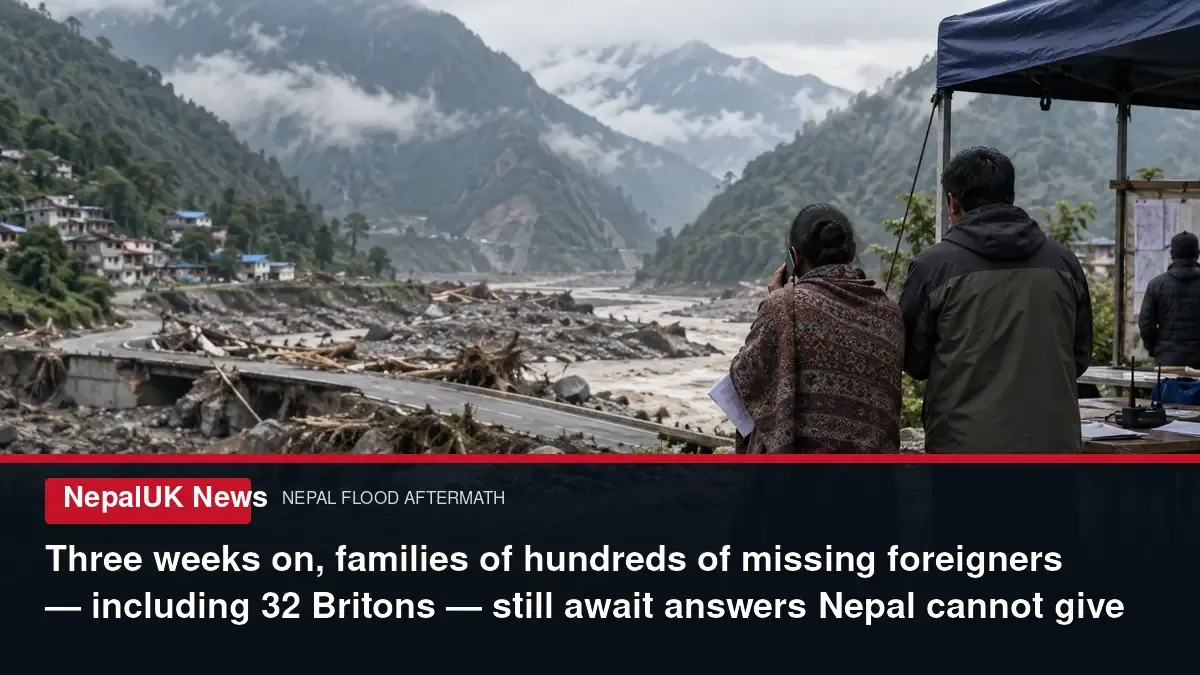
Three weeks after a glacier collapse unleashed Nepal's deadliest flood in generations, the Tourist Police's list of 795 still-missing tourists has stopped shrinking easily, and grieving relatives from Britain, India, Russia, Ukraine, the United States and dozens of other countries are demanding more than search helicopters — they want an official record of what happened to their loved ones.
On 7 September, Vichitra Jain stood outside the Nepal Tourism Board's office in Bhrikutimandap, Kathmandu, holding a photograph of Kirill Tretiakov, a Russian friend who vanished during a trip towards Kailash. Officials inside had just finished a ceremony mourning those killed in the Bhotekoshi disaster. When the gate shut, Jain — like a Russian national and a Ukrainian man also waiting outside that day — had nowhere left to go for answers, according to reporting by The Kathmandu Post.
The flood struck on 26 August 2026, when a section of glacier collapsed on Langtang Lirung in the Himalayas, triggering flash floods that tore roughly 70km down the Trishuli and Bhotekoshi river corridors in Nepal's Rasuwa and Nuwakot districts before crossing into Tibet. Within a week, Nepal's National Disaster Risk Reduction and Management Authority had confirmed more than 1,000 dead and put the number of missing nationally at 3,916, according to a 1pm update reported by ABC News on 1 September. By 11 September, Nepal's Foreign Secretary told The Kathmandu Post that 1,385 bodies had been recovered and 5,130 people remained missing, including around 600 foreign nationals from roughly 35 countries — figures that continue to shift as recovery operations proceed and bodies are identified.
Within that wider toll sits a more specific, closely tracked list. As of 16 September, Nepal's Tourist Police recorded 795 tourists as missing: 607 foreign nationals and 188 Nepali nationals. India has the largest number of missing foreign nationals, at 189, followed by 65 Americans, 55 Malaysians, 54 Ukrainians, 37 Chinese nationals, 33 Latvians, 33 Australians, 32 Britons and 30 Canadians, with smaller numbers from Germany, Singapore, South Korea, South Africa, Russia, Japan, New Zealand, France and several European countries.
Sunil Sharma, officiating director of the Nepal Tourism Board, told The Kathmandu Post that families of foreigners who have been out of contact for three weeks are now asking for death certificates or, at minimum, formal documentation of their relative's status — not just news of ongoing searches. Nepal cannot issue a death certificate without a confirmed death at a hospital or an identified body, Sharma said, so the Tourist Police have instead been issuing slips stating that a missing person is "out of communication". The Ministry of Foreign Affairs' Emergency Response Team is still fielding 13 to 14 inquiries a day from families, down from dozens daily in the disaster's first days.
For Jain, the search has been complicated by the international border running through the disaster zone. Floodwaters also struck the Chinese side of Rasuwagadhi, and she said she has received no reliable information on bodies or survivors recovered there, despite unconfirmed reports that three Russians were found on the Chinese side. Tretiakov's brother, Dmitrii, has called on Nepal and China to run a coordinated cross-border search using drones, thermal imaging and rescue dogs, and to publish daily maps showing which areas have been searched.
A separate case illustrates the same cross-border strain: the family of Kazakh national Irina Blonskaya, missing in Rasuwa, sought diplomatic assistance from Kazakhstan's embassy in India on 11 September after a planned helicopter search was delayed by the need for special flight clearance to enter a restricted border zone.
For the diaspora and the wider international community, the story is a reminder that the Bhotekoshi disaster's toll extends well beyond Nepal's own citizens. Thirty-two British nationals remain unaccounted for, according to the Tourist Police's tally — a fact with direct bearing on UK families and on how the UK government and Nepal's authorities coordinate consular support in the weeks ahead. What remains unresolved is whether cross-border search access will improve, whether the government will find a way to issue clearer official status documentation for families who may wait months for confirmation, and how many of the 795 names still on that list will ultimately be found.


