

Nepal UK
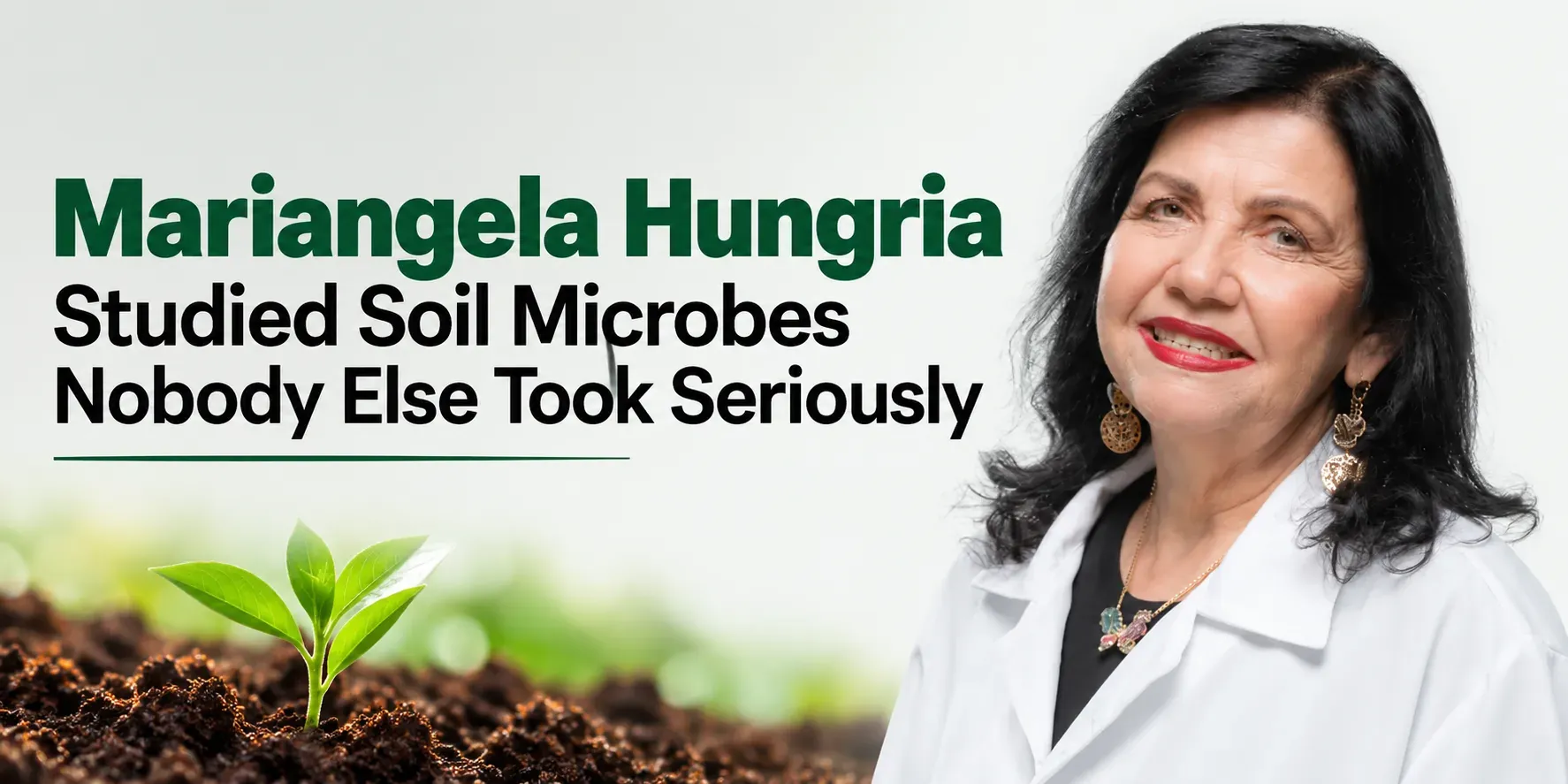
Mariangela Hungria studied soil microbes nobody else took seriously. Brazilian farmers now save billions of dollars a year because of it.
For most of her working life, Mariangela Hungria studied something almost nobody in science wanted to talk about: the bacteria living in the dirt beneath Brazil's soybean fields. "When I started out, nobody spoke about biological nitrogen fixation," she has said. "But I loved microbiology and basic science" — and she kept going anyway, according to the World Food Prize Foundation, which announced on May 13, 2025 that Hungria would receive the 2025 World Food Prize, the field's highest honour, carrying a $500,000 award.
Hungria, a microbiologist who spent her entire 40-year research career at Brazil's national agricultural research agency, Embrapa, studies rhizobia and other soil microbes that pull nitrogen directly from the air and hand it to plant roots — a natural substitute for synthetic fertiliser. Mentored early on by the pioneering researcher Johanna Döbereiner, she went on to develop seed and soil "inoculants": coatings of living bacteria that farmers apply to soybean, bean, maize and pasture seed instead of, or alongside, chemical fertiliser. According to the Foundation, her rhizobia inoculants raise soybean yields by up to 8 percent over synthetic fertiliser alone, while combining two of her bacterial strains together roughly doubles yield gains in beans and soybeans; a separate inoculant she developed for grass pastures increases biomass by 22 percent.
The scale of adoption is what turns a laboratory discovery into a national story. The World Food Prize Foundation puts her technologies in use across more than 40 million hectares of Brazilian farmland, with over 70 million doses of her combined inoculants applied to roughly 15 million hectares every year — saving Brazilian farmers an estimated $40 billion annually in fertiliser and other input costs, and avoiding more than 180 million metric tons of CO2-equivalent emissions a year. Other outlets report somewhat lower figures for the same work — the U.S. Department of Agriculture's Foreign Agricultural Service cites savings of "up to $25 billion annually," and the Brazilian environmental research institute IPAM cites 250 million tons of CO2 avoided "in one harvest" for soy alone — a reminder that even record-breaking numbers like these are still being measured and refined across sources. What isn't in dispute is the trajectory: Brazilian soybean production has grown from roughly 15 million tonnes in 1979, when Hungria's career was just beginning, to a projected 173 million tonnes today, according to the Foundation.
None of it came easily. "Many people questioned me and my abilities throughout my career," Hungria has said, "but I believed in what I was doing and persevered." She has spoken openly about the added skepticism she faced as a woman in a male-dominated field, and has used her prize platform to argue that "the role of women in agriculture, from farming to science, deserves more recognition." According to Brazilian Farmers and the Brazilian environmental research institute IPAM, Hungria is the first Brazilian woman — and only the second woman from Latin America — to win the World Food Prize since it was established in 1986.
Dr. Gebisa Ejeta, chair of the prize's laureate selection committee, said Hungria was honoured "for her extraordinary scientific achievements in biological nitrogen fixation that transformed sustainability of agriculture in South America," per the World Food Prize Foundation's announcement.
Hungria has framed her life's work as a sequel to an older one. Norman Borlaug's Green Revolution used chemistry and plant breeding to fend off famine in the 20th century; Hungria says her own goal has been to start a "micro green revolution" — replacing some of that chemistry with biology, one bacterium at a time. It is, in the end, a quietly radical idea: that one of the most promising fixes for how the world feeds itself was never going to be found in a factory. It was already living in the ground.


