

Nepal UK
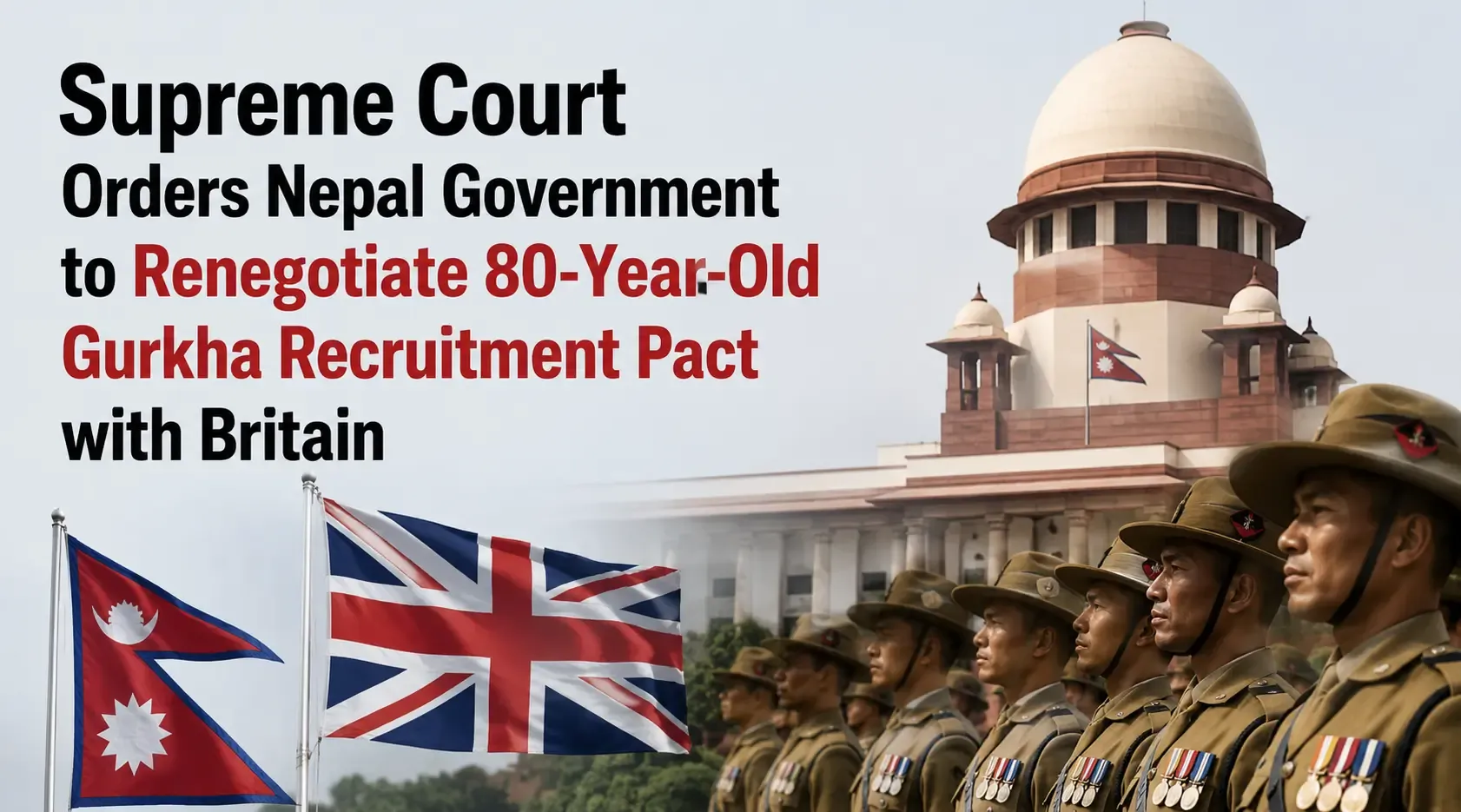
Nepal's Supreme Court has issued an eight-point directive ordering the government to review and ultimately replace the 1947 Tripartite Agreement — the colonial-era treaty that governs Gurkha recruitment into the British Army — with a bilateral Nepal-UK deal, in a ruling that could reshape pension rights for thousands of Gurkha veterans living in the UK and Nepal.
A joint bench of Justices Hari Prasad Phuyal and Mahesh Sharma Poudel ruled on 26 February 2026 on a writ petition filed by Bhim Bahadur Limbu Tawa and Lal Bahadur Ghising of the British Gurkha Satyagraha Struggle Committee. The 71-page judgment found that the Tripartite Agreement — originally splitting Gurkha regiments between Britain and India — no longer reflects reality now that the two armies are fully separate, and warned that "continuous discrimination against Gurkha soldiers would automatically allow Nepal to limit or terminate its obligations under the principle of reciprocity."
The court's guidance instructs Nepal's government to pursue high-level diplomatic talks with the UK, to verify how many Gurkhas died or were injured in the two World Wars and pursue compensation for their families, to seek equal pensions and service facilities for Gurkhas who retired before 1997, and to have pensions paid directly from the UK to Nepal rather than routed through India as at present. Notably, the court stopped short of halting ongoing Gurkha recruitment, saying it was not the judiciary's place to intervene directly in executive diplomacy.
The ruling lands amid an active protest campaign: Krishna Bahadur Rai, chief coordinator of the British Gurkha Satyagraha United Struggle Committee, wrote to Prime Minister Keir Starmer (since succeeded by Andy Burnham) in January 2026 demanding a resolution by 31 March, warning of renewed demonstrations in both Nepal and the UK if talks stalled. For context, the British government's standing position — reiterated by Defence Minister Louise Sandher-Jones in Parliament — is that pre-2007 Gurkha pensions under the 1948 scheme are "at least as good, and in many cases better" than equivalent British Army pensions for identical service. This is precisely the point of contention Gurkha campaigners dispute, arguing the comparison ignores the cost of living in Britain versus historical Indian army pay scales. For the roughly 15,000–20,000 Gurkha veterans and family members settled in towns like Aldershot and Folkestone, the case represents the most significant legal pressure point in years on a grievance that has simmered since the 2009 Gurkha settlement rights campaign fronted by Joanna Lumley.


