

Nepal UK
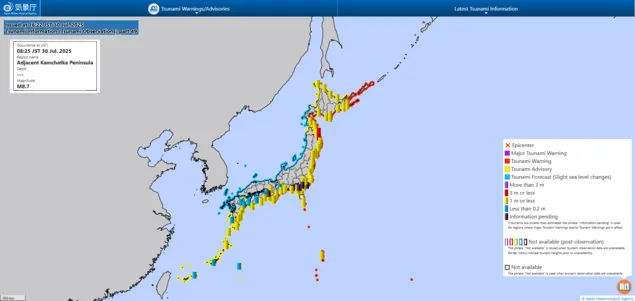
Source: Japan Meteorological Agency
TOKYO, JAPAN – Japan's Pacific coastline experienced tsunami waves up to 60 centimetres high on Wednesday, following a powerful magnitude 8.8 earthquake off Russia's Kamchatka Peninsula earlier in the morning. Authorities have maintained evacuation warnings across vast coastal areas of Japan, leading to significant disruption. Tsunami alerts were also issued across a broad section of the Pacific, including Hawaii and parts of the US West Coast.
The Japan Meteorological Agency (JMA) had warned of potential waves as high as 3 metres for Japan, with signals expected to persist for approximately a day. In Japan, the highest recorded waves were 60 centimetres, which arrived after 1 p.m. local time in Hamanaka town, Hokkaido, and Kuji Port in Iwate Prefecture. Some areas of Hokkaido also reported 30-centimetre waves. A smaller 20-centimetre wave reached Tokyo's Harumi waterfront district, and tsunami activity was observed in Aichi, Kagoshima, Miyazaki, and Okinawa prefectures.
Internationally, tsunami warnings and advisories stretched across the Pacific. This included Hawaii, Alaska's coastal regions, and parts of the US West Coast, specifically California, Oregon, and Washington state. Alerts were additionally issued for countries such as China, the Philippines, Indonesia, Guam, Peru, Ecuador (Galapagos Islands), Chile, Costa Rica, New Zealand, Australia, Palau, and the Northern Mariana Islands.
In response to the threat, Japanese Prime Minister Shigeru Ishiba pledged to implement all possible measures to ensure public safety, directing government ministries and agencies to mitigate any potential damage. Chief Cabinet Secretary Yoshimasa Hayashi had earlier urged residents in all affected areas in Japan to evacuate to higher ground. In the United States, Hawaii Governor Josh Green called on residents and tourists to heed evacuation orders and move to higher ground, while US President Donald Trump advised Americans to remain alert for tsunami warnings.
The earthquake that triggered the tsunami occurred at 8:24 a.m. Japan time, approximately 120 kilometres east-southeast of Petropavlovsk-Kamchatsky, at a depth of about 20 kilometres. Initially reported at magnitude 8.0, its strength was later revised upwards to 8.8. In Russia's Kamchatka region, tsunami waves as high as 3 to 5 metres were recorded, leading to several minor injuries and damage to buildings. A state of emergency was declared in the northern Kuril Islands due to flooding and damage.
At Japan's Fukushima Daiichi nuclear power complex, which is undergoing decommissioning, the operator, Tokyo Electric Power Company Holdings Inc. (TEPCO), instructed workers to move to elevated locations. The release of treated radioactive wastewater into the Pacific Ocean was manually halted as a precaution, and no irregularities were reported at any of Japan's nuclear power plants. Beyond nuclear facilities, the tsunami warnings caused significant disruptions within Japan, affecting transport with Sendai airport closing its runways and major rail operators suspending services near coastal regions. Businesses, including Nissan Motor Co., paused production, and convenience store chains temporarily closed hundreds of outlets. Beaches in Miyagi Prefecture were also shut.
This seismic event underscores the Pacific region's vulnerability to tsunamis, recalling past incidents. A magnitude 8.2 earthquake off the Kamchatka Peninsula in 1952 generated tsunami waves up to 3 metres along Japan's Pacific coast, causing widespread flooding. More recently, the devastating magnitude 9.0 earthquake in 2011 triggered tsunami waves over 10 metres, submerging the Fukushima Daiichi plant and leading to a major nuclear crisis.
As the Pacific Rim remains on high alert, ongoing vigilance is crucial in the face of nature's formidable power.


