

Nepal UK
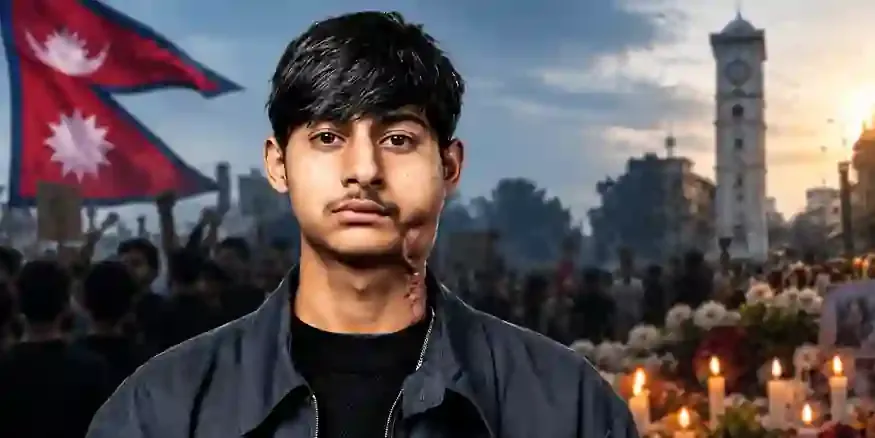
A year after Bhadra 23–24 (September 8–9, 2025), the boy shot through the jaw in Itahari is still waiting for a new face — and Nepal is still waiting for accountability.
On the morning of September 8, 2025 — Bhadra 23, 2082 in the Nepali calendar — Shantanu Dhakal, an 18-year-old from a farming family in Morang district, finished his classes and walked to a demonstration gathering outside the Itahari sub-metropolitan office and police station in neighbouring Sunsari district. He was a top student — second in his class, with a GPA above 3.70 — and this was the first protest of his life. He carried no weapon and, by his own account, no particular anger. He simply wanted to stand with his generation.
By early afternoon he was on a stretcher, unable to breathe without a tube in his throat. A bullet had shattered his jaw, crushed his molars and travelled on toward his chest, killing two students standing beside him. He would spend three weeks at Birat Teaching Hospital in Biratnagar, unable to speak, documenting his own recovery — swollen face, surgical drains, a hollowed cheek — because, as he later wrote online, "there is a limit to the pain a human mind can bear; once a part of the body crosses that limit, it stops feeling pain at all," as reported by SBS Dateline and Nepal's Global Voices.
One year on, that sentence reads less like an isolated tragedy than a summary of an entire country's breaking point.
The trigger was almost bureaucratic: on September 4, 2025, Nepal's government shut down 26 social media platforms — including Facebook, Instagram, X, YouTube and WhatsApp — for failing to register under new rules, according to Britannica and Wikipedia's detailed timeline of the uprising. But the ban landed on a country already at a boiling point. Nepal's median age is 25; nearly half its citizens are active on social media; youth unemployment stood above 20 percent; and remittances from Nepalis working abroad made up roughly a third of GDP. For months, a viral "Nepo Kid" trend had been circulating — young relatives of ruling politicians flaunting foreign degrees, luxury cars and holidays abroad, against the backdrop of a population many of whose own children had to leave the country simply to find work.
When the government cut the platforms where that anger lived, hundreds of thousands of young Nepalis did not go quiet. They organised instead through Discord servers — reportedly coordinated in part through the youth network Hami Nepal — using VPNs and hand-drawn, QR-coded flyers to route around the blackout, according to Wikipedia's account of the protests.
What followed on September 8 and 9 was, by any measure, the deadliest political unrest in Nepal since the 2006 movement that ended direct royal rule, according to the Tribune India. Tens of thousands gathered at Maitighar Mandala and marched on the federal parliament in Kathmandu's New Baneshwor. When some protesters tried to breach the parliament perimeter, police responded first with tear gas and water cannon, then — video evidence later showed — with live ammunition.
This is where the story stops being simply tragic and becomes, in the language of human rights investigators, alleged unlawful. A three-part analysis published by Harvard's T.H. Chan School of Public Health Atrocity Prevention Lab found that forensic evidence showed victims were "struck above the waist, primarily in the head, neck, and chest" — a direct violation of Nepal's own crowd-control regulations, which require security forces to aim below the knee when live fire is unavoidable. Nepal Police's own records, later obtained by the Kathmandu Post, documented 2,642 rounds of live ammunition fired over the two days, part of a wider total the Harvard analysis put at over 13,000 rounds of live, rubber and tear-gas munitions combined. Among the dead was a 12-year-old child. At least 19 people, most of them students, were killed on September 8 alone.
By the time the violence subsided, the death toll had climbed in stages — 19, then 34, then 51, finally settling near 72 as more bodies were recovered and injured victims succumbed in hospital, according to Nepal News' one-year retrospective timeline and the Tribune India. Government figures eventually put the injured at over 2,600. Home Minister Ramesh Lekhak resigned within hours of the first deaths. Prime Minister K.P. Sharma Oli fled Kathmandu by helicopter as protesters set fire to Singha Durbar, the Supreme Court, the presidential residence, parliament itself, and the homes of senior politicians including former Prime Minister Sher Bahadur Deuba, who was injured when his house was burned. More than 13,500 prisoners escaped from jails nationwide, and an estimated 1,200 police firearms went missing in the chaos — a security legacy Nepal is, by some accounts, still grappling with.
By the evening of September 8, the government had already rescinded the social media ban. It made no difference to what came next. On September 9, Oli formally resigned. Youth organisers, coordinating through a Discord server that swelled past 100,000 members, debated and polled their way to a consensus candidate for interim prime minister: former Chief Justice Sushila Karki, passing over more prominent names like Kathmandu Mayor Balen Shah. On September 12, Karki was sworn in as Nepal's first woman prime minister, parliament was dissolved, and elections were scheduled for March 2026 — an extraordinary act of leaderless, digitally organised democratic self-correction, achieved at a cost measured in dozens of young lives.
This is the point where an inspirational story risks becoming a comfortable one, and it shouldn't. A government fell in three days. A generation, organising through Discord polls rather than any political party, chose the country's next leader and forced free and fair elections that, in March 2026, delivered the Rastriya Swatantra Party a near two-thirds majority and made Balen Shah, at 35, Nepal's youngest elected prime minister — a genuinely remarkable outcome for a country long governed by the same handful of recycled leaders. A commission of inquiry, chaired by former Special Court judge Gauri Bahadur Karki, was formed within two weeks and submitted its report in March 2026. Forty-five of the dead were formally declared martyrs by the state in November 2025.
But accountability for the killings themselves has stalled. Oli and Lekhak were arrested in March 2026 on charges of criminal negligence, then released weeks later when a Supreme Court-mandated review period expired without conclusive findings. A further review panel in July 2026 concluded there was insufficient evidence to proceed with criminal prosecution, according to Global Voices' one-year anniversary reporting — a finding human rights groups, including Human Rights Watch and CIVICUS, had explicitly warned against when they called in 2025 for "prompt, impartial investigations" into the shootings. As of this writing, no security official has been criminally convicted for a death toll that, per capita, exceeds that of most modern crowd-control disasters in South Asia.
That unresolved question sits uneasily beside the human stories of survival. Liza Adhikari, shot by rifle fire near parliament, lost the use of nerves in her arm, underwent surgery in India, and has not returned to university; she told Global Voices she now feels regret about having gone to the protest at all. Riya, a police constable struck by stones that day, still carries the psychological weight of what she calls "the scariest moment" of her life — a reminder that the state's own rank-and-file were also, in a different sense, casualties of a crisis created above their heads. And Shantanu Dhakal, whose provisional skin graft still needs the reconstructive, bone-grafting surgery his family cannot afford in Nepal, says he still intends to study engineering. His father told SBS Dateline that hospital costs already exceeded 50,000 rupees against 20,000 rupees in state compensation — a gap that, multiplied across thousands of injured families, is its own quiet scandal.
What makes Bhadra 23–24 more than a domestic political drama is what it teaches, plainly, about power and accountability anywhere: that a government can fall in 72 hours when a generation with nothing left to lose organises itself, but that toppling a government is easier than building the institutions that make such a toppling unnecessary next time. Nepal's Gen Z did not just win an election a few months later — they forced open a conversation about corruption, nepotism and disproportionate force that Nepal's political class had spent decades avoiding.
The lesson for readers watching from the diaspora, in the UK and elsewhere, is not a triumphant one — it is a demanding one. Democratic renewal bought at this price carries an obligation: to keep asking, as insistently as Shantanu's generation once did, what happened to the promises of accountability made in September's smoke, and to make sure that the next young person who stands outside a police station with no weapon and no anger, only hope, never has to pay what he paid to be heard.


