

Nepal UK
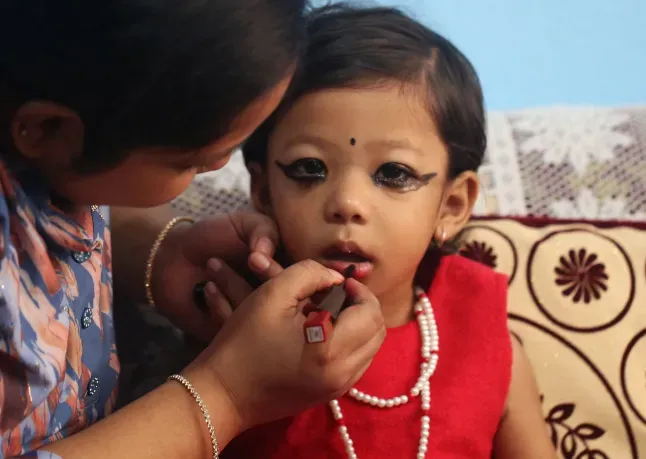
Aryatara will live away from her family until she reaches puberty and her tenure comes to an end (Picture: Sunil Sharma/ZUMA Press Wire/Shutterstock)
Kathmandu - Newly appointed Kumari, Aaryatara Shakya, has assumed the traditional Kumari throne on Tuesday.
The two-and-a-half-year-old Aaryatara was chosen by an elaborate process spanning nearly two years.
Aryatara took her seat as the Living Goddess Kumari amidst a religious ceremony. The outgoing Kumari, Trishna Shakya, was given a ceremonial farewell accompanied by traditional music and festivities. Mr Gautam Shakya, coordinator of the Kumari Ghar Management Committee, said that the new Kumari was taken to the Taleju Bhawani temple for a ritual visit with a special musical procession.
Kumari, who is worshipped as a living goddess, is also regarded as a symbol of Goddess Mahalakshmi. It is believed that the tradition of the Living Goddess was established by then-King Jayaprakash Malla around the mid-18th century.
During the Kumari selection process, all relevant stakeholders were contacted and requested to recommend names. There is also a tradition where the head of state pays homage to the Kumari on the day of Kojagrat Purnima, the last day of Dashain.
Believed to be the only Living Goddess, “Kumari” is worshiped by both Hindu and Buddhist communities of Nepal. The meaning of Kumari is Virgin where a young prepubescent girl is said to be the living incarnation of the goddess Durga and Taleju Bhawani.


