

Nepal UK
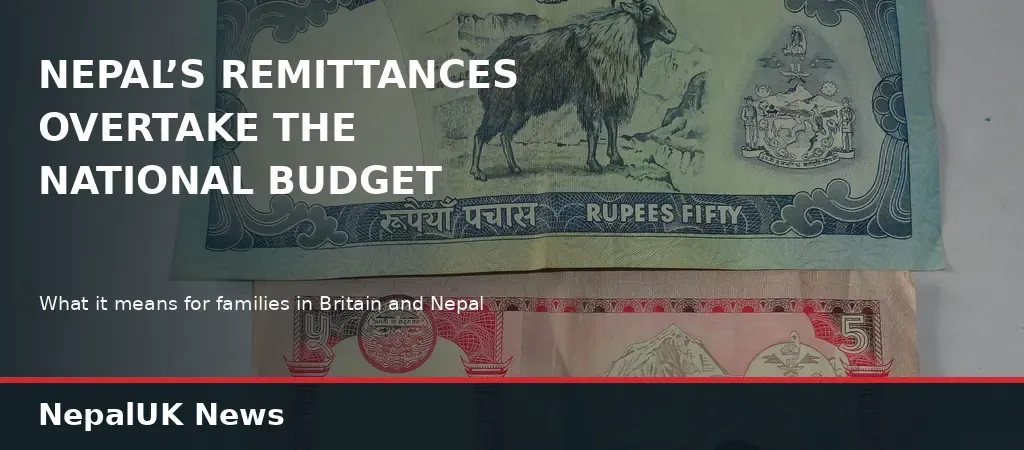
New Nepal Rastra Bank data shows remittances hit a record Rs 2.36 trillion in the fiscal year to mid-August 2026 — larger than the government's entire annual budget — intensifying a decades-old debate about an economy built on its citizens working abroad.
Remittances sent home by Nepali migrant workers reached Rs 2.36 trillion (about $16.19 billion) in the fiscal year ending mid-August 2026, according to Nepal Rastra Bank data reported on 27 August — for the first time exceeding the government's own implemented budget of Rs 1.964 trillion for the same year, by roughly 20 percent. The milestone, confirmed through the central bank's official statistics, underscores how central overseas labour has become to Nepal's economy, at a moment when the country is also absorbing the costs of its worst flood disaster in decades and a new government under Prime Minister Balendra Shah is testing promises of governance reform.
A record built on migration, not diversification
The growth was sharp: remittance income rose 37.1 percent in rupee terms and 28.1 percent in US dollar terms year-on-year. Nepal Rastra Bank data cited by OnlineKhabar shows 406,519 Nepali workers received fresh approvals for foreign labour during the year, alongside 385,783 re-entry approvals for workers returning to jobs abroad — though fresh approvals were down from 505,957 the previous year, a shift that may reflect either tightening opportunities in destination labour markets or a maturing pattern of repeat, rather than first-time, migration. Either way, the figures confirm that Nepal's growth is still overwhelmingly a function of its citizens' labour abroad rather than domestic industry or exports.
Why the numbers matter beyond the balance sheet
Remittances now underwrite everyday consumption, construction and, increasingly, disaster recovery: with reconstruction after the Bhote Koshi flood estimated at Rs 723.32 billion, informal household transfers from relatives abroad are likely to supplement formal relief efforts in flood-hit districts, even though no government figures yet quantify this. Economists have long warned that heavy remittance dependence can dampen incentives for domestic investment and leave the economy exposed to shocks in destination countries — from Gulf labour policy changes to global downturns — though this analysis draws on established economic reasoning rather than a specific 2026 study, and readers should treat it as informed context rather than a proven causal claim about this year's data.
The UK dimension
Britain hosts a substantial and growing Nepali community, including former Gurkha soldiers, students who have transitioned into skilled work, and healthcare and social-care staff recruited in recent years. While the reported remittance figures are not broken down by source country in the data reviewed for this article, London is understood to be one of several major diaspora hubs alongside the Gulf states, Malaysia, the United States and Australia. For UK-based Nepali households sending money home — whether for family support, festival spending around the approaching Dashain season, or flood-relief contributions — the record inflow figures reflect a system that remains, for many, the primary financial link to relatives in Nepal, typically via formal money-transfer operators and banks rather than informal hundi channels, which authorities have targeted in recent years.
What remains uncertain
Nepal Rastra Bank's release, as reported, does not break down remittance inflows by source country, nor does it quantify how much of the record inflow is being channelled into productive investment versus consumption. It is also not yet clear how the Shah government — which came to power on an anti-corruption and transparency platform — intends to convert diaspora capital into longer-term development financing, an issue likely to feature in economic policy debates in the coming months.


