

Nepal UK
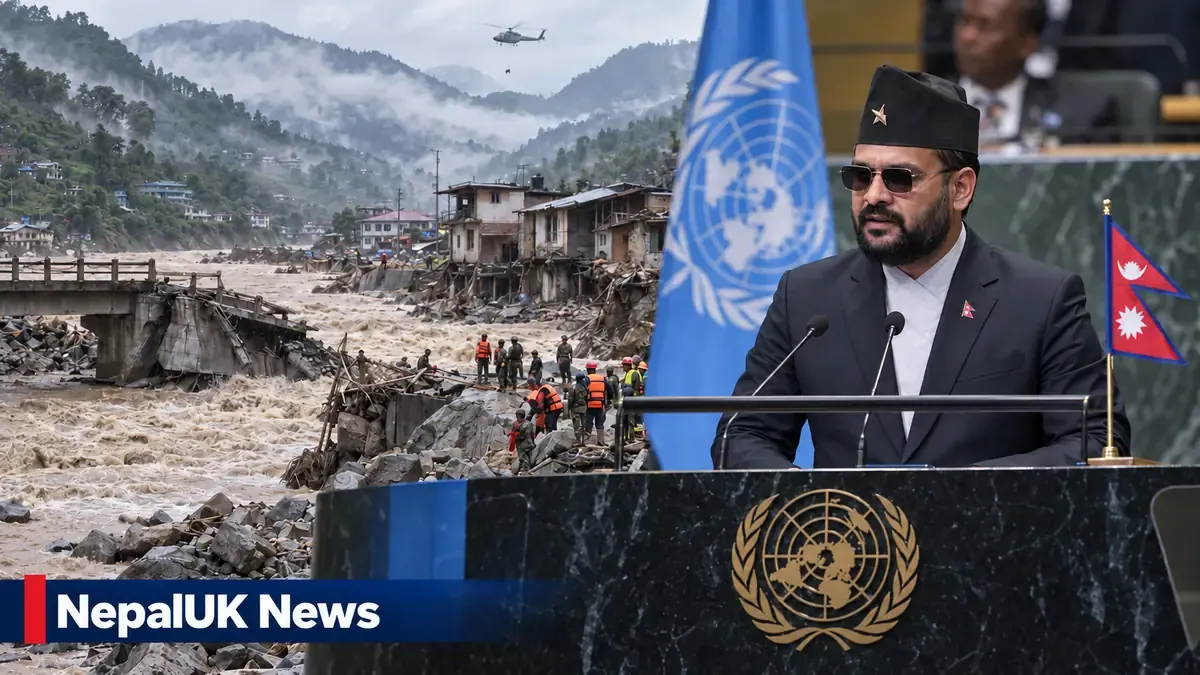
Three weeks after a glacier collapse killed well over a thousand people and left thousands more missing, Prime Minister Balendra "Balen" Shah will make his first foreign trip since taking office to press wealthy nations for climate compensation at the UN General Assembly — testing whether Nepal's disaster can shift a stalled global conversation on loss and damage.
Nepal's Prime Minister Balendra Shah will address the 81st session of the United Nations General Assembly in New York on 24 September, leading a Nepali delegation that departs Kathmandu on 22 September. It will be his first trip abroad since being sworn in on 27 March, and comes as Nepal recovers from the Bhotekoshi flood of 26 August — a glacier collapse on Langtang Lirung that sent flash floods down the Trishuli and Bhotekoshi corridors, killing well over a thousand people and leaving thousands more missing.
Foreign Secretary Amrit Bahadur Rai told The Kathmandu Post that Shah will use his address to highlight "the heavy toll that climate change and related disasters have repeatedly taken on Nepal, despite the country's negligible contribution to global carbon emissions." Central to the appeal is a call for immediate and appropriate compensation through the Fund for Responding to Loss and Damage (FRLD), the UN climate-finance mechanism created at COP27 in 2022 specifically to help vulnerable countries cope with climate disasters. On 31 August, Finance Minister Swarnim Wagle and Environment Minister Gita Chaudhary wrote to the FRLD Board asking it to take a special decision to respond rapidly, arguing a prompt response would "demonstrate that the Fund can translate international solidarity into timely support," according to Mongabay's reporting on the letter. Rai said the request has received declared support from groupings representing Asia, Africa, Latin America, the least developed countries and small island developing states.
Shah will also press wealthy nations to make climate finance and resilient-infrastructure technology "readily and affordably available" to Nepal, according to Rai, while pointing to the country's more than 46 percent forest cover and extensive Himalayan watershed as evidence of its contribution to the global environment despite bearing a disproportionate share of climate impacts.
Nepal's timing is difficult. Pledges to the FRLD total roughly $820 million since its 2023 launch, but at its most recent board meeting in July, 119 countries had already submitted 176 funding requests worth an estimated $2.8 billion — far outstripping the money available, pushing a decision on the full portfolio to the board's next meeting, in December 2026 in Manila. Nepal's request is for immediate relief rather than a standard project proposal, but experts told Mongabay the fund's pilot-phase rules contain no clear mechanism for rapid response, despite its founding instrument allowing for it. "The resources currently available are orders of magnitude below the scale of actual loss and damage needs," Vera Künzel of Germanwatch told Mongabay.
By 11 September, 1,385 bodies had been recovered from the flood-hit areas and 5,130 people remained missing, including roughly 600 foreign nationals from about 35 countries, according to figures Rai supplied to The Kathmandu Post — figures that have continued to change as search operations proceed. Nepal's direct damage from the flood is estimated at $2.6 billion by a remote-sensing specialist at the International Centre for Integrated Mountain Development (ICIMOD), while reconstruction and recovery could cost $4-5 billion or more, a range consistent with the Nepali government's own preliminary estimate of Rs723.31 billion.
During his five-day visit, Shah will attend a high-level climate action meeting convened by UN Secretary-General António Guterres, though a Nepali diplomat in New York said no other bilateral meetings have been confirmed, and neither India nor China is sending its head of government to this year's Assembly. Foreign Minister Shisir Khanal — originally slated to lead Nepal's delegation before Shah decided to attend personally after the floods — will instead lead a side event on 25 September, "Sagarmatha to the Sea: A Call to Action for a Climate-Resilient Future," and represent Nepal at ministerial meetings of the Least Developed Countries, Landlocked Developing Countries, the Non-Aligned Movement and the G77 and China groupings.
Rai told The Kathmandu Post the visit is also a chance to brief the international community on Nepal's Gen Z movement, last year's political transition, and the election that brought Shah's government to power. For the diaspora, the outcome will help determine whether Nepal secures the financing it says it needs to rebuild, and whether a global fund still finding its feet can respond to a disaster increasingly framed by Nepali officials and civil society as a test case for climate justice. What remains uncertain, ahead of the FRLD board's December meeting in Manila, is whether Nepal's request for rapid relief becomes an exception to the fund's still-unbuilt fast-response machinery, or joins a queue of requests several times larger than the money available.


