

Nepal UK
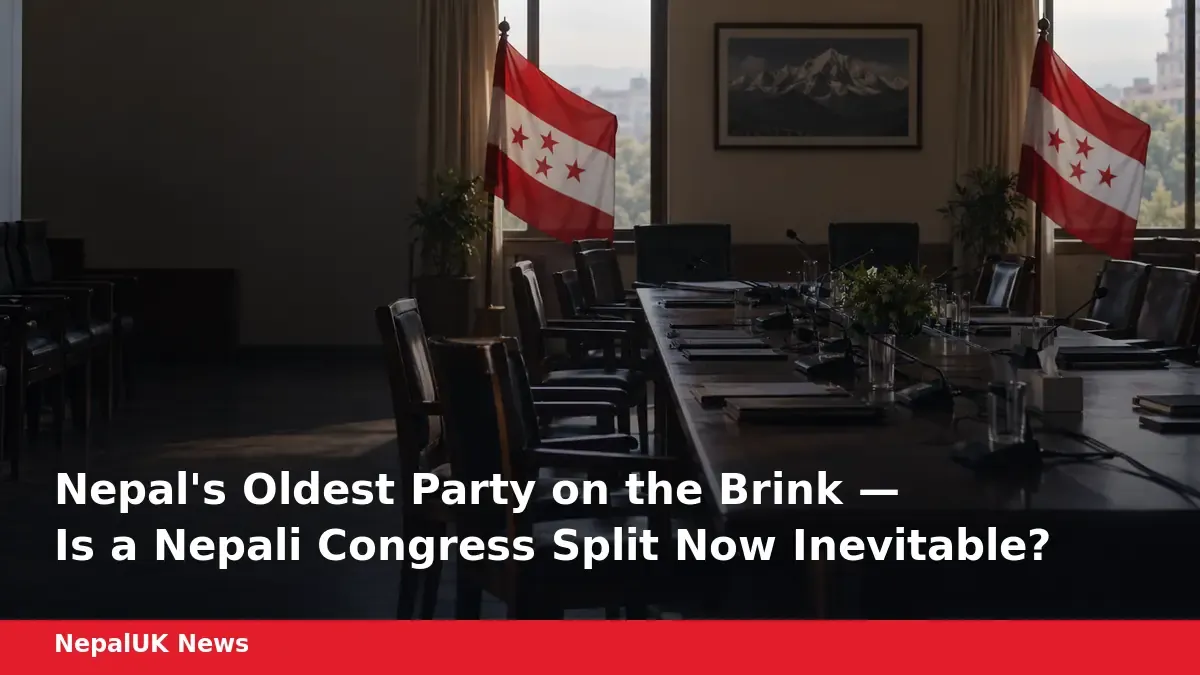
Six months after a Gen Z-driven election rout, Nepali Congress is effectively running two rival conventions under one banner — and a former acting president says only "an extraordinary turn of events" can now stop a formal break.
Purna Bahadur Khadka, a former acting president of the Nepali Congress, warned on 20 September that Nepal's oldest political party "stands on the brink of a formal split," announcing he would boycott the general convention organised under current president Gagan Thapa. The warning, reported by Nepal News, is the sharpest sign yet that the crisis engulfing Nepal's historic democratic party — battered at the ballot box in March and now split into rival factions contesting the legitimacy of its own leadership — is approaching a breaking point. For the party that led Nepal's democracy movement for over seven decades, and for the many Nepalese in the UK who trace their own political identity to it, the outcome will shape whether Nepal retains a credible centrist opposition at all.
From landslide defeat to leadership crisis
The roots of this crisis lie in the extraordinary political upheaval of the past year. A Gen Z-led anti-corruption movement forced a snap general election on 5 March 2026, in which Nepali Congress and CPN-UML — the two parties that had dominated Nepal's parliament for decades — saw their combined representation collapse to roughly a third of its former strength. The upstart Rastriya Swatantra Party, led by former Kathmandu mayor Balendra Shah, surged to 182 of 275 seats, two short of a two-thirds majority, and Shah was sworn in as prime minister on 27 March. Both defeated old-guard leaders, Congress president Gagan Thapa and UML chair KP Sharma Oli, personally lost their own constituencies and faced immediate internal calls to resign, according to Kathmandu Post reporting from March. Oli has held firm despite dissent within his own party. Thapa's position has proved more precarious.
A disputed convention, a Supreme Court case, and two rival camps
According to Nepal News, Khadka's faction argues that the special general convention which elected Thapa violated the party's own constitution, the Political Parties Act, and Election Commission precedent. A Supreme Court division bench initially ruled against Khadka's challenge, but a full bench later admitted a review petition, citing procedural errors — a case that remains pending. Rather than await that ruling, Thapa's faction has pressed ahead with its own convention process, leaving the party in the unusual position of running what are, in effect, two rival conventions simultaneously under the same registered name. Party vice-president Bishwa Prakash Sharma has publicly defended Thapa, arguing the March defeat "could not be attributed to Thapa alone" and that his immediate resignation was unnecessary — a view Khadka's camp firmly rejects.
What is confirmed, what is disputed, and what happens next
What is confirmed: Khadka's public warning of an imminent split, his announced boycott, and the existence of a pending Supreme Court review. What remains genuinely uncertain is the Court's timeline and, crucially, what a formal split would mean in practice — control of the party's name, assets, and above all its parliamentary seats, none of which is fully resolved in Nepali law for a party fracturing outside election season. Khadka has said his faction will accept whatever the Supreme Court decides, which for now keeps a full rupture technically avoidable.
Why it matters beyond Kathmandu
A formal Congress split would matter well beyond internal party politics. Nepal's post-election settlement already rests on an unfamiliar arrangement — a Gen Z-aligned RSP government facing two badly weakened legacy parties. A fractured, litigating Congress would leave Nepal without a coherent centrist counterweight to either the RSP government or a resurgent UML, at precisely the moment the country is also managing flood recovery and reconstruction financing running into tens of billions of rupees. For Nepalese abroad who have long followed Congress as the party of multi-party democracy's founding generation, its fate now hinges less on ideology than on a courtroom outcome still awaiting a hearing date.


