

Nepal UK
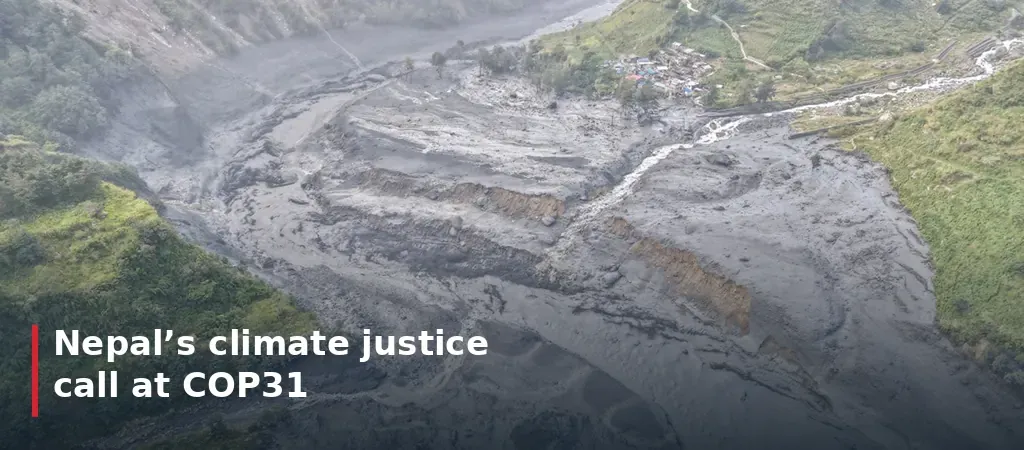
Nepal will go to the COP31 climate summit in Antalya, Türkiye, next month with a message that has taken on sharper meaning after a devastating monsoon: that a country responsible for very little of the world's emissions is paying heavily for warming, and needs money and a practical mechanism to cope.
The conference runs from 9 to 20 November. Government officials said this week that Nepal's delegation will be led by Foreign Minister Shisir Khanal and Forests and Environment Minister Gita Chaudhary, with representatives from other ministries and civil society also being brought in.
The government's stated priorities are climate justice, protection of the Himalayan region, adaptation, and compensation for loss and damage. Ministry Secretary Rajendra Prasad Mishra said Kathmandu wants to link Himalayan risks, adaptation, loss and damage and justice to "a practical implementation mechanism", and called for a delegation that is "organized, effective and inclusive".
Dr Maheshwar Dhakal, joint secretary in the ministry's climate change division, pointed to recent disasters in the Bhotekoshi and Budhigandaki river systems, and earlier events in Melamchi, Thame, Manang, Mustang, Kanchanpur and Ilam. He said discussions are under way on how Nepal can access the Loss and Damage Fund, and that officials hope for an announcement of support by the summit. Prime Minister Balendra Shah's climate justice commitment at the UN General Assembly will inform the agenda, officials said.
A national conference on 29 October will bring together ministries, diplomatic missions, development partners, civil society and the private sector. The national position paper and climate policy documents are due to be released there, and finalised afterwards in light of feedback. Nepal also plans a pavilion at the venue, in space provided by the Turkish government, featuring material on floods and Himalayan vulnerability. The ministry is seeking funding and partners to pay for it.
The urgency is not abstract. A flash flood on 11 October destroyed a concrete bridge span over the Budhi Gandaki on the Dhading-Gorkha border; the Nepal Army has since installed a 27.43-metre temporary bridge at Aarughat. The national disaster authority's daily report to 10am on 19 October recorded 20 incidents in 18 districts in 24 hours, with one death and 16 injuries. Since 14 April, it counts 7,416 incidents, 385 deaths, 14 missing and 2,421 injuries, mainly from snakebites, landslides, floods, lightning and fires. Not all of these are climate-driven, and the figures are as published by the authority and may be revised. Separately, the government has registered a Building (Second Amendment) Bill after floods damaged 7,570 private homes, according to a 16 October report of ministerial statements.
Not everyone is convinced Nepal is ready. A report published on 1 October said stakeholders, including the Non-government Organisations Federation of Nepal, believed the draft National Climate Policy had been rushed, linking its timing to the August Bhotekoshi flood and the summit, and citing gaps on rising temperatures, implementation, monitoring and accountability. Dr Dhakal responded that the ministry had held extensive consultations, including provincial sessions drawing 700 to 1,000 people each, and that a revised draft would follow the comment deadline.
Climate scientist Kushal Gurung urged better access to climate finance and more effective carbon trading. He warned that implementing Nepal's third Nationally Determined Contribution (NDC 3.0) will be costly, so grants and concessional finance should be prioritised to avoid adding to national debt. He also recommended evidence-based scientific assessments of recent disasters and a rapid-response financing mechanism.
For Nepalese communities in the UK, the outcome touches family homes, remittance-supported reconstruction and the credibility of aid appeals after each monsoon. Whether the Loss and Damage Fund delivers anything tangible for Nepal remains uncertain; officials have only said they hope for an announcement. The 29 October conference will show whether the position paper contains costed, specific requests, which is what donors tend to respond to.


