

Nepal UK
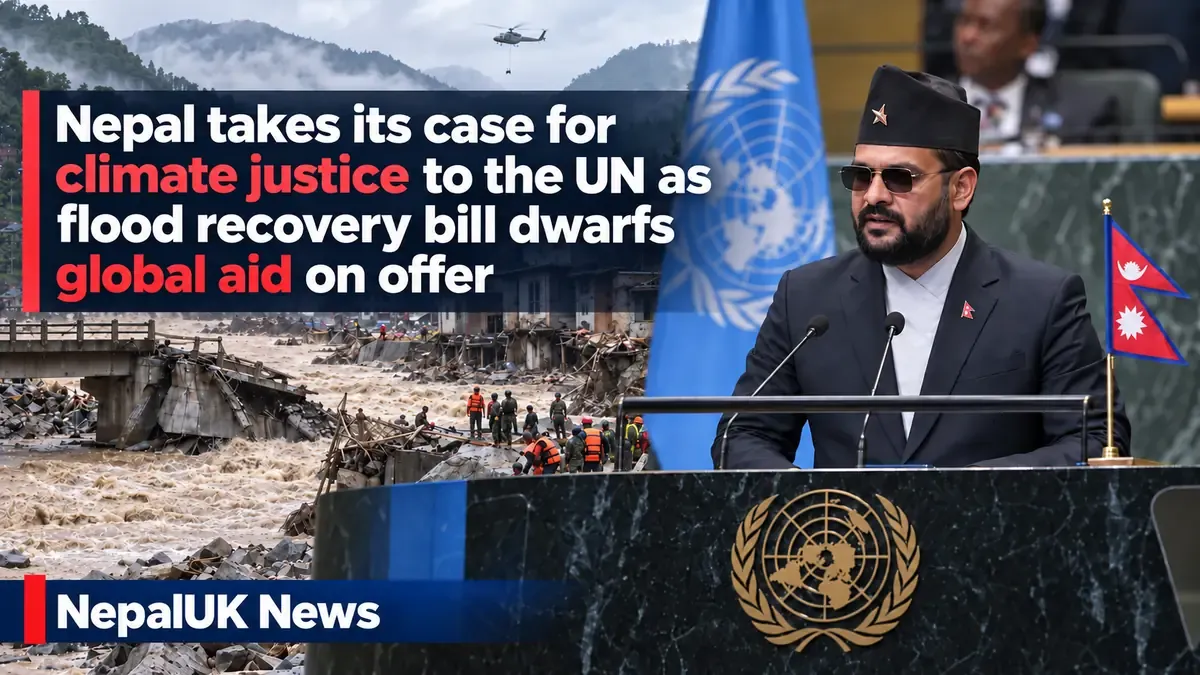
Prime Minister Balendra Shah travels to New York this week to address the UN General Assembly on climate justice, as Nepal's request for international disaster funding remains stuck behind a queue of 118 other countries.
Prime Minister Balendra Shah is due to leave Kathmandu on 22 September for New York, where he will address the 81st session of the UN General Assembly on 24 September and meet UN Secretary-General António Guterres, according to Nepal's Ministry of Foreign Affairs and reporting confirmed by the Kathmandu Post. It will be Shah's first foreign trip since taking office in March 2026, and it comes as Nepal seeks international support following the 26 August glacial-lake flood that killed more than 1,300 people, left thousands missing and destroyed over a tenth of the country's hydropower capacity. For Nepalese communities in the UK and worldwide, the visit is a test of whether the diplomatic profile of Nepal's youngest-ever head of government can translate into concrete financial relief for a country still burying its dead.
A modest ask against an enormous bill
Nepal has formally requested approximately $20 million from the UN's Loss and Damage Fund, the mechanism established at COP27 to compensate developing nations for climate-driven disasters. That figure sits awkwardly against the Nepalese finance ministry's own estimate that full recovery and reconstruction will cost between $4 billion and $5 billion — close to a tenth of the national economy. Separately, the UN and the Nepalese government have launched a flash humanitarian appeal for $49.6 million to reach roughly 84,000 people with shelter, healthcare and cash support before the end of this year, according to UN News.
A fund that has not yet paid out
The scale of the gap is not unique to Nepal. At least 119 countries have lodged requests with the Loss and Damage Fund, whose board had, as of its most recent meeting in June 2026, approved none of them. Wealthy nations have pledged around $820 million to the fund but delivered only $250-300 million of that — roughly a third — against $2.8 billion in cumulative requests, according to analysis published via The Conversation and Climate Home News. Campaigners have called for an emergency board meeting specifically on Nepal's case, a request that had not been granted as of the most recent reporting.
What Shah is expected to say
Nepalese officials preparing for the UN visit say Shah's address will focus on the human cost of the climate crisis and press for faster, larger, and more predictable international climate finance — arguing that a country contributing negligibly to global emissions is bearing a disproportionate share of the damage. This is Nepal's own government position and should be read as advocacy rather than an independently verified account of climate causation, though the broader scientific link between glacial retreat and Himalayan flood risk is well established in peer-reviewed research and UN assessments.
Why it matters beyond Nepal
For the diaspora, the stakes are practical as much as symbolic. Slow reconstruction affects remittance-dependent households, delays the rebuilding of damaged infrastructure and hydropower assets that underpin the domestic economy, and shapes how much additional support UK-based Nepalese charities and community organisations may need to mobilise. It also puts Kathmandu's relationship with major donors, including the UK — a long-standing bilateral development partner — under scrutiny in the months ahead.
What remains uncertain
The exact death toll and number of people still missing continues to be revised by Nepalese authorities and is not treated here as final. Whether the Loss and Damage Fund board will act on Nepal's request, and on what timeline, is unknown. NepalUK will continue to follow both threads.


