

Nepal UK
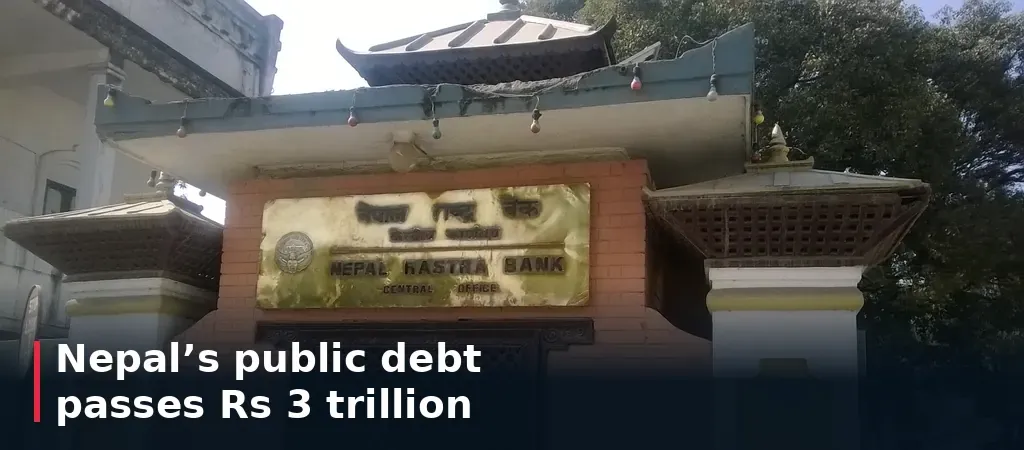
Nepal's public debt has passed Rs 3 trillion for the first time, a milestone that arrives as the World Bank reports record borrowing and rising repayment costs across the developing world.
The Public Debt Management Office put outstanding debt at Rs 3.009 trillion in mid-October, equal to 45.59 per cent of GDP, up from Rs 2.981 trillion in mid-July. Domestic debt accounts for 21.37 per cent of GDP and external debt for 24.22 per cent. These are the most recent monthly figures located, and a November update could not be verified. Ministry of Finance figures show debt stood at Rs 1.433 trillion in FY2019/20, so it has more than doubled in six years.
The cost of carrying it
Repayments took Rs 98.87 billion in the first quarter of FY2026/27, made up of Rs 77.74 billion in principal and Rs 21.12 billion in interest. Debt service totalled Rs 386.22 billion in FY2025/26, about four-fifths of it on domestic debt, and the current budget allocates Rs 417.88 billion. The Finance Ministry's April white paper said principal and interest absorbed 24.0 per cent of federal spending and 35.0 per cent of federal revenue in FY2024/25. About Rs 167 billion of the stock reflects exchange-rate movements rather than new borrowing.
The global backdrop
The World Bank's International Debt Report 2026, published on 5 November, found that the external debt of low- and middle-income countries rose 5.5 per cent to a record $9.4 trillion in 2025, the fastest rise since 2021. They paid $1.4 trillion in debt service, the fifth consecutive annual increase. The poorest countries, those eligible for concessional World Bank finance, paid an average of 8.2 per cent on new private-creditor loans, the highest since 1989.
Where Nepal stands
A 14 November analysis by chartered accountant Tej Prakash Dixit, drawing on the World Bank report and on debt office, central bank and IMF data, argues that Nepal's structure is favourable. It puts external debt at $11.87 billion at the end of 2025, up 12.3 per cent in a year, with more than 90 per cent of public external debt owed to multilateral lenders and new official loans in 2025 averaging 0.7 per cent interest. Those Nepal-specific World Bank figures are as reported in that analysis and were not checked against the report's tables. The IMF has described the debt as sustainable while warning about the growing cost of servicing domestic borrowing.
The analysis locates the pressure at home. It says Rs 245.89 billion of this year's planned Rs 410 billion domestic borrowing will refinance maturing debt, creating rollover risk, and that the head of the debt office views the position as satisfactory while one economist expects repayments to squeeze capital spending.
Remittances: shield and exposure
Remittances reached Rs 2.36 trillion ($16.19 billion) in FY2025/26, up 37.1 per cent and above the Rs 1.964 trillion budget for that year, according to Nepal Rastra Bank. They help explain why headline risk ratings remain low. Yet first-time approvals for foreign employment fell to 406,519 from 505,957 over the same period, and the Gulf, where the foreign ministry counts roughly 1.8 million Nepali citizens, is unsettled. A Nepali worker was killed in a drone attack at Saudi Aramco's Shaybah oilfield on 21 October, and about 45 per cent of scheduled flights from Saudi airports were cancelled between 8 and 25 October, according to reporting on 2 November. The dependence cuts both ways: remittances cushion the debt burden, but a shock to Gulf employment would weaken that cushion. That is NepalUK's assessment rather than an official forecast.
Readers can track the debt office's monthly releases and the central bank's macroeconomic reports for the next signals.


