

Nepal UK
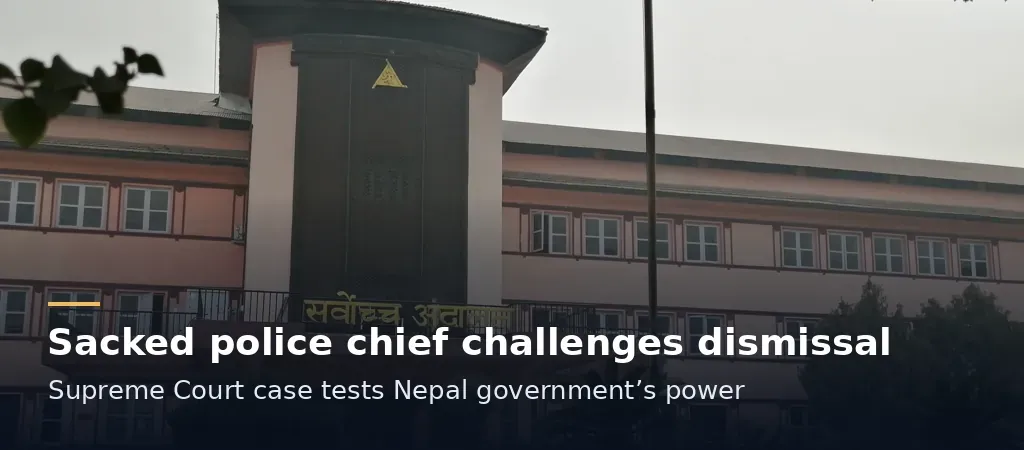
Nepal's Supreme Court will hear on 16 November a petition that could decide how far an elected government can go in removing the head of the national police. The case has become the sharpest test so far of Prime Minister Balendra Shah's approach to the institutions of the state.
Dan Bahadur Karki was removed as Inspector General of Police at an emergency Cabinet meeting on Wednesday 4 November, less than a day after a regular Cabinet session had not discussed the matter. Additional Inspector General Manoj Kumar KC, who ranked third in the police hierarchy, was appointed in his place and received his insignia that evening from Home Minister Sudan Gurung. He became Nepal's 34th police chief.
Karki's lawyers lodged a writ petition the following morning. The court administration held it for review for a day before registering it on Friday 6 November, and set the hearing for 16 November (Kartik 30) at the petitioner's request, after the Tihar holiday.
The petition argues that appointing a new chief while the post was not vacant breached Rule 41 of the Nepal Police Regulations, 2071. It seeks to quash the Cabinet decision, asks under what legal authority KC holds office, and requests an interim order that would stop KC exercising the chief's powers and allow Karki to resume while the case is decided. Karki had about 17 months of his term left; his petition puts the figure at 18.
The government has not presented the move as a disciplinary step. Government spokesperson Sasmit Pokharel announced that a new post of prime minister's special security adviser, at the rank of inspector general, had been created at the Office of the Prime Minister and Council of Ministers, and that Karki had been assigned to it. Pokharel said the change reflected recommendations from the ruling Rastriya Swatantra Party (RSP). The party's spokesperson, Jagadish Kharel, rejected that account: "We have not asked for the inspector general to be removed."
Reporting in Kathmandu has linked the removal to growing friction between Karki and the prime minister's secretariat over the investigation into Inam Sapkota, a fixer held on money-laundering and banking charges, and over the brief detention of journalists on 30 October. Officials close to the secretariat have accused Karki of improper contact with Sapkota and of delaying arrests they ordered. Karki has denied any improper association. Police officers close to him say some instructions were legally untenable. None of these competing claims has been tested in court, and no disciplinary or criminal proceedings against Karki have been announced.
Both sides will have to reckon with 1997. That April, the government removed police chief Achyut Krishna Kharel just 36 days into his term and installed a successor. The Supreme Court later held that removing an inspector general who remained legally qualified, without reasonable grounds, was contrary to the rule of law, warning that a police force dependent on political favour would lose its impartiality. Karki's petition also relies on the case of Hitendra Dev Shakya, whose transfer from the Nepal Electricity Authority was overturned by the court.
The dispute does not stand alone. Senior civil servants describe a climate of fear following the detention on 30 October of two senior water-resources officials, who were taken to the Prime Minister's Secretariat and released the next day after a disputed tender was cancelled. Official records show 464 civil servants have resigned since mid-July, and a bill that would force retirement at 55 or after 30 years' service is pending. The government has argued that its reforms target politicised and underperforming institutions, a message that resonated with voters who gave the RSP a parliamentary majority in March.
For Nepalese abroad, many of whom invest, own property or have family business interests at home, the outcome matters beyond Kathmandu politics. A ruling either way will signal whether senior public posts carry legal protection from political change. The case also comes as Prime Minister Shah prepares for an expected, though not yet officially announced, visit to New Delhi later this month.
The first hearing on 16 November is expected to take up Karki's request for an interim order. A final ruling on whether his removal was lawful is likely to take longer.


