

Nepal UK
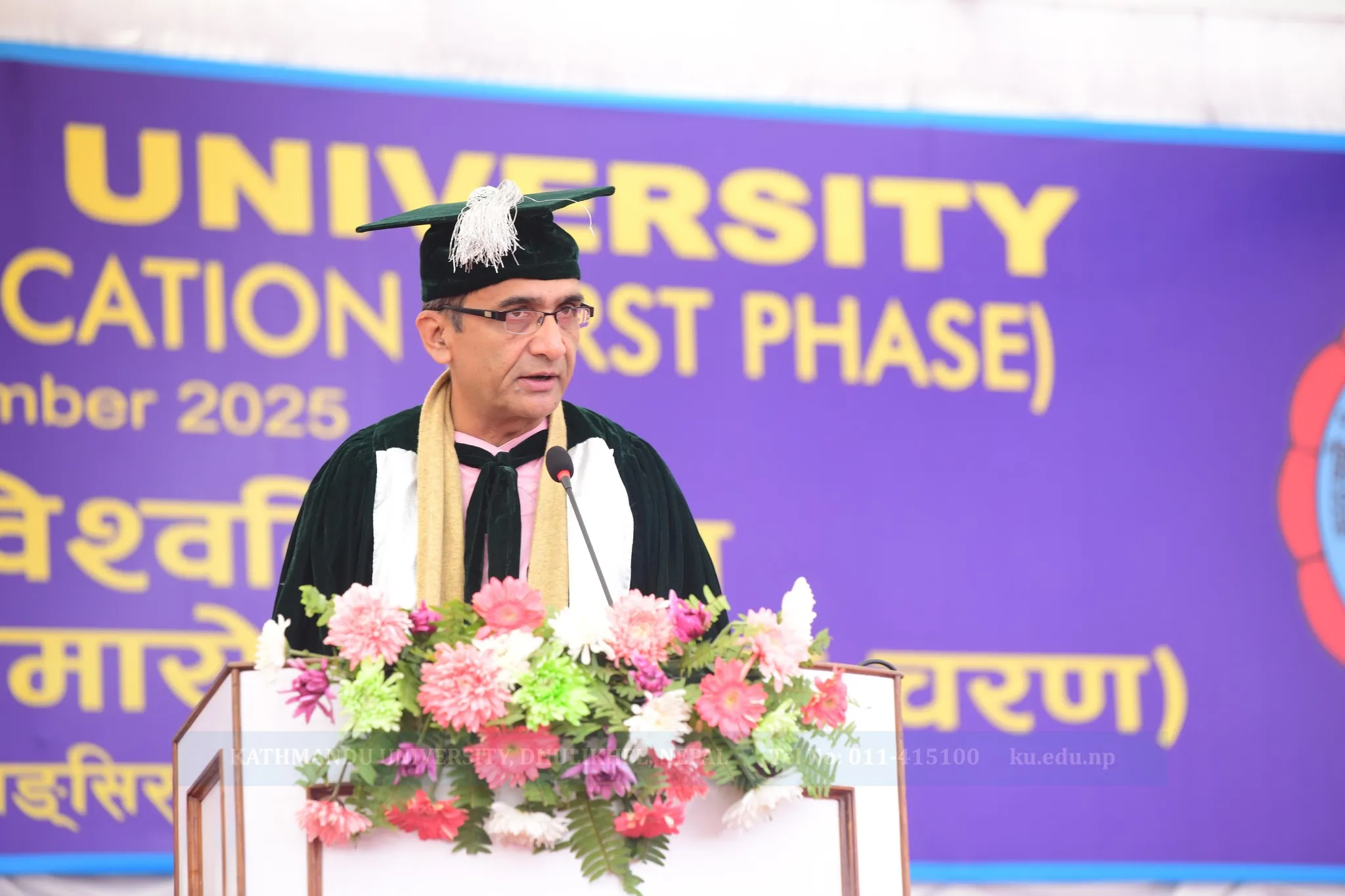
Nepal can offer cost advantage, cultural warmth of Nepal and around the year hospitable weather for students, teachers and researchers
By Prof Dr Achyut Wagle
It’s a moment of joy and accomplishment for Kathmandu University (KU). Among the 2,209 scholars graduated on 10 December, almost half, or about 47.76 percent, are female.
Among the new graduates, 83 are from the School of Arts, 294 from the School of Education, 340 from the School of Engineering, 36 from the School of Law, 378 from the School of Management, 881 from the School of Medical Sciences and 197 from the School of Science. The degrees to be awarded include 7 at the PhD level, 27 at the M.Phil level, 397 at the Postgraduate level, 50 at the PGDE and 1,728 at the undergraduate level.
For the first time in KU's history, we are awarding academic degrees to 20 scholars with Masters of Medical Research, one with MPhil by Research in Mathematics and 29 with Bachelor of Science in Agriculture. As of today, a total of 50,040 scholars have graduated from Kathmandu University.
Challenges in higher education
There should be no hesitation to acknowledge that, at present, Nepal's higher education faces near-existential crisis marred by a chronic lack of comprehensive national vision and objectives linked to the national development goals, asymmetric coverage of higher education in different sections of the population, tardy pace of modernization and chronic underinvestment, among others. Brain-drain and capital flight in the name and pretext of higher education is massive and unabated. During the last 5 years alone, over 350,000 students have left the country, and the country has bled at least USD 10 billion equivalent of foreign exchange. The exact figures on both types of exoduses are estimated to be far higher than these officially recorded data.
Evidently, after the September Revolution exactly three months ago, Nepal today stands at a historic inflection of socio-economic and political transformation. This revolution was a clear manifestation of the aspirations of younger generations — Zen-Y, Zen-Z and even Zen-∝ — to explore and ensure their future within this country. They expect to attain quality higher education akin to modern world-class knowledge and skills, get gainful employment after graduation, and ensure quality of life not only for themselves but also for their posterity. These are unquestionably an articulation of an organically evolved social phenomenon, and the quest for change is very rightful on the part of these future custodians of the Nepali nation-state.
It is obvious that the universities and Higher Education Institutions (HEIs) are at the core of fulfilling these aspirations of the youths, including the ones framed through the September Revolution. The higher education structure and delivery must shoulder the responsibility for:
1. Providing quality education to produce industry-ready graduates,
2. Creating interfacing platforms with the national and global job markets, and
3. Equipping our future citizenry with the sense of humanity, compassion and patriotism.
We, at Kathmandu University, fully recognize this responsibility towards the nation, society and humanity at large. Our graduates of all disciplines are in high demand both in domestic and international skill markets, and several thousands among them have undertaken successful business ventures. And we are proud to announce that the employment rate of our willing-to-work graduates is close to one hundred percent.
Expansion and sustainability
Our commitment to quality education is complemented by the trust of the parents and students which is reflected in several global as well as regional rankings. In a single spring intake of this academic year 2025/2026, KU's student enrollment mainly at the undergraduate level has increased by almost 23 percent. The university has admitted 300 additional students in Engineering, and nearly 100 additional students each in Science, Management and Education. While the growth in constituent programs has remained at 18 percent, we have also increased student seats in affiliated programs by additional 5 percent approximately. Further, we expect relevant regulatory authorities to approve over 400 new seats for us in different medical disciplines.
With the same constructive considerations, the current management of KU has adopted a careful but liberal strategy to expand the reach of its brand value to provincial levels through a very transparent process of affiliation and partnerships. So far, 12 institutions under the School of Arts and the School of Education have received affiliation, while evaluations of programs under other schools are ongoing. Despite some infrastructural and logistic limitations, we now feel that our expansion efforts are becoming instrumental to stop at least a few thousand talents and ensuing foreign exchange from leaving the country, each year.
That KU continues to be an undisputed leader in quality higher education in the country is validated by a number of globally recognized rankings as well. In medical education, KU is ranked globally within the top 1,000 universities, and the overall university is ranked 703rd in the International Outlook indicator (Times Higher Education, 2025). We are working to achieve academic, research and impact factor excellence to become one of the 1,000 best universities in overall global standing, hopefully, within a couple of years.
Internationalization and Brain-gain efforts
We in Nepal have for long lamented the incessant brain-drain ratchet and as its resultant effect, capacity constraints in development administration and knowledge industry. To reverse this narrative and trend, KU has recently opened opportunities for foreign faculty or Nepalis teaching in foreign universities to teach at least one full semester being physically present in any of our seven Schools. To our pleasant surprise, in a matter of months, we received more than 400 applications from 30 countries. About a dozen such faculty have already started to take classes in various schools.
This is expected to significantly contribute not only to the transfer of knowledge and teaching techniques, research collaboration, and intercultural understanding, but to foster the culture of cross-fertilization of ideas across the academia and industries and the capacity building of faculty, staff, and students. Kathmandu University is dedicated to sustaining this spirit of growth through the introduction of more multidisciplinary programs, enhanced educational infrastructure, expanded scholarships, collaboration with industry, and sustainable approaches in financial management.
Internationalization has been one of the most important contributors to KU's quality. Over the past three decades, 12 percent of the university’s graduates have been international students. 196 international students graduating today come from 17 countries as diverse as Australia, Austria, Bangladesh, Bhutan, UK, India, Japan, Malaysia, Maldives, Mexico, Namibia, Russia, Spain, Sri Lanka, Sweden, USA and Vietnam. The total number of foreign nationals graduating from KU stands at 5,860 from 59 countries.
We continue to strive for internationalization of our collaboration, partnerships and academic expansion, with 300 MoUs with foreign HEIs. In addition to academic programmes now running in countries like India and Australia, we are all set to deliver KU's undergraduate courses in management and engineering in Japan, to address the growing demand for KU academic programmes among our young diaspora based there.
It is a happy coincidence that today Kathmandu University begins hosting the secretariat of the Himalayan Universities Consortium (HUC), a network of more than 100 universities from the Hindu Kush Himalayan region and beyond. The HUC was established in 2007 and headquartered at the International Centre for Integrated Mountain Development (ICIMOD). In an era of climate change-related uncertainties and catastrophes, the relevance of such an important Consortium dedicated to "international cooperation in research, education, capacity development, policy advocacy, and public outreach for resilient, just, inclusive, and regenerative communities and thriving geo- and ecosystems..." has only increased. I would like to thank ICIMOD Director General Dr. Pema Gyamtsho and the international community for entrusting KU with this important responsibility. I also request for continued collaboration and cooperation from all the partners and stakeholders of the HUC in the days to come as well.
In another important institutional level collaboration with Bhashini, the Indian government's digital undertaking established to facilitate translingual communication through a digital language processing platform, the Kathmandu University AI/DPI center will soon come under operation. In addition, we are in the process of starting a collaboration with the Regional Centre for Biotechnology (RCB) in Faridabad, India, for collaborative high-end research in the field of biotechnology.
We are prioritizing the development of physical infrastructure. We have started the DPR process to construct a 450-bed teaching hospital building and completed the bidding process for the construction of an Academic and Examination bloc, and a separate IT and Records building. Despite this, the most painful experience for us in KU this year has been to turn down the admission for about 350 talented female students for lack of adequate hostel facilities here. I would like to emphasize that building an additional Girls’ Hostel is our top infrastructure priority for the coming year. I look forward to a generous support from the Government of Nepal and other partners to this noble cause towards increasing gender equity in higher education.
Digital moves
We are simultaneously working on digital infrastructure. This year, Kathmandu University established a dedicated Information Technology Center (KU-ITC) with a long-term vision to promote research, innovation, and digital sustainability in Nepal. The center will operate through three main units: High-Performance Computing Unit, which manages a supercomputing cluster for advanced and complex research; Data Science and Policy Unit, which supports national policy implementation by conducting research using local data and developing ethical frameworks; and Disaster and Emergency Decision Support Unit DEDSSU, which develops decision-support systems for emergencies such as earthquakes, pandemics, and floods. All these efforts will complement and reinforce our efforts to produce next generation of digital scientists in Nepal.
The KU Connect Mobile App, which provides students with digital access to academic, administrative, and campus-related information, has come into operation. It offers information about examinations, events, fee payments, and requests for certificates and transcripts of the user The university’s Resource Management System (RMS) has been fully integrated with the KU app to facilitate room reservations, resource management, and class scheduling. The App will soon be customized for the academic and administrative staff members. Space optimization has enhanced with the use of the digital reservation system of the classrooms, labs and conference halls.
We are in the rigorous process of updating our curriculum and pedagogy to integrate the suitable components of digital learning and teaching including the Artificial Intelligence across all the schools and programmes.
To broaden the reach of quality higher education accross the country, KU spends more than 100 million rupees in its scholarship programs of diverse nature aimed at rewarding talents considering the geographical and ethnic inclusion. The university has expanded the scholarship schemes to all seven provinces, offering six top-performing Grade 12 students from each province a 100 percent tuition fee waiver. This expansion adds to over 500 scholarships the university provides annually across all disciplines.
In conclusion
My sincere congratulations to all the graduates of the Class of 2025. It's your day, today! Your hard work and dedication, the sacrifices of your parents/guardians, and the pathways shown by the University have borne fruits. This must now translate into your ability and willingness to contribute to humanity, global peace, and in making planet earth habitable for our future generation as you embark on the next lap of your journey of life in education, employment, or entrepreneurship.
I urge this august gathering to consider unleashing Nepal's prospect of not only regional but also global education hub, at least in certain disciplines like medical education, environmental education, Buddhist and oriental studies, culture and diplomacy, among many others. This is a real prospect, and we, through our policy reforms and modern global outlook, must stand to harness this opportunity and create Nepal's own 'Higher Education Economy'. We can offer cost advantage, cultural warmth of Nepal and around the year hospitable weather for students, teachers and researchers.
Prof Wagle is the Vice Chancellor of Kathmandu University. This article is the edited version of his speech at KU’s convocation ceremony held at Dhulikhel on 10th December, 2025.


