

Nepal UK
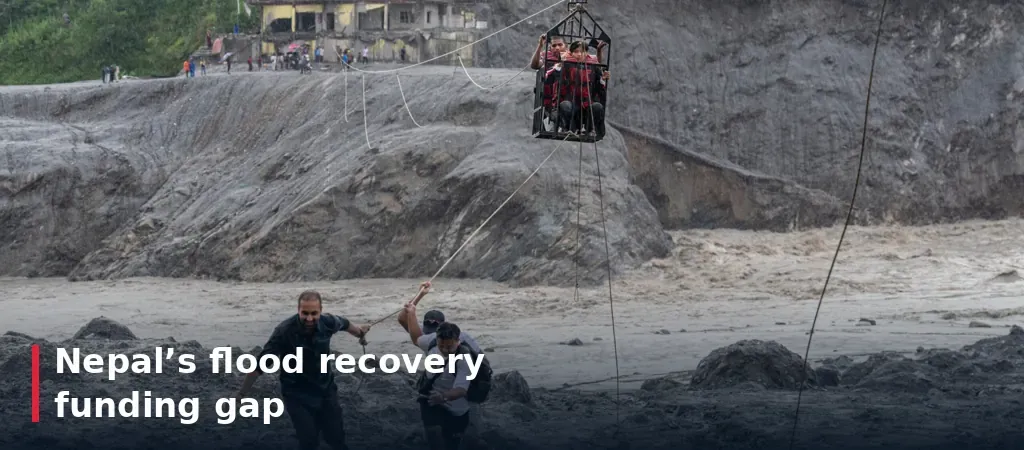
Nepal goes to the COP31 climate summit in Antalya, Türkiye, later this month with an early but modest win: a provisional $21.6 million from the Fund for Responding to Loss and Damage (FRLD) for recovery from the August floods. Set against official estimates of roughly $4.8 billion in recovery needs, the allocation also illustrates how far climate finance remains from the scale of damage.
On 29 October, speaking as chief guest at the National Climate Summit in Kathmandu, Foreign Minister Shisir Khanal welcomed the allocation and set out four priorities for COP31: a dedicated mountain agenda, making loss-and-damage support operational, securing accessible climate finance, and advancing climate justice based on equity. He described mountain conservation as "a shared global responsibility" and called for predictable, grant-based funding with simpler access procedures.
According to CarbonCopy, the FRLD made its provisional allocation on 22 October: $20 million for recovery and $1.6 million for oversight. The report describes it as the Fund's first provisional allocation for a specific disaster. Nepal asked for urgent help on 31 August, and the Fund's first emergency meeting took place about seven weeks later. The $20 million is less than 0.5 per cent of Nepal's recovery needs.
Nepalese officials give consistent headline figures for the damage. A government assessment cited by CarbonCopy puts recovery and reconstruction needs at $4.77 billion, and Nepal News reports a Khanal figure of $4.8 billion. Separately, Nepal News reports that three Nepalese projects worth a combined $45 million have been approved under the Adaptation Fund. Adaptation funding addresses future risk, while loss-and-damage funding addresses harm already suffered.
The FRLD was established at COP27 and made operational at COP28. CarbonCopy reports that, as of March 2026, it held pledges of $822 million, and that its first funding round of $250 million, later raised to $342 million, faced eligible requests of $2.8 billion, almost eight times as much. These are CarbonCopy's figures and should be checked against the Fund's own publications. Harjeet Singh of the Fill the Fund campaign welcomed Nepal's allocation but said: "Nepal needs billions to rebuild, and this Fund is responding only in millions." He called for a permanent mechanism able to deliver aid within days.
The Minister for Agriculture, Forests and Environment, Gita Chaudhary, and Speaker Dol Prasad Aryal discussed COP31 preparations on 29 October. COP31 runs from 9 to 20 November. Nepal plans 44 side events between 9 and 19 November and a pavilion highlighting the Bhote Koshi–Rasuwa floods. The national climate summit was also due to launch the Living Everest mountain strategy and Nepal's COP31 position paper, according to Nepal News.
CarbonCopy reports that the August disaster on the Bhotekoshi–Trishuli river system killed more than 1,400 people, with thousands still missing. That casualty figure comes from a single secondary source here, and figures in such disasters may change. Prime Minister Balendra Shah told the UN General Assembly that recovery could cost up to 10 per cent of GDP.
For Nepalese communities in the UK, the climate-justice debate is not abstract. Many have raised relief funds for the flood zone, and the UK is among the wealthier economies whose contributions to loss-and-damage finance will be scrutinised. Pledges, rather than delivery, are the weak point: the gap between what is promised and what reaches affected communities is the issue that advocates, and Nepal's negotiators, are likely to press hardest in Antalya.
Several uncertainties remain. The allocation is described as provisional, and the final approval and disbursement timetable were not available. Whether COP31 delivers a faster, permanent rapid-response mechanism is also unresolved; some developed countries are reported to be wary of setting a precedent for emergency funding. Nepal's call for joint transboundary hazard mapping and early-warning systems with India and China, voiced by a ministry adviser quoted by CarbonCopy, is a further test of regional cooperation.


