

Nepal UK
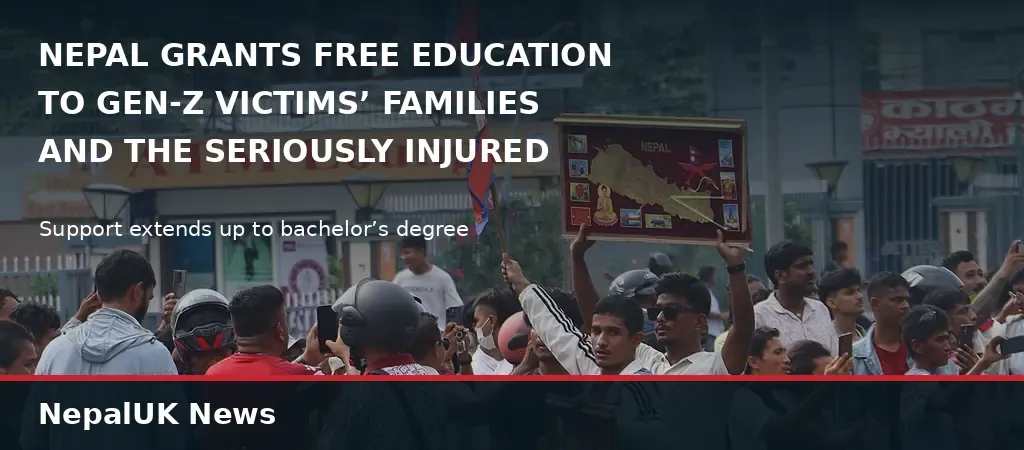
A year after Nepal's deadliest protests in decades reshaped its government, new Ministry of Education guidelines promise free schooling through bachelor's level for the children and siblings of the dead and for certified seriously injured survivors — but the policy also exposes how few of the movement's victims have so far been formally certified to receive it.
Nepal's Ministry of Education and Sports issued guidelines on 22–23 September 2026 offering free education, up to bachelor's degree level, to the children and siblings of people killed during the September 2025 "Gen-Z" protests, and to protesters holding official identity cards certifying them as seriously or critically injured. The Guidelines for Providing Free Education to Families of Martyrs and the Injured of the Gen-Z Movement, 2083, promise school materials, uniforms and cash assistance at basic and secondary level, reserved university scholarship quotas, and University Grants Commission (UGC) support for unsuccessful applicants. The measure fulfils part of a ten-point agreement the interim government signed with Gen-Z representatives on 10 December 2025 — but it arrives roughly nine months late, and only after renewed protest warnings from victims' families in August, raising questions about how fairly and how fully it will reach those it is meant for.
What the new guidelines provide
At basic level (grades 1–8), eligible children receive free education, uniforms and learning materials, alongside cash assistance channelled through local governments. At secondary level (grades 9–12), the same in-kind support continues with cash assistance. At bachelor's level, universities must reserve scholarship places for eligible applicants; those not selected under quota can instead receive scholarships and cash support via the UGC. Applicants must submit a beneficiary identity card, citizenship or birth certificate, proof of relationship to the martyr, and an institutional recommendation — basic and secondary applications go through schools to local government, while undergraduate applications go through university campuses to the UGC. Neither the guidelines nor the reporting reviewed for this article specify a total budget ceiling or the number of children expected to benefit.
Who qualifies — and the gap between the dead and the "martyrs"
The policy's eligibility test is narrower than it first appears. Nepal's Home Ministry recorded 76 deaths during the 8–9 September 2025 protests, after the toll was revised upward several times from an initial count of 19. Yet the state formally declared only 45 of them "martyrs," in a decision announced on 4 November 2025 — and it is martyr status, not death alone, that unlocks compensation and now education benefits. Nepal News reported that, as of late October 2025, twelve of the dead remained unidentified, their remains reduced to ashes and bone fragments in fires at three Bhatbhateni Supermarket outlets during the unrest; DNA testing at Kathmandu's forensic laboratory was under way, and a Home Ministry spokesperson said officials had "not decided where, to whom, and how to give the money" once — or if — those twelve were identified. It could not be confirmed whether all twelve have since been identified and their families certified; this is a clear point NepalUK will follow up on, since an unidentified victim's siblings or children cannot obtain the paperwork this new education scheme requires.
The injured: a much larger, less certain group
The injury toll tells a similar story of scale outrunning certification. Government figures put the total injured at roughly 2,660 by May 2026, yet only 513 individuals had been formally classified and were receiving the associated monthly allowances as of a July 2026 government update — Rs 18,000 a month for the most critical cases, Rs 9,000 for serious injuries and Rs 4,000 for moderate ones, determined through a district-level classification committee process. That leaves well over 2,000 people injured in the protests outside the certified category that the new education guarantee explicitly requires. Nepal's Gen Z Nepal organisation — representing injured survivors — has been vocal about this gap: its president, Badal Rai, has said "those who fled rose to top positions, while contributions of us who shed blood have been devalued," while activists have separately described some injured survivors paying for treatment in India out of their own pockets.
Money already delivered, and what's still missing
Families of the 45 declared martyrs have received a one-off payment of roughly Rs 1.5 million (Rs 1 million compensation plus Rs 500,000 for related expenses) and a monthly pension — reported at Rs 28,800, combining a Rs 7,000 government contribution with a Rs 21,800 top-up from the privately funded Gen Z Martyr Families Welfare Society — guaranteed for ten years. Employment assistance, promised in the same December agreement, has been the most visibly unmet pledge: widow Manju Sada, raising two daughters after her husband's death, told reporters she had received compensation but no job offer despite asking for one. Families have also criticised delays to a planned martyrs' memorial — its unveiling was postponed after relatives said the statues did not resemble their children — and Prime Minister Balendra Shah's continued absence from meetings with victims' families, including at the first anniversary on 8 September 2026.
Why this matters for Nepalese communities in the UK and beyond
For the diaspora, the story is both a marker of political change — a government that itself exists because of the protests is now the one being tested on delivering for their victims — and a case study in how post-crisis compensation schemes succeed or fail in practice. The core accountability questions NepalUK will continue to track are the same ones raised by families themselves: how quickly the remaining unidentified dead can be confirmed and their relatives certified; whether the roughly 2,100-plus injured protesters outside the 513-strong certified group will ever be formally classified and thus made eligible for this education support; and whether the guidelines' promise translates into actual enrolments once schools and universities begin processing applications in the coming academic term.


