

Nepal UK
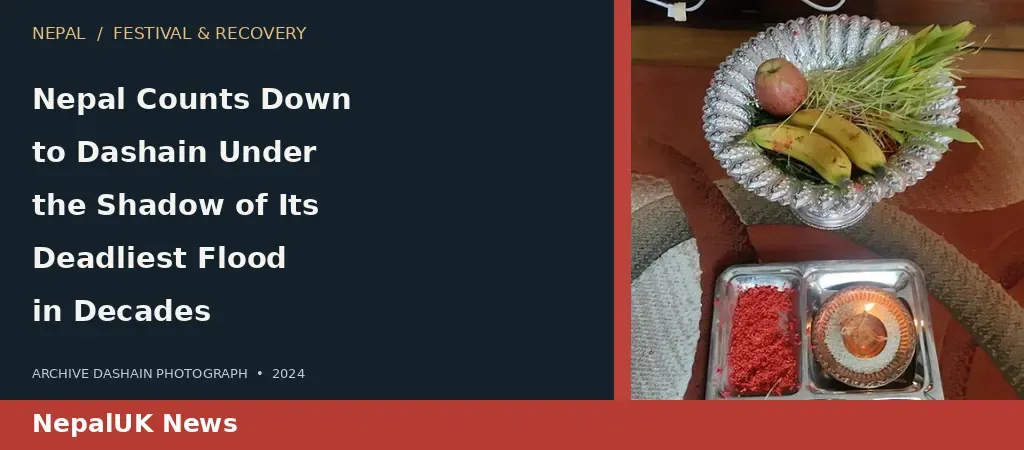
With Ghatasthapana falling on 11 October and Tika day on 21 October, Nepal is preparing for its biggest annual homecoming even as flood-hit highways, stalled compensation payments and a fresh rain warning complicate the return of hundreds of thousands of migrant workers and diaspora visitors.
Nepal's biggest festival, Dashain, begins on 11 October 2026 with Ghatasthapana and culminates in Vijaya Dashami — tika day — on 21 October, according to the Nepali lunar calendar (Ashwin 25 to Kartik 8, 2083 BS), independently confirmed by two festival calendars. In an ordinary year, the 15-day observance triggers the country's largest annual movement of people, as workers return from the Gulf, Malaysia, India and beyond to receive tika and jamara from their elders. This year, the homecoming falls weeks after the 26 August glacial-collapse flood that killed at least 1,377 people and left 5,130 missing along the Bhote Koshi and Trishuli corridor, according to Nepal's Ministry of Foreign Affairs — meaning the same roads, budgets and family structures that Dashain depends on are, in many districts, still broken.
A festival calendar built for travel
Dashain's rituals are unusually logistics-heavy. Families plant barley seeds (jamara) at Ghatasthapana, observe Phulpati on 17 October, Maha Ashtami and Navami on 18 and 20 October, and gather for tika on 21 October, before visits continue for several more days through Kojagrat Purnima on 25 October. Nepal's government calendar sets roughly five public holidays around 17–23 October, during which offices, banks and most shops close outside tourist zones — a period travel guides describe as the country's peak domestic travel season, urging early booking of flights, buses and accommodation.
Travelling on damaged roads
That advice carries extra weight in 2026. The Galchhi–Syabrubesi highway, severed by August's floods, remains closed, with the Ministry of Physical Infrastructure targeting reopening only by mid-October — cutting it close to, or possibly clashing with, the festival's peak travel window for communities in Rasuwa, Nuwakot and Dhading. Compounding the risk, Nepal's Department of Hydrology and Meteorology has forecast heavy to very heavy rainfall across five provinces between 25 and 27 September, with authorities warning of renewed flash-flood and landslide danger along the same river systems, weeks before the festival travel rush is due to peak. It remains unclear whether repair work will be complete, or whether further rain will cause fresh disruption, before millions attempt the journey home.
A festival funded, in part, by unspent relief
The economic backdrop is equally strained. Dashain traditionally drives a surge in retail spending — on clothing, festival discounts and animals for feasts — even as families in flood-hit districts face what the government's own National Planning Commission has estimated at Rs 723.32 billion (roughly $4.74 billion) in reconstruction costs. Nepal's Prime Minister's Disaster Relief Fund had accumulated Rs 15.06 billion by 22 September, according to Nepal News, of which the government has so far released only around Rs 1 billion to affected regions — a gap between funds raised and funds distributed that will be closely watched as displaced and bereaved families approach a festival built around family reunion and gift-giving with, in many cases, no home to return to.
What this means for the diaspora
For Nepalese communities in the UK and elsewhere, Dashain is typically a season of homeward flights and family remittances timed to festival spending. Airlines have historically raised fares sharply during the pre-Dashain rush, and this year's combination of infrastructure damage and disaster-driven household costs may put additional pressure on both travel plans and the size of remittances sent home for the festival. Whether the government's relief disbursement accelerates before 21 October, and whether the Galchhi–Syabrubesi road reopens on schedule, are the two clearest tests of whether this Dashain proceeds normally or under continued strain.


