

Nepal UK
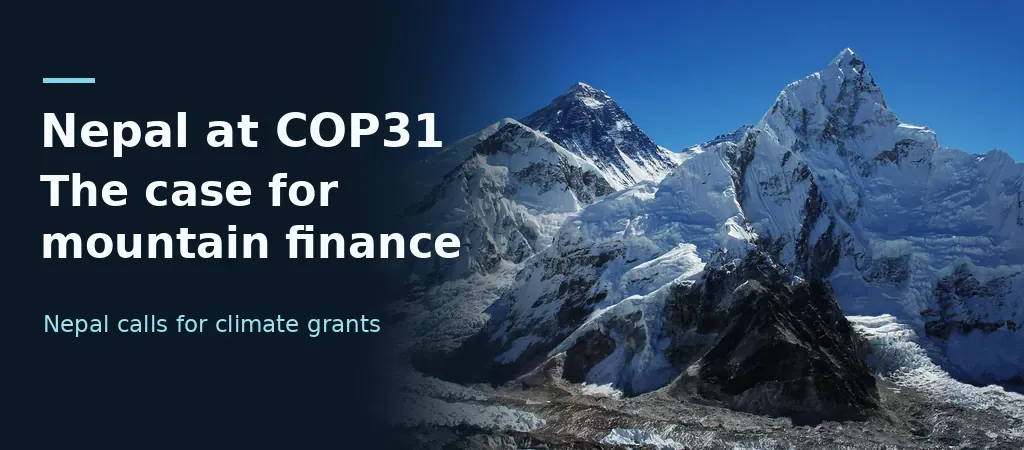
Nepal has opened its campaign at the UN climate conference in Antalya by demanding more, and easier, money for mountain communities. Yet a study released days earlier suggests the deeper problem may be the type of money on offer: since the Paris Agreement, almost two-thirds of the international climate finance reaching Nepal has come as loans.
Foreign Minister Shisir Khanal, who leads Nepal's delegation to the 31st Conference of the Parties (COP31), told a high-level event on Monday 9 November that adaptation finance must be predictable, adequate and readily accessible. The session, titled "Strengthening Mountain Resilience through Adaptation Finance", was jointly organised by Nepal, Bhutan and Kyrgyzstan with the International Centre for Integrated Mountain Development (ICIMOD) and the Zoi Environment Network. The conference runs until 20 November.
Mr Khanal anchored his case in the floods of 26 August, which swept down the Bhote Koshi in Rasuwa and caused heavy loss of life and infrastructure. He described the disaster as a "Himalayan tsunami" and argued that roughly a third of the world's population depends directly on mountain ecosystems, so mountain resilience deserves recognition as a priority within the UN climate process.
He also set out three specific requests to the conference presidency: keeping the 1.5°C limit as a matter of urgency for mountain regions, establishing a dedicated work programme on mountains and climate change, and building mountain-specific indicators into both the Global Goal on Adaptation and the new climate finance target agreed at COP29.
Nepal is running its own pavilion in Antalya, with more than 40 side events planned. On 12 November it is due to convene a high-level mountain agenda meeting with Tajikistan, Kyrgyzstan, Bhutan and Pakistan. Officials have also said a bilateral memorandum of understanding on carbon trading with South Korea is scheduled to be signed during the conference, although no signing has yet been confirmed.
The timing of the push is significant. The Prakriti Resources Centre, a Kathmandu-based research organisation, has published a study mapping international climate finance to Nepal between 2016 and 2023. It found that Nepal received about USD 3.19 billion over that period, of which only 30 per cent arrived as grants and 63 per cent as concessional loans. Multilateral development banks supplied almost 67 per cent of the total; bilateral partners about 26 per cent; and dedicated climate funds just over 5 per cent.
That pattern sits awkwardly with Nepal's emissions profile. UNICEF has noted that Nepal produces about 0.1 per cent of global greenhouse gas emissions, while the Himalayas are warming roughly twice as fast as the global average. Campaigners have argued since the August floods that a country bearing so little responsibility should not have to borrow to rebuild. An open letter addressed to the World Bank on 31 August, circulated by farmers' movement La Via Campesina, called for proposed flood-recovery financing to be converted into grants.
The government's position has moved in the same direction. Mr Khanal has called for grant-based adaptation finance that does not add to national debt, and Nepalese officials say Nepal has secured preliminary support from the Fund for Responding to Loss and Damage. Those sums, however, remain modest when set against reconstruction needs, and accounting for climate finance remains contested: totals differ depending on whether commitments or disbursements are counted, and some development loans are reported as climate finance because of their "co-benefits".
For the UK, this is not a distant debate. Britain is a significant bilateral development partner to Nepal and a major shareholder in the multilateral banks that supply most of Nepal's climate money. MPs from constituencies with large Nepalese populations, including Reading, Harrow and Hounslow, pressed ministers on support for Nepal during a Commons debate on 14 October, citing families in their constituencies who lost relatives in the floods.
For British Nepalese families who sent money home after August, the arithmetic is also personal. Remittances and community appeals filled gaps quickly; the question in Antalya is whether international mechanisms can do the same at scale and without creating new debt.
Mountain countries have struggled for years to win dedicated recognition in UN negotiations, and outcomes will not be clear until the final texts are agreed at the end of the conference. Nepal's credibility will depend partly on its own capacity to absorb and account for what it receives. A measurable test arrives sooner: whether the carbon-trading agreement with South Korea is signed, and on what terms.


