

Nepal UK
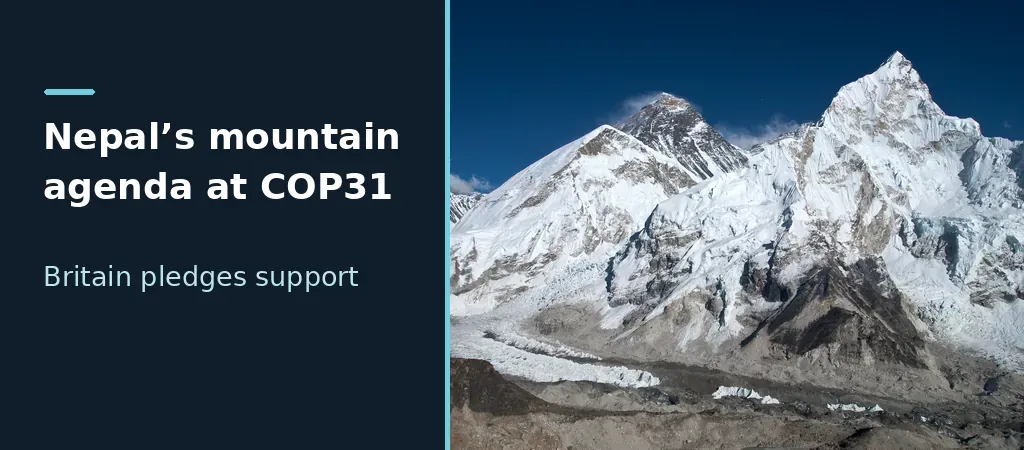
Nepal's delegation leaves for the UN climate summit in Türkiye this weekend seeking something mountain nations have long lacked: a dedicated place for the Himalaya in global climate negotiations. A summer of catastrophic flooding has sharpened the case, and the UK has said it will back Nepal's push.
Foreign Minister Shisir Khanal is due to leave for Türkiye today, Saturday 7 November, to lead Nepal's 18-member delegation to the 31st Conference of the Parties (COP31) of the UN Framework Convention on Climate Change. The conference runs in Antalya from 9 to 20 November. Khanal is scheduled to address the opening session on Monday and attend the Leaders' Summit on 11 and 12 November. Agriculture, Forests and Environment Minister Geeta Chaudhary will lead the delegation in the second week.
The centrepiece of Nepal's diplomacy is a joint proposal with Bhutan, submitted under Rule 12 of the conference's draft rules of procedure, to add a supplementary agenda item titled "1.5°C Warming in Mountains". It asks for four things: deeper scientific work on what 1.5°C, and any overshoot beyond it, means for mountain regions; an annual high-level dialogue on mountains and climate change; a dedicated UNFCCC mountain work programme; and the integration of mountain priorities into climate finance and adaptation frameworks.
Submission does not guarantee adoption. Supplementary items are subject to the conference's procedures and the agreement of parties when the agenda is taken up, and mountain concerns have historically been folded into broader adaptation and loss-and-damage discussions rather than treated as a standalone track.
Khanal is also due to take part in a high-level event on glaciers, the cryosphere and resilience under overshoot, co-organised by Nepal, Bhutan, Tajikistan, Kyrgyzstan and Pakistan, giving the proposal a wider coalition of mountain states.
The proposal draws directly on Nepal's own losses. It cites an estimate from the National Disaster Risk Reduction and Management Authority that restoring property and infrastructure after the 26 August flood in the Bhote Koshi, triggered by a glacier collapse, may cost $4.7 billion, about 10 per cent of the country's GDP. Figures reported in Kathmandu this week put the death toll from the floods at more than 1,400, with over 5,000 people still unaccounted for. Bhutan suffered a glacial lake outburst flood in late October.
Speaking in Kathmandu this week, Minister Chaudhary argued that Nepal contributes negligibly to the climate crisis but bears a heavy share of its cost. She said climate finance should arrive on time and as grants rather than loans, and called on developed countries to triple adaptation support. She said Nepal had received $21.6 million from the Fund for Responding to Loss and Damage and that three projects worth about $45 million had been approved under the Adaptation Fund. Against a reconstruction bill measured in billions, the gap is stark.
According to a readout of a meeting in Kathmandu on Thursday 5 November, British Ambassador Rob Fenn told Vice President Ramsahay Prasad Yadav that the UK will support Nepal's "Mountain to Sea" climate agenda at COP31, and that the UK is willing to support reconstruction in flood-affected areas, noting King Charles III's particular interest. NepalUK has not yet seen a separate UK government statement setting out the form of that support.
The commitment fits the UK's stated priorities for Antalya. In a statement to the COP31 Presidency, the UK has said the summit must scale up adaptation and tackle barriers to accessing finance for resilience, so that support reaches those most exposed. Whether that translates into backing for a formal agenda item, new money, or diplomatic support in negotiating rooms remains to be seen.
For Nepalese communities in the UK, many with family in hill and mountain districts, the outcome is not abstract. Glacier-fed rivers underpin Nepal's hydropower, farming and tourism, and diaspora fundraising has followed each major disaster. A recognised mountain track would give Nepal a standing forum to press for finance; failure would leave it competing for attention within crowded general negotiations.
The first test comes on Monday, when the conference adopts its agenda. The second, harder test is finance, which is likely to dominate the closing days of the summit.


