

Nepal UK
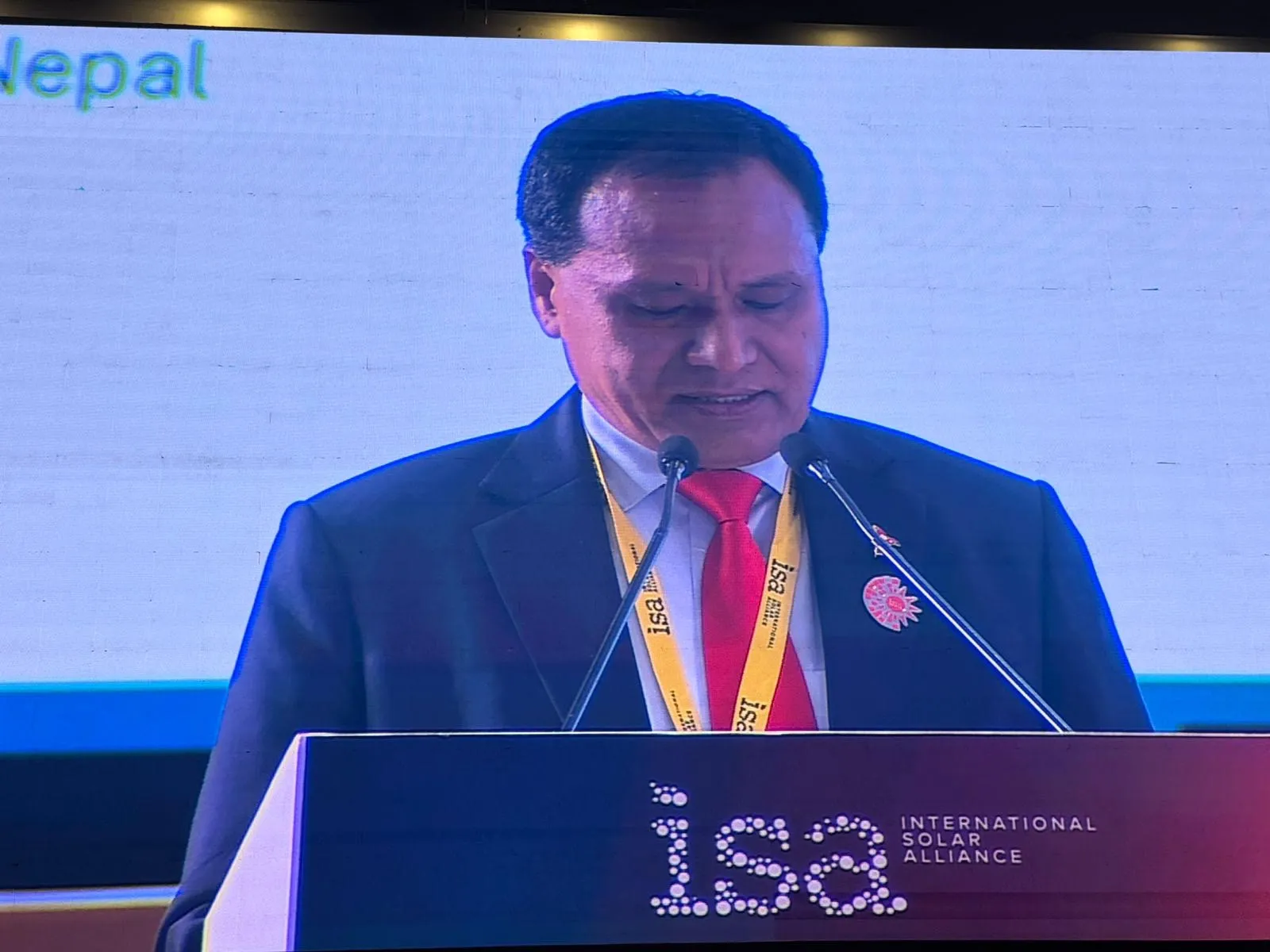
New Delhi - Minister for Energy, Water Resources and Irrigation, Kulman Ghising, has said that Nepal aims to become a major clean energy exporter in South Asia—targeting up to 15,000 megawatts of renewable power exports by 2035.
Addressing the thematic session entitled ‘Envisioning Regional and Global Interconnections for Large-Scale Clean Energy Transition’ in the International Solar Alliance Assembly in New Delhi on Tuesday, Minister Ghising said that Nepal looked at hydropower as a strategic enabler of South Asia’s clean energy transition and a vital source of grid stability and flexibility.
“We have developed nearly 4000 megawatts of generation capacity, with hydropower and solar contributing almost entirely—making Nepal one of the greenest electricity producers in the world. Blessed with an estimated 83,000 MW of hydropower potential and about 42000 MW of pumped storage potential, our resources are clean, renewable, and perfectly complement the solar and wind systems of our neighbouring countries,” said Minister Ghising.
“Alongside hydropower, Nepal is steadily expanding solar generation, with about 140 MW already connected to the national grid and around 1100 MW in various stages of development. Our policy aims to continue scaling up solar energy to maintain a balanced and diversified renewable mix, enhancing overall grid reliability and energy security,” he added.
Minister Ghising said that a landmark long-term power trade agreement between Nepal and India, concluded in June 2023, envisions the export of 10,000 megawatts over the next decade. Building on the Joint Vision Statement of Prime Ministers of Nepal and India in April 2022, this milestone marks a major step in expanding the regional power market and strengthening energy cooperation. “Cross-border energy cooperation lies at the heart of Nepal’s clean energy vision. We have established strong interconnections with India and initiated trilateral power trade with Bangladesh,” he added.
Minister Ghising informed that during the wet season, Nepal exports around 1,100 megawatts of electricity, while in the peak dry season, imports up to 800 megawatts through various market mechanisms. “For effective regional integration, it is essential to strengthen transmission infrastructure not only between Nepal and India but also between India and Bangladesh. This will lay the foundation for a fully interconnected BIMSTEC power grid,” he added.
Nepal’s power transformation has been driven by growing cross-border connectivity with India. What began with modest 33 kV links in the 1970s has evolved into high- voltage interconnections like the Dhalkebar–Muzaffarpur 400 kV line. Among other measures, this interconnection helped eliminated decade long load shedding in Nepal, said Minister Ghising.
Under our joint transmission planning with India upto the year 2035, eight high-voltage interconnections have been identified to enable over 16 gigawatts of cross-border power exchange. The Dhalkebar–Muzaffarpur 400 kV line is already operational, while the Butwal–Gorakhpur and Dhalkebar–Sitamarhi lines are in advance stages of construction. The development and financing modalities for next two high voltage transmission corridors have been finalized and studies are underway for several cross-border lines to reinforce this expanding network, the Minister said.
As regional and global grids evolve, interconnections will enable renewable power to flow across time zones— balancing demand and supply, lowering costs, and expanding access. This vision aligns perfectly with “One Sun, One World, One Grid (OSOWOG),” where clean energy flows seamlessly and sustainably across borders, Minister Ghising said.
“To make this vision a reality, regional countries must work toward integrated power markets that enable smooth, non- discriminatory, and unrestricted green energy flow. Transparent regulations, harmonized standards, and open access to transmission infrastructure will be key to attracting private investment and ensuring long-term sustainability,” the Minister added.
Minister Ghising, however, warned that increasingly frequent floods and droughts are causing severe damage to our power systems and livelihoods, often demanding major reconstruction efforts. Strengthening climate-resilient infrastructure is, therefore, a national priority. “We call for stronger regional and international cooperation to address climate-induced losses and to mobilize financing for effective mitigation and adaptation to increasing climate impacts,” he said.
Minister Ghising also urged the international community to invest in Nepal's renewable energy such as hydro and solar power.
“With ample potential on hydropower, increasing solar energy capacity and expanding international transmission line as well as energy relations, we have possible capacity to make the region energy abundant. I invite our friendly countries and partners to invest in Nepal, in renewable energy and be a part of light to all and green future," said Minister Ghising, who also holds Physical Infrastructures, Transport and Urban Development ministries in the interim government.


