

Nepal UK
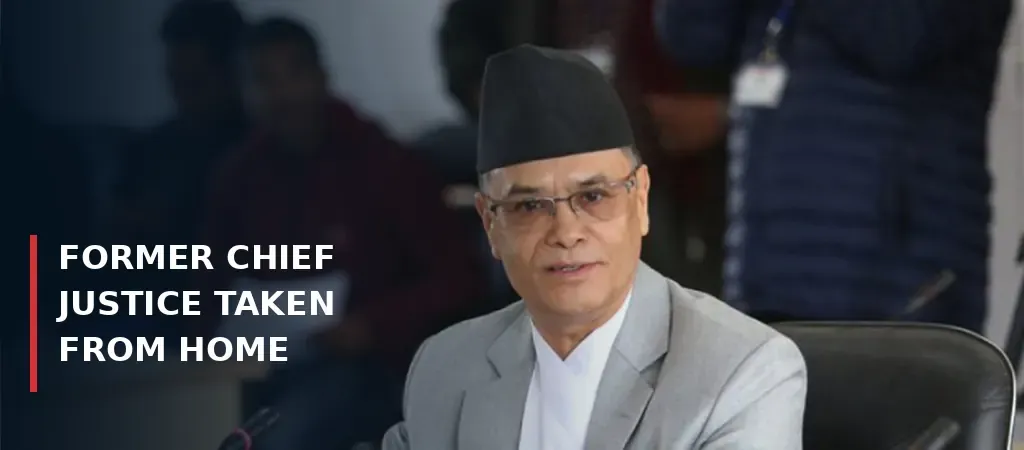
Police removed former chief justice Cholendra Rana from his home in the early hours of Sunday, held him for roughly twelve hours without charge, and offered no clear explanation of who authorised it — an episode unprecedented in the Supreme Court's 70-year history, arriving weeks after his long-running corruption case ended on a technicality.
Shortly after midnight on Saturday into Sunday, a team from the Kathmandu Valley Crime Investigation Office, led by Deputy Superintendent Yograj Khatiwada, arrived at the Maharajgunj home of Cholendra Shumsher Rana, Nepal's 29th chief justice, and took him into custody. No arrest warrant was produced, no charges were filed, and no case was registered. Police said only that he was being held "for his own security" in response to an unspecified "threat." He was released to his family at around 2pm on Sunday, roughly twelve hours later, and is reportedly staying elsewhere under police watch. The episode, first reported in detail by the Kathmandu Post, has no precedent in the history of Nepal's Supreme Court and has reopened long-standing anxieties about the independence of the judiciary and the security services from executive pressure — anxieties that were central to the Gen Z-led protests that swept Nepal a year ago.
What Happened, and What Hasn't Been Explained
Beyond the bare sequence of events, almost nothing about the detention has been officially clarified. Police have not identified the nature or source of the alleged "security threat," nor explained why a crime investigation unit — rather than the personal security detail routinely assigned to former chief justices — was the agency that removed him from his home overnight. Rana's family has said police mentioned threats linked to "Gen Z protesters," a claim Rana himself disputes; he has said only that he had asked for additional home security, not that he anticipated a specific threat requiring removal from his residence. Nepal's National Human Rights Commission was reportedly denied access to see him during his detention — itself an unusual restriction if the stated justification (his own protection) were the genuine rationale. Inspector General of Police Dan Bahadur Karki has acknowledged that "due process" questions have been raised internally but has not detailed who ordered the operation. Speculation, unconfirmed by any official source, has centred on the Prime Minister's Office, though the government has not publicly confirmed any involvement. NepalUK treats the "Gen Z protester threat" explanation, and any claim of political motivation, as unverified pending an official, on-the-record account.
A Judiciary Still Living Down 2022
The detention lands awkwardly on the heels of the collapse of Rana's own long-running corruption case. In February 2022, 98 lawmakers from the then-ruling coalition filed a 21-point impeachment motion accusing Rana of promoting corruption within the judiciary, interfering in judicial appointments and bargaining for a share of cabinet positions in exchange for favourable rulings — allegations that triggered his automatic suspension the same day. A parliamentary committee recommended impeachment in September 2022, but the House of Representatives never voted on the motion before its term expired in November that year, and Rana retired in December 2022 while still technically suspended, the case unresolved. It took until 9 September 2026 — just over two weeks before his detention — for the Supreme Court to rule that the impeachment motion had "lapsed" with the dissolution of that parliament, restoring his pension and benefits on procedural rather than substantive grounds. In other words, Rana had only just been formally cleared of a four-year-old cloud over his conduct when he was hauled from his home at midnight with no clearer explanation offered this time than in 2022.
Why It Matters Beyond One Man
For a judiciary and security apparatus that Nepal's Gen Z protest movement accused of shielding entrenched elites, an unexplained, warrantless overnight detention of the country's most senior former judicial officer is a serious credibility test — regardless of what actually motivated it. Prime Minister Balen Shah's government, elected in March 2026 on an anti-corruption and transparency platform, has made a point of pursuing accountability for officials linked to last year's protest violence; if any part of that push touched Rana's case, the government has not said so, and offering no explanation risks undermining the very transparency standard it has set for itself. Conversely, if the "security threat" explanation is genuine, the refusal to give the National Human Rights Commission access and the absence of any public detail leave that account effectively untestable. Nepalese communities in the UK and worldwide, many of whom followed the 2022 impeachment saga and last year's protests closely, will be watching for a formal government or police statement clarifying the chain of authorisation — something that, as of this writing, does not exist.
What Remains Unknown
The identity or credibility of the alleged security threat; who within government or police ordered the operation; why a crime unit rather than a protective unit carried it out; and whether Rana's recent political meetings with Rastriya Swatantra Party and Nepali Congress figures, and discussions with UML chair K.P. Sharma Oli, bore any relation to the detention, are all, at time of writing, unconfirmed. NepalUK will follow up as official statements become available.


