

Nepal UK
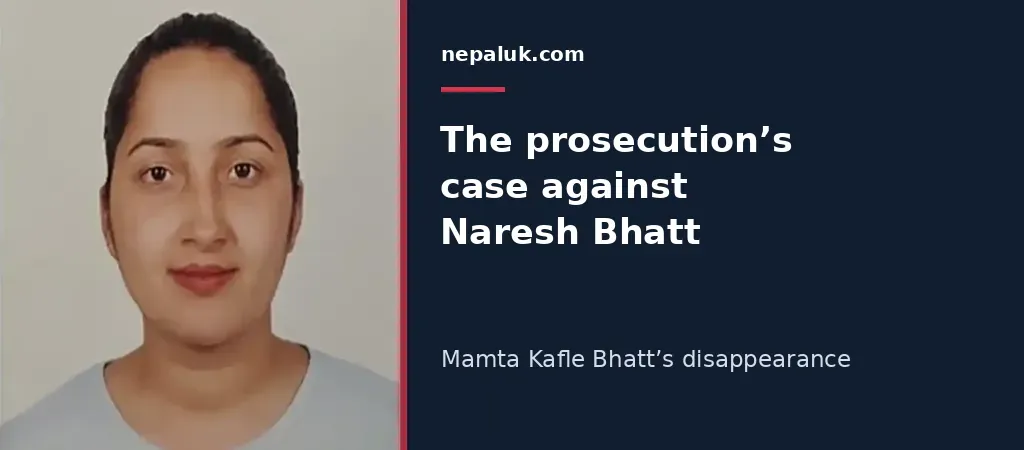
More than two years after Nepali nurse Mamta Kafle Bhatt disappeared from her home in Virginia, her husband is facing a murder trial built around digital records, surveillance footage, shopping receipts and forensic evidence. Her body has never been found.
Naresh Bhatt, who was 37 at the time of her disappearance, has pleaded not guilty to charges of first-degree murder, concealing a body and defiling a body. He is presumed innocent unless the prosecution proves the charges beyond reasonable doubt.
The trial began on Monday 5 October 2026 before Judge Kimberly Irving in Prince William County and is scheduled to continue until 19 November. Testimony reached its tenth day on Wednesday 21 October.
For Mamta’s family, the proceedings concern both the allegations against her husband and the unanswered question that has endured since July 2024: what happened to her?
Mamta, 28 when she disappeared, grew up in Nepal and worked as a registered nurse on a medical-surgical unit at a hospital in Manassas, Virginia. She worked two days a week and spent much of her remaining time caring for her daughter, who was approaching her first birthday.
Her family lived in Nepal, and she regularly spoke to her mother twice a day.
Nadia Navarro, who previously shared an apartment with her, has described Mamta as calm, responsible and unlikely to act impulsively.
Testifying on 19 October, Ms Navarro told jurors that Mr Bhatt had offered her a discounted room in exchange for helping his wife settle in America. She said she had not known at the time that he owned the apartment.
Ms Navarro said she last received a missed call from Mamta on 28 July 2024. Following the disappearance, she organised a fundraiser to support searches and later returned the donations when Mamta was not found.
Mr Bhatt, a former Army reservist who left police recruit training in Fairfax County before completing it, had been married to Mamta for about three years.
The court has heard about difficulties in the marriage before Mamta disappeared.
Police attended the family home in February 2024, when Mamta told officers that her husband would not give her documents and had destroyed her phone. No charges were brought.
The court has also been told that she sent her brother a photograph showing bruising to her face that month, asking him to keep it in case it was needed later.
According to a court filing, a search was entered on Mr Bhatt’s work laptop in April asking how long it takes to remarry after a spouse dies.
The defence has told the court that the couple were separating.
In a police interview recorded on 12 August 2024 and shown to jurors on 19 October, Mr Bhatt described the marriage as very good. He also said the couple had sometimes threatened to leave or divorce and that his wife had previously left home three or four times.
Hospital surveillance footage from about 8.17pm on Saturday 27 July 2024 shows Mamta outside the entrance with a friend before she gets into a black sedan.
Her colleague Punam Gurung told jurors that she had been shown footage from that evening and confirmed it was the last time she saw or heard from Mamta.
On 28 July, Mamta called a friend and posted a video of her daughter on the stairs.
The following night, she spoke to her mother by video call. That conversation on 29 July is the last known contact between Mamta and anyone outside the household.
Prosecutors now allege that she was killed on 29 July. The original complaint gave the date as on or about 30 July.
The prosecution’s case draws together a series of events in the days immediately after Mamta’s last known contact.
According to the timeline presented in court, a phone in the house was used at 4.13am on 30 July to search for a diagram of the brain. A search for a nearby chicken farm followed at 4.30am.
A text was sent to the babysitter at 5.40am. At about 6.30am, Mr Bhatt handed his daughter to the babysitter at an apartment complex on Clark Place in Manassas.
About ten minutes later, surveillance footage shows him putting bags into a dumpster, although the family had rubbish collection at home.
At around 8am, he bought rubber gloves at a Home Depot. A store security officer identified him in footage, and a cashier testified that he paid cash.
A Walmart employee’s testimony also placed the purchase of a three-pack of kitchen knives at that store, although earlier court accounts named a different retailer. The court heard that not all three knives were recovered during the search of the house.
A Lidl sales operations consultant testified on 19 October that Mr Bhatt also bought extra-strong black rubbish bags and energy drinks using his wife’s rewards account.
These purchases and movements form part of the prosecution’s allegations. Their significance remains a matter for the jury to assess alongside the other evidence.
At about 1.30am on 31 July, a security camera in Falls Church recorded a man wearing white gloves moving bags from a Tesla into a rubbish compactor.
A licence-plate camera recorded a blue Tesla in Fairfax that day. Prosecutors say the car’s data places it at the compactor and that Mr Bhatt’s phone had gone quiet during the relevant period.
That morning, the home’s water meter recorded 111 gallons of water use in a single hour. The prosecution has compared that with an estimated typical hourly use of three or four gallons for a household of this kind.
An earlier figure presented in court exceeded 150 gallons; the written expert notice gives the figure as 111.
Later that day, Mr Bhatt was recorded buying carpet cleaner, other cleaning products and body wash at a Walmart.
At 5.30pm, footage placed him back at the Clark Place dumpster with more bags and gloves. The babysitter later told police that he appeared nervous and repeatedly looked around.
A cashier at a petrol station in the Chantilly–Loudoun area testified that, at about 3pm on 1 August, Mr Bhatt opened the Tesla’s boot and carried at least one bag beyond the camera’s view, past a clothing donation bin.
Police later recovered a stained bath mat from a donation bin. A preliminary test indicated the possible presence of blood.
Mamta’s phone transmitted its last known signal from that area. Neither the phone nor Mamta has been reported found.
After Mamta failed to attend a shift, colleagues contacted police.
Officers visited the family home on 2 August, recording a 14-minute interaction on their body cameras.
Mr Bhatt told them that his wife was visiting family in Texas or New York, that she had broken her phone before leaving and that he did not want to report her missing. According to the account presented in court, she had no family in either location.
A basement tenant testified that Mr Bhatt asked him to help move a bed, a bedside table and a dresser in the bedroom, possibly before officers arrived that day. He said Mr Bhatt did not explain why.
Mamta was formally reported missing on 5 August. Friends organised searches, circulated flyers and established a Facebook group.
In a media interview on 14 August, Mr Bhatt said he was suffering and referred to Mamta as his wife and his child’s mother.
Sachchi Mainali, an independent Nepali journalist who interviewed him in Nepali after the missing-person report, testified during the trial’s second week. She said she had not known that police had asked him not to speak to the press.
Mr Bhatt subsequently told a detective that he planned to send the baby to Nepal. The Tesla was sold within days.
Police searched the house on 21 August.
Investigators reported blood and possible signs of dragging in the main bedroom and a bathroom. The court has also been told that a dog trained to detect human remains alerted in both rooms.
Investigators found a packed suitcase and passports belonging to Mr Bhatt and his daughter.
A crime-scene investigator told jurors that he used Bluestar, a chemical screening product that can indicate the possible presence of blood. He identified areas of suspected staining, including on a large carpet.
Samples were sent to the state forensic laboratory. Forensic experts are expected to testify about the findings.
Police Chief Mario Lugo said in December 2024 that testing had confirmed the presence of Mamta’s blood. A grand jury subsequently indicted Mr Bhatt on the murder charge.
Prosecutors allege that he killed Mamta in the house, dismembered her body with a saw and removed her remains in bags. The defence disputes the charges.
A landscaper testified through an interpreter on 21 October that Mr Bhatt gave him a battery-powered saw in exchange for lawn care in August 2024.
He said he handed the tool to Loudoun County police on 9 September and that neither he nor his workers had used it to cut a human body.
The accounts reviewed for this article do not establish whether that tool was the same saw previously described as having been found in the house.
The couple’s daughter was carried out of the house on 22 August, two days after her first birthday. She has since been cared for by Mamta’s mother and brother, who travelled from Nepal on emergency visas in 2024.
Mamta’s body has not been found, and no post-mortem examination has established a cause or precise time of death.
No remains have been reported recovered from the dumpsters or compactor.
Police believe much of the rubbish went to a landfill in Page County but have said they cannot identify which truck carried it or when.
Two sergeants testified on 19 October that police searches in August and September 2024 had recovered nothing of evidentiary value. Chief Lugo has said Mamta may never be found.
An early description of the evidence has also been challenged.
The original complaint stated that there was evidence of a body being dragged out of the house. A police captain later wrote that the detective could support only the conclusion that something had been dragged between rooms.
The defence described the original statement as fabricated but withdrew its motion before a judge ruled on the issue.
Mr Bhatt’s previous lawyer characterised the visible blood as minuscule, emphasised the absence of a confession and said Mamta had left to visit family.
Mr Bhatt has said on camera that he last saw his wife at dinner at home on 31 July, two days after the date on which prosecutors now allege she was killed.
His current defence team has publicly disclosed little of its alternative account. In September, defence lawyer Tracey Lennox described the case as science-based and said the defence had retained experts, although six had not completed their work.
The defence also asked the judge to exclude 18 statements Mamta made about her marriage because she cannot be cross-examined. The judge indicated that two might be admitted, with the remaining statements to be considered individually.
On the opening day of the trial, Mr Bhatt appeared in a grey suit and read 11 complaints to the judge, saying that he had not reviewed the evidence and lacked the prosecution’s resources.
Judge Irving denied his requests. He pleaded not guilty to all three charges, while Mamta’s mother and brother followed proceedings through interpreters’ headsets.
Three hundred people were summoned for jury selection. Twelve jurors and four alternates are hearing a case expected to involve more than 100 witnesses over approximately seven weeks.
They are not sequestered but have been instructed to delete news and social-media apps from their phones.
The jury must decide whether the evidence proves the charges beyond reasonable doubt. For Mamta’s family, the trial continues while her whereabouts remain unknown.


