

Nepal UK
Picture: Courtesy of Press Association (PA)
London - After four heatwaves this summer, London's parks and open spaces remain parched, and the threat of wildfires is a very real and growing concern for the London Fire Brigade (LFB). This summer alone has seen 64 wildfires across the capital—the highest number since 2022 and a sharp increase from just 19 in 2019. Almost all of these blazes were caused by human activity, with discarded cigarettes, barbecues, and even broken glass acting as catalysts.
For the LFB, wildfires and grass fires are no longer an occasional event but the "new normal," requiring a fundamental shift in strategy.
A Wake-Up Call from the Wennington Fire
The catalyst for this change was a major wildfire that erupted in Wennington, East London, on July 19, 2022. The fire, which occurred at the 'rural-urban interface' where the city meets the countryside, was exceptionally fast-moving and destroyed 16 homes. The day was one of the busiest in the brigade's modern history, with over 2,496 calls received, 740 of which were wildfire-related.
A subsequent review of the incident praised the LFB staff's "bravery, tenacity, and determination" but identified key areas for improvement. The report found that 39 fire engines were unavailable due to staff shortages. It also highlighted a need for better training and a lack of a fully qualified wildfire tactical advisor.
New Strategy and Equipment
In response, the LFB has significantly bolstered its capabilities. It has since created 10 wildfire officers and 30 wildfire tactical advisers, who will receive specialised training in more rural parts of England where wildfires are more common. New equipment has also been introduced to combat the rising threat. These changes were part-funded by a £40 million transformation fund from City Hall.
According to Ken Spratt, the LFB's wildfire lead, drier springs and summers are directly contributing to the increased frequency and intensity of these fires. The new tactical approach is to send a large number of fire engines to grass fires to contain them quickly, as they often threaten homes. Specialist vehicles and equipment are deployed when a fire requires more than four engines, at which point it is reclassified as a wildfire.
Specialist Vehicles and Drones
The LFB is currently trialling new 4x4 wildfire vehicles that can access hard-to-reach, off-road locations where large fire engines cannot. These new vehicles, along with the use of drones and "holey hoses" that create a wall of water, are designed to enable a "quick and sustained attack on a fire," according to Deputy Assistant Commissioner Phil Morton.
The new unit’s kit also includes a misting lance which delivers a high-pressure spray deep into the ground, cooling smouldering peat and roots to prevent fires from reigniting days later.
Understanding the Human Factor
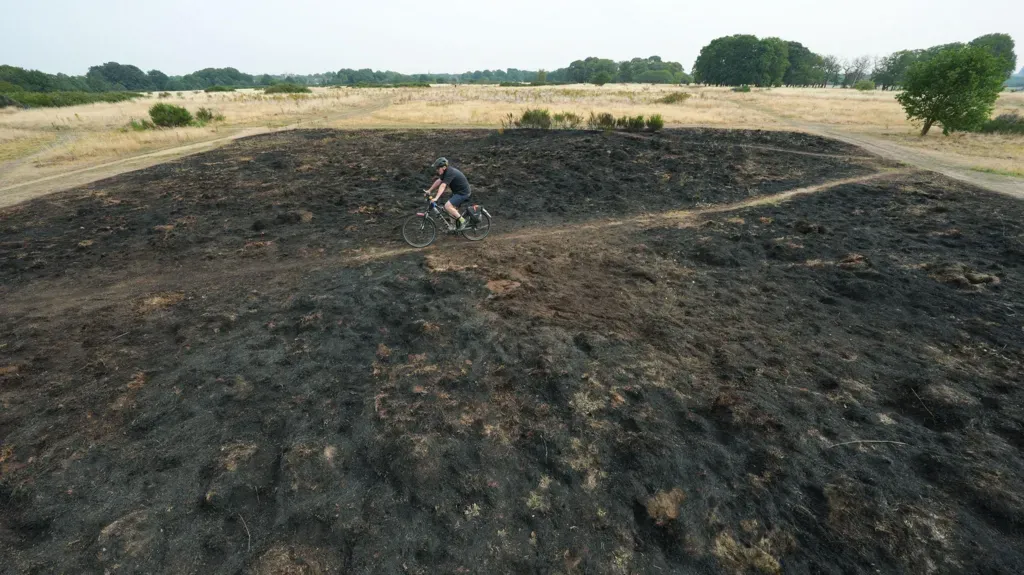
Parts of Wanstead Flats in East London, an area that has experienced multiple fires this summer, remain charred and dry. Station Commander Tony Jackson notes that the human factor is a key contributor to these blazes, which can be started by discarded cigarettes, unattended barbecues, or even sunlight reflecting off broken glass.
While a warming climate will inevitably lead to more heatwaves and wildfires, nearly 80 deliberate fires in open grasslands, scrublands, and parks have been recorded since the beginning of June. The impact on these habitats is devastating. Caroline Haines of the City of London Corporation highlights the immediate effect, noting the absence of birdsong after a fire and the potential for long-term damage to trees and nesting wildlife.
As London faces these new climate challenges, the LFB is adapting its strategy to tackle what has become a routine threat to the capital's green spaces and communities.
(Source: This report is based on reporting from the Press Association (PA).


