

Nepal UK
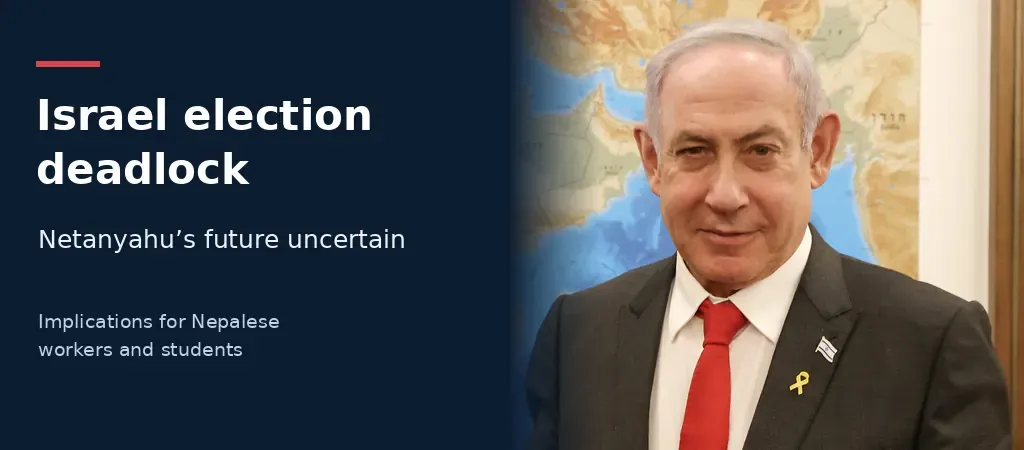
Israel's first general election since the 7 October 2023 Hamas attacks has produced no clear winner, with exit polls suggesting neither Benjamin Netanyahu's bloc nor the opposition led by Gadi Eisenkot has reached the 61 seats needed for a majority in the 120-seat Knesset. Official counting continues, and the outcome matters to thousands of Nepalese workers and students in Israel.
Voters went to the polls on Tuesday 27 October. Israel's Central Elections Committee reported turnout of 77.7% when polls closed at 10pm, 7.1 points higher than in 2022. Exit polls reported on Tuesday night gave Mr Netanyahu's bloc 51 to 52 seats and the opposition 49 to 51. Revised projections on Wednesday morning put his bloc at 53 to 57 and the opposition at 47, with Likud the largest party on 27 to 28 seats and Mr Eisenkot's Yashar on about 21. Arab parties were projected at 16 to 19 seats. Both blocs still fall short of a majority on these figures. Exit polls have differed from final results in earlier elections, and the last update of this reporting was 06:39 on 28 October.
The campaign ended in bitter exchanges. Mr Netanyahu called the vote a "matter of life and death" and, during the day, accused Arab-party activists of trying to steal the election. Mr Eisenkot's party said he was laying the groundwork for a baseless challenge to the results. Those are claims by interested parties, and no evidence of fraud has been presented in the reporting reviewed. Incidents on polling day included scuffles at a Holon campaign booth and an arrest after a man approached a party leader with a knife; the shekel rose more than 1.2% against the dollar during the day.
What happens next is uncertain. With no bloc assured of a majority, coalition talks may take weeks, and one explainer noted Mr Netanyahu could remain in power in the meantime even if he loses. Anti-defection law is also expected to shape negotiations, though the detail was not available in the sources reviewed.
Israel is a significant destination for Nepalese labour. In January 2026 Nepal's cabinet approved three protocols sent by Israel: a revised caregiver programme for elderly-care centres, an agricultural employment pathway, and home-based caregiving jobs of up to five years, to be recruited through government-to-government mechanisms. Over 3,000 Nepalese young people had earlier gone under agricultural training schemes such as "Learn and Earn". The reporting reviewed does not say whether the protocols have since been signed or how many placements are planned, so readers should check with the Department of Foreign Employment before committing money to any recruiter.
A prolonged coalition negotiation is unlikely by itself to change existing placements, but it could slow new policy decisions and budgets, and any security deterioration would hit workers directly. NepalUK has seen no statement from the Nepali embassy or Government of Nepal on the election. Nepalese families in the UK with relatives in Israel should follow official embassy notices rather than social-media rumours.


