

Nepal UK
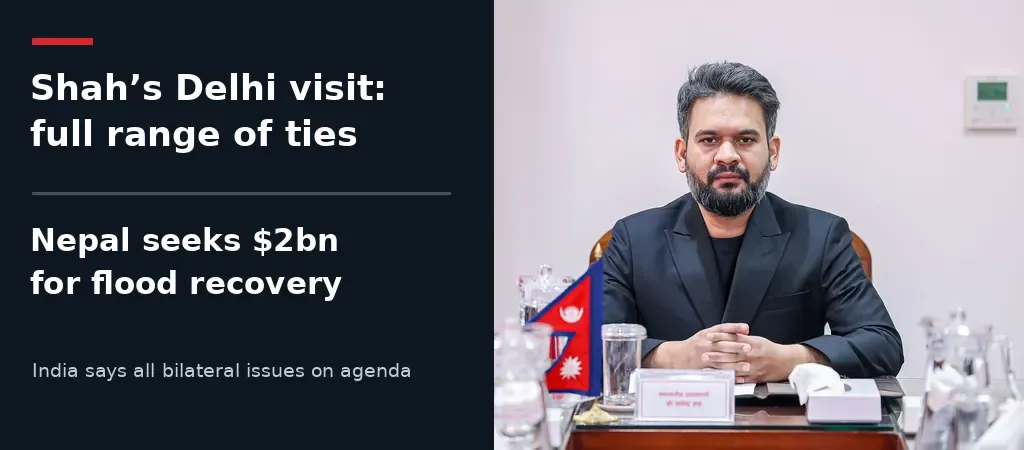
India's foreign ministry has said Prime Minister Balendra Shah's first official visit to New Delhi will cover the full breadth of the relationship, as Kathmandu prepares to ask for around $2 billion to help rebuild after August's catastrophic floods.
Speaking at the ministry's regular briefing on Tuesday 10 November, spokesperson Randhir Jaiswal confirmed that an invitation had been extended and that discussions on the visit were continuing. "The entire range of bilateral relations that we have with Nepal will be discussed," he said, describing the relationship as an expansive and special partnership. Neither government has formally announced dates, although 22–25 November has emerged as the likely window, with delegation-level talks with Prime Minister Narendra Modi reportedly expected on 23 November. This account is current as of the evening of 10 November, Nepal time.
Mr Modi extended his invitation shortly after Mr Shah's government took office earlier this year. It was repeated in person on 4–5 November, when Indian Foreign Secretary Vikram Misri visited Kathmandu, held talks with his Nepali counterpart Amrit Bahadur Rai, met Foreign Minister Shisir Khanal and Finance Minister Swarnim Wagle, and called on Mr Shah. The two sides discussed possible outcomes in trade, energy, hydropower, connectivity, development partnership and border management.
Nepal is seeking about $2 billion in concessional loans and grants for reconstruction in the Bhotekoshi–Rasuwa corridor, devastated by the floods of 26 August. It also wants additional air-entry routes for its international airports, progress on the long-delayed Pancheshwar Multipurpose Project, better trade and transit arrangements, and a resolution of boundary disputes over Kalapani, Limpiyadhura and Susta. Cross-border transmission lines, hydropower and the delivery of India-funded projects are also expected on the agenda.
Trade friction is already live. India is Nepal's largest trading partner, and higher Indian anti-dumping duties, combined with the withdrawal of domestic incentives, are reported to be squeezing eastern Nepal's jute industry.
Observers have cautioned Kathmandu against arriving in Delhi with an extensive wish list, arguing that the priority should be rebuilding political trust. On the evidence so far, NepalUK's assessment is that the reconstruction request looks the most deliverable item, since financing can be agreed in a single meeting, whereas the boundary disputes have resisted resolution for years. That is an editorial judgement, not an official position of either government.
Mr Shah's wider foreign-policy signals add context. At the UN General Assembly in September he proposed a trilateral mechanism involving Nepal, India and China to cooperate on the impacts of climate change.
The $2 billion request puts the scale of recovery in perspective. The UK government pledged £5 million in emergency humanitarian support after the floods and deployed a rapid response team to Kathmandu to assist British nationals. In mid-October, MPs from several parties urged longer-term British backing; Gareth Thomas, MP for Harrow West, suggested Nepal could need around £5 billion for reconstruction and resilience. That is his estimate rather than an official figure, and its scope differs from India's request, so the two numbers are not directly comparable. Nepali community organisations in the UK have also raised funds, with groups reporting transfers worth millions of rupees.
For Nepali families in Britain with relatives in the affected districts, the practical question is whether recovery money arrives at scale and quickly, and from whom.
Dates and the agenda are unconfirmed. It is not yet clear whether India will commit to a headline figure, or how any assistance would be split between grants and loans. Nepal's foreign ministry has said previously that preparations were under way without fixed dates, and no formal itinerary had been published at the time of writing.


