

Nepal UK
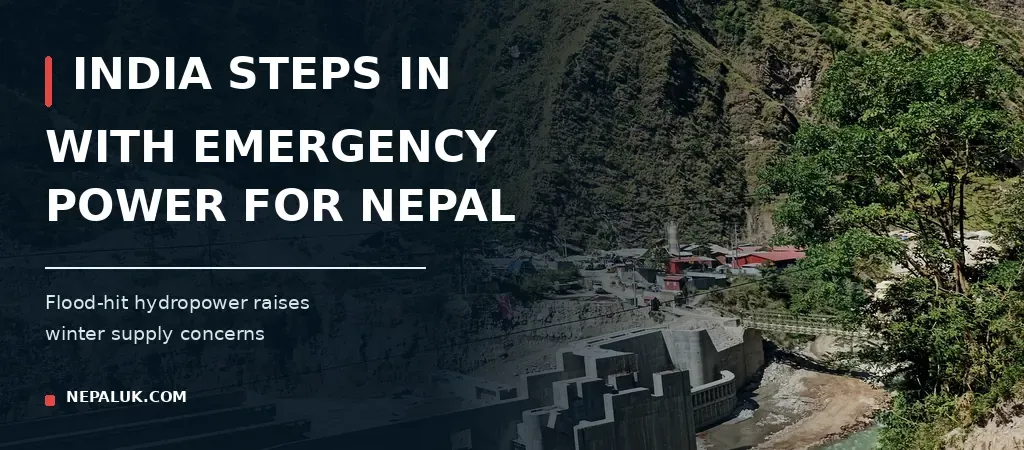
With a dozen hydropower plants destroyed or damaged by August's floods, India has approved 654 megawatts of additional electricity exports to keep Nepal's lights on through the dry season — a stopgap that also exposes how exposed Nepal's energy security has become.
India's Central Electricity Authority approved an additional 654 megawatts (MW) of power exports to Nepal on 13-14 September 2026, to run 18 hours a day — from midnight to 6pm — between 13 September and 31 December. The move responds directly to a 350-400MW shortfall caused by the 26 August floods, which destroyed or damaged twelve hydropower installations across Rasuwa and Nuwakot. For Nepal, which relies on hydropower for the great majority of its electricity, the deal is a lifeline through the dry winter months when domestic generation naturally falls and demand from households, businesses and the diaspora-linked economy typically rises around the Dashain and Tihar festival season.
The scale of the damage
According to Nepal Electricity Authority (NEA) figures reported by the Kathmandu Post, the floods completely destroyed four projects — the Trishuli 3A, Devighat and Middle Trishuli Ganga hydropower plants and the Nuwakot Solar Farm — and partially damaged six more, including Upper Trishuli 1, Rasuwagadhi and Chilime. The combined lost capacity exceeds 400MW. The Post reported the energy sector's damage at Rs134.69 billion (roughly £780 million at current exchange rates), with a further Rs17.69 billion in losses and an estimated Rs390.62 billion required to fully restore the power-grid system — figures that illustrate why energy alone accounts for roughly half of the flood's total reconstruction bill, according to earlier UN-linked damage assessments reported by Reuters.
Why India, and why now
"For the dry season, we had requested India to export additional power to Nepal to meet our demand. They have approved it," NEA acting managing director Dirghayu Kumar Shrestha told the Kathmandu Post. The new approval sits on top of 1,650MW of total export capacity agreed at an India-Nepal energy meeting in July 2026, and feeds into a longer-term 2024 agreement targeting 10,000MW of exports from Nepal to India over the coming decade — a reminder that the two countries' power grids are becoming steadily more interdependent in both directions. During monsoon months, when Nepal's rivers run high, it typically exports around 500MW of surplus hydropower to India; the current arrangement effectively reverses that flow for the dry season.
What it means for Nepalese households and the diaspora
For families in Nepal, the deal should reduce the risk of extended load-shedding during Dashain and Tihar, historically Nepal's most electricity-intensive weeks, at a moment when the country can least afford further disruption to reconstruction and daily life. For the diaspora, including Nepalese communities across the UK, the story carries a practical dimension: many households in Nepal rely on remittance-funded small businesses — shops, guesthouses, workshops — that depend on a stable power supply, and reconstruction of the damaged hydropower fleet is likely to take years rather than months.
Risks and what happens next
The arrangement is explicitly temporary, running only to the end of December, and analysts and officials alike will be watching whether Nepal can secure a further extension or accelerate reconstruction of its own damaged plants before then. The episode also renews longstanding debate in Kathmandu about the risks of energy dependency on India, even as the two countries deepen cross-border power trade. No pricing details for the emergency imports were disclosed in the reporting reviewed for this article, and that commercial detail — along with the pace of domestic hydropower reconstruction — is worth monitoring in the weeks ahead.


