

Nepal UK
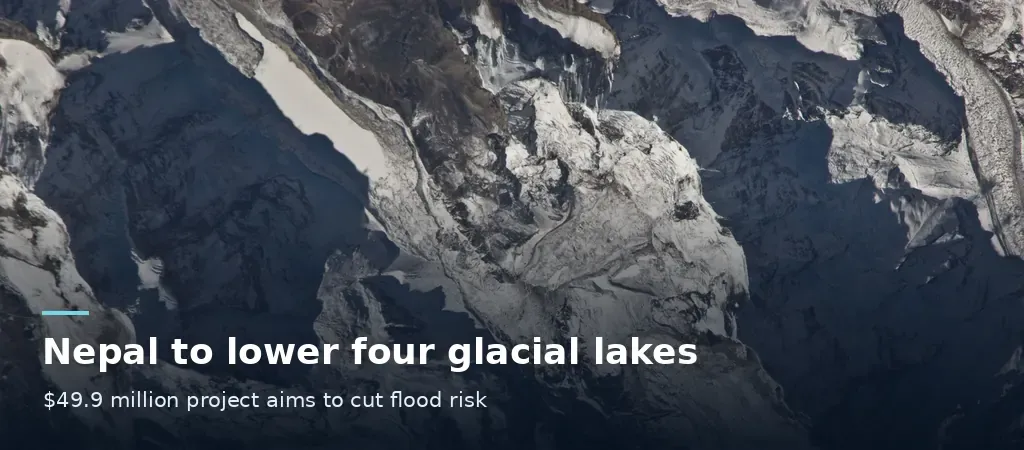
Three months after a glacial collapse sent a deadly flood down the Bhote Koshi, Nepal has formally launched its largest effort yet to reduce glacial lake risk. The project aims to lower four high-risk lakes and build a warning network across three river basins. It is a major test of whether international climate finance can protect mountain communities before a disaster rather than after one.
The GLOF Sanjibani Project was launched at a national inception workshop in Kathmandu on Wednesday 25 November. It is led by the Government of Nepal through its hydrology and water resources research centre, with the United Nations Development Programme (UNDP) as the accredited entity for the Green Climate Fund (GCF).
The project's total value is $49.94 million. The GCF is providing a $36.16 million grant, the Government of Nepal $11.32 million, UNDP $2.14 million and private-sector partners about $320,000. According to UNDP's project summary, the private partners include the Nepal Tourism Board and the Independent Power Producers' Association, Nepal. The project formally began in March 2026 and runs until March 2033.
The four target lakes are Thulagi in Manang, Lower Barun in Sankhuwasabha, and Lumding Tsho and Hongu 2 in Solukhumbu. Figures presented at the launch show that engineers plan to lower Thulagi, Lower Barun and Lumding Tsho by three metres each, and Hongu 2 by one metre. The project expects to benefit 385,956 people directly, 55 per cent of them women, and close to two million indirectly.
Lake lowering is only part of the plan. The monitoring component will install 24 automatic weather stations, 27 hydrometeorological stations, nine precipitation stations, six base stations and nine sirens across the Marshyangdi, Dudhkoshi and Arun sub-basins. River walls and revetments will be combined with nature-based measures such as slope stabilisation, check dams and catchment restoration.
Project Director Dr Rajan Bhattarai told the workshop: "The challenge is changing, and our response must change too." His presentation said glaciers in the Hindu Kush Himalaya retreated 65 per cent faster between 2011 and 2020 than in the previous decade. Nepal's total glacial lake area grew by 25 per cent between 1987 and 2017. The glacier feeding Thulagi retreated by an average of 30 metres a year between 1991 and 2016.
A modelled outburst scenario for Thulagi found assets worth an estimated $406.73 million exposed to risk. This figure measures the value of assets in the flood path. It is not a forecast of damage. A 2020 UNDP and ICIMOD assessment identified 47 potentially dangerous glacial lakes across its study area: 21 in Nepal, 25 in China's Tibet Autonomous Region and one in India.
UNDP Resident Representative Kyoko Yokosuka linked the project directly to this year's disasters. She said recent floods in the Rasuwa–Bhote Koshi and Gandaki regions showed how quickly climate hazards can become humanitarian emergencies. "We cannot wait for the next disaster to act," she said.
The project will not address the hazard that caused the 26 August disaster. In a statement on 4 September, the GCF said "the geography of our project does not overlap with the disaster area". That flood began with a collapse of glacial ice and rock upstream in a transboundary basin. The GCF statement also acknowledged concerns about how long the proposal took to reach approval. The concept note was first submitted in 2018, and the project was approved in July 2025.
The gap matters. Nepal's most dangerous glacial threats include lakes and ice masses on the Chinese side of the border, which Nepal cannot engineer directly. Dr Bapon Fakhruddin of the GCF Secretariat used the launch to call for regional data-sharing and a national platform to track climate finance from receipt to delivery. Both remain undeveloped.
The target districts supply guides, porters and hydropower workers to the national economy. In Solukhumbu, the village of Thame was badly damaged by a glacial flood in 2024. Many families across the global diaspora have roots in Manang, Solukhumbu and Sankhuwasabha, and they will watch implementation closely. Trekkers and tour operators in the UK also have a direct interest in more reliable early warning along popular routes.
The next milestone is detailed design for the lake-lowering works. Officials say this will be finalised in the coming months. High-altitude construction is possible only in short seasonal windows, so the timetable for that design work will show how quickly results can follow.


