

Nepal UK
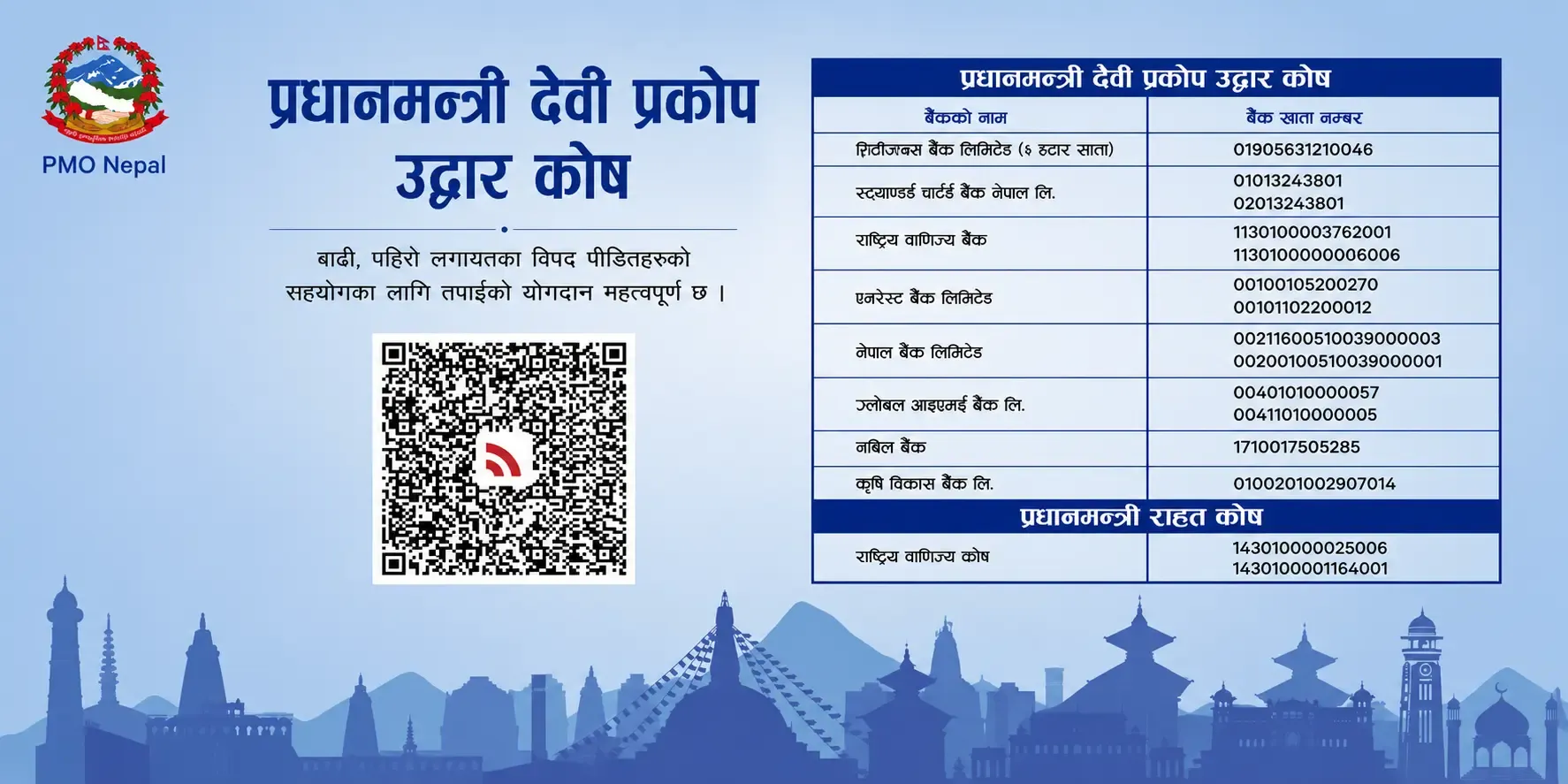
Six days after the Bhote Koshi flood tore through northern Nepal, the confirmed death toll stood at 987 as of Tuesday morning according to Nepal's National Disaster Risk Reduction and Management Authority, with several thousand people still unaccounted for, while Prime Minister Balendra Shah announced that the government's Prime Minister's Disaster Relief Fund (PMDRF) had passed Rs 6.36 billion — more than £37 million — in donations by Monday evening. NepalUK is urging members of the UK's Nepali community to channel their contributions through this single, audited, government-run account at pmdrf.nchl.com.np, rather than through unverified or informal appeals now circulating on social media and messaging apps.
The case for the PMDRF rests on accountability. Nepal's Ministry of Finance has been designated the formal focal point for all contributions, funds are deposited into accounts held at nine commercial banks plus dedicated US-dollar accounts at Himalayan Bank and Laxmi Sunrise Bank, and the Office of the Prime Minister and Council of Ministers has launched a public "Rescue Request Portal" that discloses major donations as they arrive — from Surya Nepal's Rs 150 million corporate contribution to businesswoman Raji Rana's Rs 10.9 million, the largest individual gift recorded so far. That level of public disclosure gives donors something an informal fundraiser cannot easily offer: a visible, traceable record of who gave what, and confirmation that the money has entered a state-audited account rather than a private one.
The Fund's growth illustrates both the scale of the disaster and the strength of the response it has drawn: Rs 1.91 billion arrived in the first 36 hours alone, rising to Rs 2.295 billion within two days, Rs 4.09 billion by the Friday evening after the flood, just over Rs 5 billion by Saturday, and Rs 6.36 billion by Monday evening — a trajectory that includes institutional support such as the Asian Development Bank's $5 million (roughly Rs 750 million) emergency grant, now also flowing through official government channels rather than parallel ones. Nepal's Foreign Ministry has separately confirmed that the international body representing Non-Resident Nepalis deposited an initial Rs 10 million, drawn from contributions by its office-bearers and coordination councils worldwide, directly into the PMDRF on 31 August — with Foreign Minister Shisir Khanal asking that any further diaspora-raised relief be coordinated with local government authorities and reported back in full. That arrangement, funnelling diaspora money into the same audited account rather than around it, is precisely the model NepalUK believes UK-based donors should follow.
For UK-based donors specifically, the practical case is straightforward. The PMDRF portal accepts international cards directly, meaning a donor in London, Birmingham or Reading can contribute in under two minutes without needing a Nepali bank account or an intermediary of any kind. Nepali missions in Washington and the Consulate General in New York have already begun circulating these official account details to their diaspora communities; NepalUK could not confirm, as of publication, whether the Embassy of Nepal in London has issued a comparable appeal, and we have asked the Embassy to clarify. Separately, donations to the Fund are eligible for a tax deduction under Section 12 of Nepal's Income Tax Act, 2058 — a detail relevant to NRN business owners and property investors who retain financial ties to Nepal and may wish to formalise larger contributions.
Casualty figures are still being reconciled across agencies, which only reinforces the need for equally rigorous financial reporting. Nepal Police put the toll at 4,270 rescued and 4,599 still missing as of 1 September, while the National Disaster Risk Reduction and Management Authority separately reported 987 confirmed dead and roughly 3,916 missing the same morning, and the Kathmandu Post had recorded 903 deaths a day earlier. With the human cost of this disaster still not fully known, NepalUK's position is that UK Nepalis wanting maximum assurance that their donation reaches flood victims — and wanting it recorded in a public account that will remain auditable months from now — should treat the PMDRF as their primary channel, and apply ordinary charitable diligence to any other appeal: check who is legally accountable for the funds, and ask for evidence of how earlier donations were spent.


