

Nepal UK
Dipesh Darshandhari.
ISKCON's global leadership has suspended eight Nepal-based officials from management and leadership duties pending further proceedings, after a two-year internal and external investigation into allegations of sexual abuse, physical violence and safeguarding failures at the organisation's residential school in Budhanilkantha, Kathmandu. The suspensions are precautionary; ISKCON Nepal disputes their validity; and separate criminal cases remain before the courts.
Editor's note: In line with NepalUK's safeguarding policy, this article does not name, photograph or otherwise identify the children involved. Pseudonyms used here follow those already published by The Kathmandu Post's investigation, on which this account substantially relies alongside independent Nepali and international reporting. All allegations against named individuals are unproven unless a court has ruled otherwise, and are described as allegations throughout.
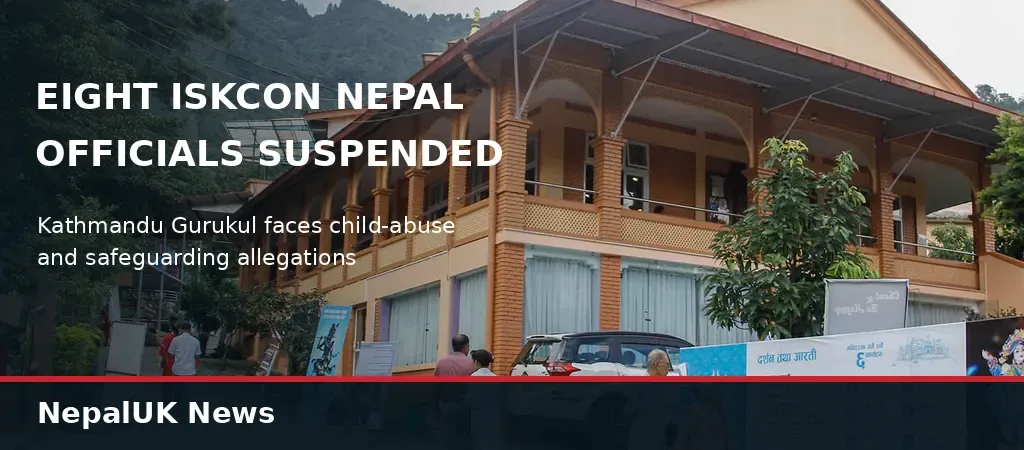
ISKCON's international Governing Body Commission suspended eight Nepal-based officials of the International Society for Krishna Consciousness from management and leadership duties on 14 September 2026, following allegations of child sexual abuse, physical violence and institutional misconduct at the Bhaktivedanta Gurukul, ISKCON's residential school in Budhanilkantha Municipality, Kathmandu. The case centres on a family's allegations that their daughter, now 13, was sexually abused at the school between 2021 and 2022, and that their young son was separately beaten and assaulted with a sharp object. The suspension order — issued by senior Governing Body Commission members Jayapataka Swami and Revati Raman Das — followed a lengthy internal review coordinated by ISKCON's Child Protection Office in India (CPO Bharat) under the oversight of its global Child Protection Oversight Committee (CPOC). ISKCON Nepal's General Assembly has publicly rejected the order as "illegal and invalid," while separate Nepal Police and court proceedings continue, with victim and witness statements scheduled for 5 October.
What the family alleges
According to The Kathmandu Post's investigation, the family — whose identities the paper withheld, using the pseudonyms Samrat (father), Shikha (daughter) and Hitesh (son) — say their daughter disclosed the alleged sexual abuse to a teacher in mid-2025, having been unable to fully understand what had happened to her at the time. "I was very innocent back then. I was completely unable to understand what was happening," she is quoted as saying. Their son separately alleged he was beaten, poked with pins and threatened with further punishment if he told his parents. The family raised their concerns with ISKCON's Child Protection Office in Bharat, India, in August 2025, and filed a formal police complaint on 30 April 2026. "I don't even have the financial capacity or money to hire a lawyer, but remaining silent is not an option for us," the father told the Post, adding: "My faith is already broken."
Two separate cases, two different legal statuses
Nepal Police and court records, as reported across multiple outlets, indicate two distinct proceedings. The first concerns Suraj Krishna Shrestha, the Gurukul's former principal (also known within ISKCON as Sundar Gopal Das), who was arrested in mid-June 2026 — outlets report the exact date variously as 10, 11 or 14 June — over alleged physical abuse of a child, including assault and battery. Kathmandu District Police Range spokesperson Pawan Kumar Bhattarai confirmed the arrest related to "an offence under the Children's Act," and said there was, at that stage, "one complaint" rather than multiple charges. Shrestha has since been released on bail; ISKCON Nepal maintains he held a general coordinator role rather than ownership of the Gurukul. The second, more serious case concerns Ishwor Shrestha, a young man named as the alleged perpetrator of the sexual abuse, who ISKCON Nepal says was 19 at the time of reporting but only around 15 at the time of the alleged offence, and was a student rather than an employee of the school. He is reported to remain absconding, with a warrant understood to be outstanding; his case is proceeding separately through the Kathmandu District Court, with victim and witness statements due to be recorded on 5 October.
ISKCON's global suspension order — and Nepal's pushback
ISKCON's own Child Protection Office first acknowledged the case publicly on 5 May 2026, saying allegations concerned "a local centre" within a Nepali Vaishnava community operating more than 65 centres nationwide, and that it had asked CPO Bharat to investigate under its standard guidelines. A follow-up statement on 10 July 2026 confirmed the internal investigation had concluded, that the matter had passed to "relevant secular authorities," and that interim restrictions had been placed on those under investigation, with the residential Gurukul itself suspended pending the outcome of the judicial process and the implementation of safeguarding reforms. The 14 September suspension of eight named officials — including the school's principal, ISKCON Nepal's vice-presidents, treasurer, secretary and regional secretary — followed. ISKCON Nepal's General Assembly responded on 22 September with a statement, signed by Joint Secretary Harendra Thakur, calling the notice "illegal and invalid" and demanding a written apology and clarification from Revati Raman Das within 24 hours. ISKCON Nepal President Pradeep Bhandari has stressed that suspension "should not imply guilt" and said the organisation operates a "zero-tolerance policy" on violence against children, while separately telling The Himalayan Times that earlier reporting on the case was "one-sided, fabricated and highly misleading."
A pattern of escalation, and what remains uncertain
The dispute has not been confined to statements. The Himalayan Times has reported, citing case-related material, that on 22 April 2026 a group of around 30 to 34 people — allegedly including Shrestha and a co-operator — confronted investigators from ISKCON's own Child Protection Oversight Committee at an apartment in Kathmandu, with claims of assault, threats and the forced deletion of evidence from investigators' devices. ISKCON Nepal disputes this characterisation, describing the gathering as concerned parents and relatives seeking to prevent an unauthorised video leak, not the "armed mob" some reports suggested. Neither account has been tested in court.
Several other facts remain unsettled: Shrestha's precise current bail conditions could not be independently confirmed beyond the Post's reporting that he was released on bail; Ishwor Shrestha's whereabouts remain unknown; no court has ruled on either set of allegations; and ISKCON's independent Review Panel of child-protection specialists had not, as of its last public statement, issued final findings. This article will be updated as the 5 October hearing and any further ISKCON statements clarify the picture.
Why this matters for Nepalese communities in the UK and beyond
ISKCON — popularly known as the Hare Krishna movement — operates temples across the UK, including Bhaktivedanta Manor in Watford, and counts followers among Nepalese Hindus in Britain and worldwide. This is not the movement's first reckoning with gurukula-related child abuse: a class-action lawsuit brought by former students of ISKCON's US residential schools led to a US$9.5 million settlement in 2005, prompting a global overhaul of child-protection systems, including the Child Protection Office network now investigating Kathmandu. For diaspora families relying on faith-based residential schools, in Nepal or overseas, the case underscores the value of independent safeguarding oversight and support for families who come forward, regardless of an institution's size or reach.


