
Nepal UK
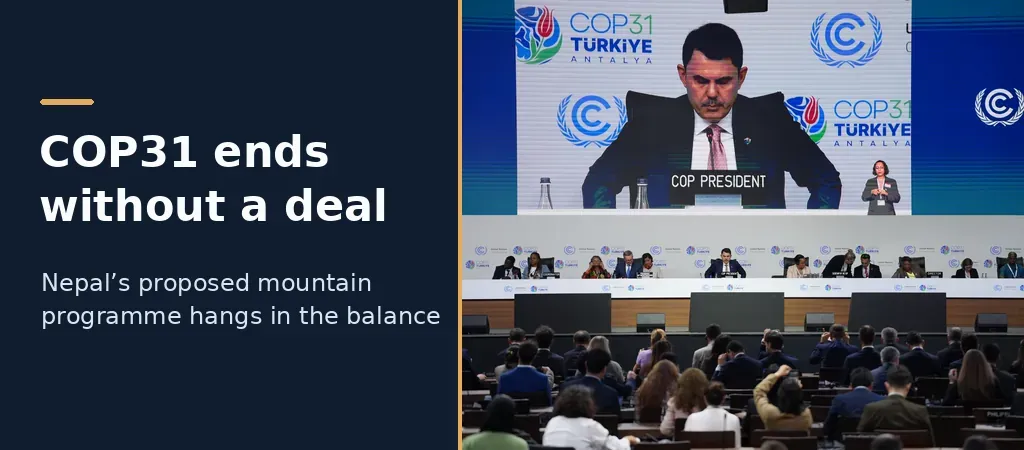
The UN climate summit in Antalya ended on Sunday 22 November without an overarching agreement, after the European Union, the United Kingdom and a group of climate-vulnerable countries rejected a final text that made no mention of fossil fuels. For Nepal, which arrived three months after one of the deadliest floods in its history, the collapse leaves a central diplomatic objective in limbo.
COP31 was due to close on Friday 20 November but ran for roughly two more days, making it the longest UN climate conference on record. Successive drafts of the cover decision, known as the Antalya Pact, removed references to coal, oil and gas after objections from oil-producing states. When the fourth draft reached the closing plenary, the EU, the UK, Norway, Panama, Vanuatu, the Marshall Islands and Belize objected.
"I understand that there is no agreement on this text," the COP31 President, Türkiye's environment minister Murat Kurum, told delegates, before declaring the decisions not adopted. UN Secretary-General António Guterres said he was deeply disappointed. A spokesperson for the UK delegation described the text as the lowest common denominator.
Existing obligations under the Paris Agreement remain in force. What has been lost is the set of new commitments and work programmes that were bundled into the cover decision.
Nepal and Bhutan had submitted a formal agenda item on 29 October titled "1.5°C warming in mountains", alongside a related proposal from Kyrgyzstan, which leads a group of about 16 mountain countries that Nepal has joined. The item was not adopted when the agenda was agreed on 9 November, but countries did agree at the opening session to hold technical dialogues on mountains.
Nepal's negotiators then shifted their effort to the cover decision. By 17 November, draft text recognised the particular vulnerability of mountain ecosystems and glacier-dependent communities. Later drafts, according to Nepali reporting on 22 November, would have created a two-year Programme on Mountains and Climate Change under the UN's two subsidiary bodies, with dialogues at their 66th and 68th sessions and a high-level dialogue at COP32. Nepali coverage hailed it as a milestone after four successive COPs of trying.
Because those provisions sat inside the cover decision that was not adopted, they do not appear to have taken legal effect. NepalUK has not yet seen an official UNFCCC statement confirming the status of the mountain programme, and that should be treated as an open question. The technical dialogues agreed at the start of the conference are on a separate footing and should go ahead.
The stakes for Nepal are not abstract. The 26 August ice-rock avalanche and flash flood in the Bhotekoshi–Trishuli corridor killed 1,451 people, with 5,745 missing, according to national disaster authority figures cited by UNDP in September. The government has put recovery and reconstruction needs at about US$4.7 billion. A dedicated UN mountain programme would not have delivered that money, but it would have given mountain risks — glacial lake outbursts, early warning gaps, debris flows — a standing place in negotiations over adaptation and finance.
Finance remains the weak link. A member of Nepal's delegation said during the talks that the Loss and Damage Fund had allocated US$20 million to Nepal, but none had yet been disbursed and Kathmandu had not submitted a formal proposal.
The UK was among the parties that blocked the Antalya Pact. Its objection was to the missing fossil-fuel language, not to anything on mountains, and Nepal's own position on the final draft has not been published. The practical effect, however, is that a text containing Nepal's mountain provisions fell partly because of a stand the UK and its European partners took on a separate issue. That gives Kathmandu a reasonable case to ask London, as a climate and development partner, for active support in reviving the mountain programme through other routes.
Nepal's options are to press for the mountain programme to be revived at the next subsidiary-body sessions in 2027, to build a wider coalition with downstream and small-island states ahead of COP32, and to move faster on its own Loss and Damage Fund proposal. Those mid-year sessions will be the first test of whether Antalya was a setback or a full reset.


