

Nepal UK
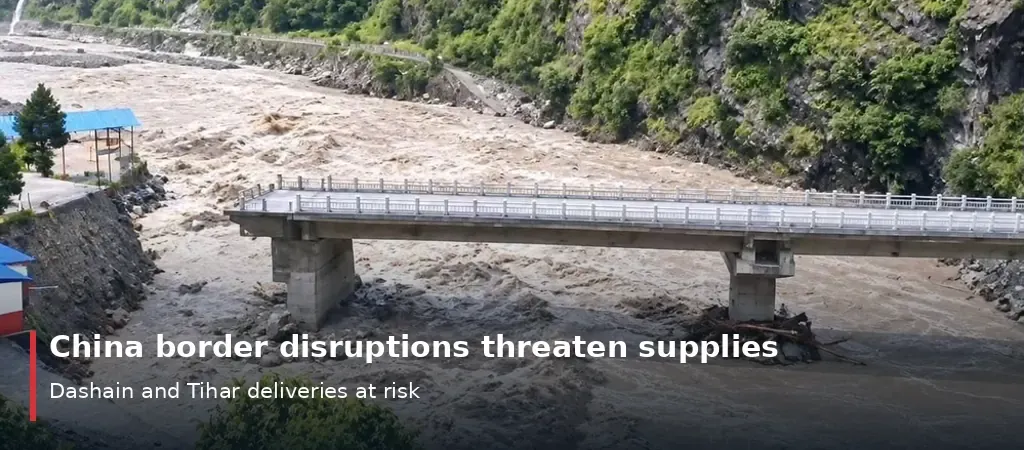
Photo: Paras Purja/KP
With all three main overland routes to China disrupted as Nepal's biggest festivals begin, traders warn of shortages and higher prices. For families sending money home, the cost of festive shopping may rise.
Nepal enters Bada Dashain this week with its main trade lifeline to China largely cut. Ghatasthapana fell on 9 October, with Tika due on 21 October, according to The Himalayan Times. As of 7–8 October, that newspaper reports, the Tatopani, Rasuwagadhi and Korala crossings were each shut or unusable.
How the routes closed. The sequence reported by the Kathmandu Post (17 September) is as follows. The Bhotekoshi flood of 26 August destroyed much of the infrastructure at Rasuwagadhi. On 29 August, China closed Tatopani (Zhangmu) to imports and exports, citing landslide risk. On 31 August, Chinese authorities told Tatopani customs by email that the suspension would last until further notice. Traders then diverted freight to Korala, which, according to The Himalayan Times, has now closed as well; that report gives no date or reason.
Why timing matters. Tatopani handled Rs 47.48 billion of imports in the last fiscal year, out of Rs 425.24 billion imported from China overall, the Post reports. The Himalayan Times puts the combined Tatopani and Rasuwagadhi share at over Rs 93 billion, a figure that does not match the Post's Tatopani number and should be checked against Customs Department data. The paper says Dashain and Tihar account for an estimated 40–70 per cent of annual retail sales in some categories. Goods affected include garments, footwear, electronics, electric vehicles and apples.
Costs and delays. According to the Post, goods take four to five days to reach Kathmandu from Korala, compared with four to five hours from Tatopani. Korala sits about 460 km from Kathmandu at 4,650 metres and lacks the customs infrastructure for heavy traffic. The Himalayan Times recalls that last year's Rasuwagadhi disruption was followed by price rises it reports as 15–30 per cent for clothing and footwear and 10–50 per cent for essential food. Those are the newspaper's figures and have not been independently verified here.
Competing positions. Infrastructure Development Minister Sunil Lamsal said talks with Chinese counterparts are continuing and Nepal is "ready to operate from our side immediately", according to The Himalayan Times. Sindhupalchok's Chief District Officer, Shashidhar Ghimire, said the Nepali-side roads are largely repaired but that China is keeping its side closed for administrative reasons, including relocating its Zhangmu customs facility to Nyalam. UML lawmaker Laxmi Prasad Pokharel called for stronger diplomacy. Beijing's official position was not available in the sources reviewed and no Chinese response has been obtained.
Revenue pressure. Customs Director General Yam Lal Bhusal said Rs 136 billion of a Rs 150 billion mid-October border-revenue target has been collected and he is confident of the remainder, the paper reports.
What it means for readers. Diaspora households buying gifts for Dashain should expect uneven availability and higher prices in Kathmandu markets, though the extent is not yet measurable. Importers face storage and demurrage costs. The longer-term question is whether Nepal can reduce dependence on a few high-altitude crossings vulnerable to floods and landslides.
What remains uncertain. There is no confirmed reopening date for any crossing, and no reason has been published for the Korala closure. Price data for this festive season has not yet been released.


