

Nepal UK
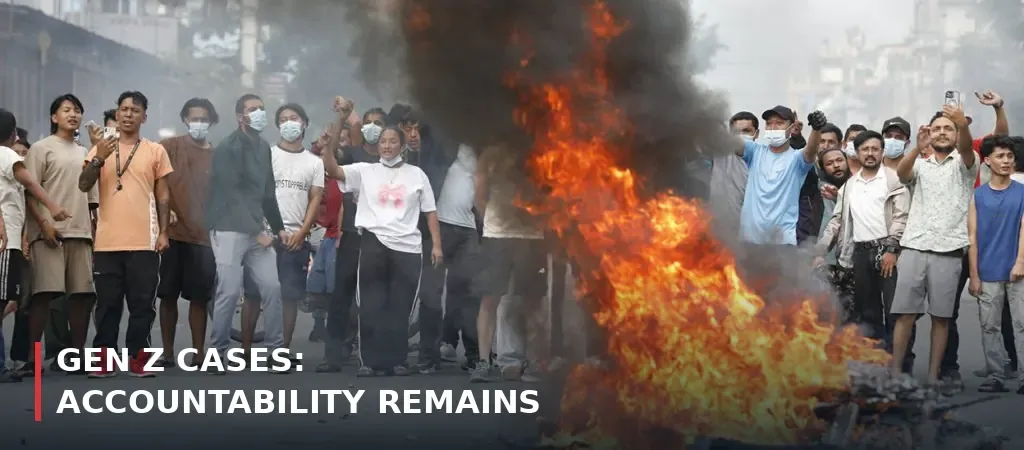
Nepal's Cabinet has passed a judicial committee's report to the Home Ministry as the government works to withdraw criminal cases linked to the Gen Z movement. The step tests how a young government balances reconciliation with accountability.
At its meeting on Monday 5 October 2026, Nepal's Cabinet decided to forward a report by a committee led by former judge Baburam Regmi to the Ministry of Home Affairs for consideration of withdrawing criminal cases connected to the Gen Z movement, according to Onlinekhabar's summary of the five decisions announced that day.
What is confirmed
The Cabinet decision is the latest step in a process that began months earlier. Spotlight Nepal reported on 5 July 2026 that the Office of the Attorney General had told government attorney offices nationwide to seek postponement of hearings in movement-related criminal cases, citing a Ministry of Home Affairs decision (dated Asar 18, 2083 in the Nepali calendar) to withdraw charges against people connected to the movement. The Attorney General's office had said the government had "initiated the process" of withdrawal, and had submitted reports to the ministry.
The movement itself began with the September 2025 protests; IANS reported on 8 September 2025 that the Cabinet formed an inquiry panel after violent protests left 19 dead. The Himalayan Times reported that Prime Minister Balen Shah's first Cabinet meeting, on 27 March 2026, decided to implement the Gen Z inquiry commission's report.
Why it matters
For Nepalese readers in the UK and elsewhere, the story touches two concerns at once: the treatment of young protesters, many of whom have relatives abroad, and the rule-of-law principle that large-scale political violence should be investigated. Withdrawal of cases against participants is not the same as a decision about prosecuting those accused of suppressing the protests. The sources reviewed do not set out how the two tracks will be separated, which is a significant gap.
Competing perspectives
Supporters of withdrawal would argue that protesters should not face prosecution for taking part in a movement that the state's own inquiry process has treated as legitimate. Critics could reasonably ask which categories of offence — for example, arson or violence against persons — would be covered. No reaction from affected parties, defence lawyers or opposition parties was found in the sources reviewed, so those positions cannot be attributed here.
What remains uncertain
The Cabinet decision, as reported, forwards the report to the Home Ministry; it does not itself withdraw any case. The report's contents, the number of cases and the criteria for withdrawal were not available in the sources reviewed. Whether courts will accept withdrawals in each case is untested.


