

Nepal UK
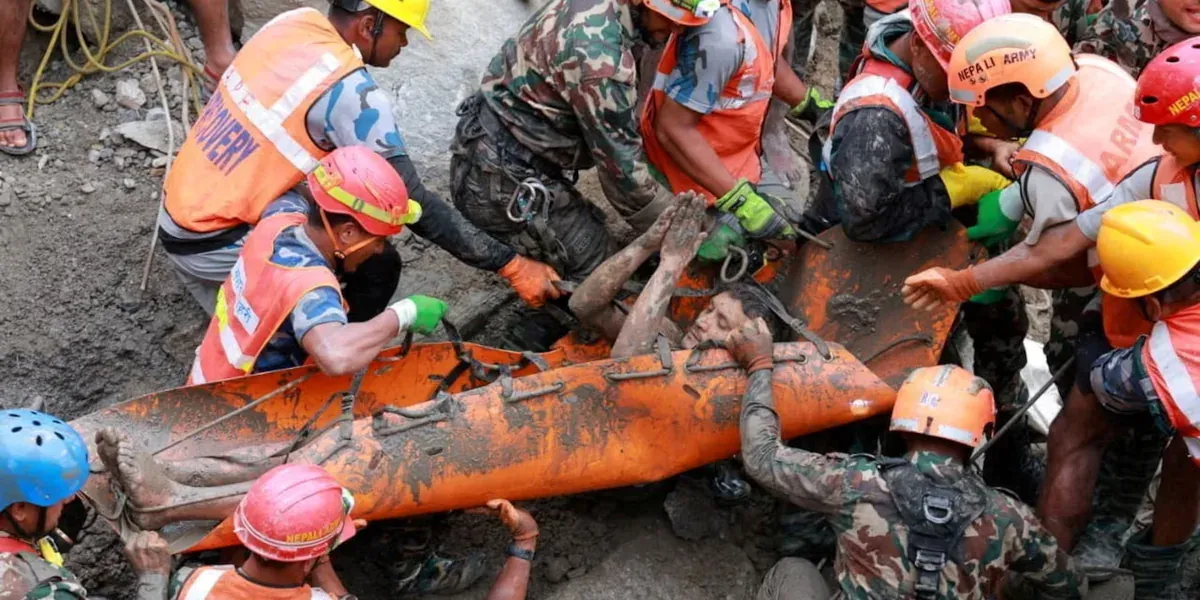
Image: Nepal Army/Handout via REUTERS
Reuters journalists spoke to the survivors' families and the rescuers who pulled them out. This report is based on that reporting.
At 7:30 a.m. on August 26, 2026, hydropower worker Kabir Maharjan called his wife, Hira Shova, before heading to his shift at the Upper Trishuli 3A hydropower station in Nepal's Rasuwa district. "I have to go inside the tunnel," he told her. "There won't be any network inside." It was, Reuters reported, the last thing she would hear from him for nine days.
An hour later, at roughly 8:30 a.m., a section of the Langtang Lirung glacier — some 25 miles upstream — collapsed, sending a wall of ice, rock, mud and water crashing down the Trishuli valley. By the time it reached the valley floor it had become one of the deadliest disasters in Nepal's modern history: more than 1,300 people killed, thousands still missing across Nepal and Chinese-administered Tibet, and roughly $2.5 billion in estimated damage, according to figures reported separately by NPR and Al Jazeera. Twelve hydropower projects along the valley were inundated, trapping close to 900 workers. At Upper Trishuli 3A alone, around 40 people were inside when the flood hit; an evacuation order went out at 9:15 a.m. — twelve minutes too late for many.
Maharjan and Sanjay Sah, a 30-year-old mechanical foreman who had spent the flood's first minutes racing floor to floor warning colleagues, found themselves trapped together in a sloped cable-duct tunnel about 160 metres from the exit. As muddy water rose around them, they found an air pocket — the pocket of oxygen that would keep them alive, and the prison that would hold them, for the next nine days.
According to Reuters' account, Maharjan drifted in and out of consciousness in what he later described as "a pool of muddy water in complete darkness," and survived, his wife said, by drinking the same silt-laden water that surrounded him. Sah, for his part, recited Hindu prayers to steady himself through the darkness. Neither man could see the other clearly; both simply waited.
A rescue fighting mud, rain and time
Outside, the rescue effort became a race against geology as much as time. Lawmaker and engineer Sagar Dhakal and engineer Shri Ram Neupane reached the site by helicopter the day after the flood. Officials prioritised the 3A tunnel because its multi-storey turbine hall and ventilation shafts suggested there might be surviving air pockets inside — but heavy machinery could not simply be driven in. "Everything you drop on that place just goes under," geologist Prakash Pokhrel told Reuters, describing debris still too waterlogged to bear weight.
It took three days just to build a stable platform to work from. All four tunnel entrances were sealed under 15 to 30 metres of mud, rock and timber. A five-inch borehole drilled from above eventually confirmed the tunnel's exact alignment, giving crews a fixed target — but repeated downpours undid hours of digging within minutes, refilling excavated shafts with fresh mud. Nearly six days passed before rescuers reached the tunnel's buried entrance. When they called into it, Reuters reported, there was no answer.
On the night before the rescue, crews hit a final wall of mud-clogged debris they could not physically move. Dhakal's team improvised, diverting a natural water channel 15 metres above the tunnel and forcing it through under high pressure — clearing several metres of blockage in minutes. A partial collapse briefly trapped some of the rescuers themselves; colleagues talked them back in, reinforced the passage with metal sheeting and gabion wire, and pressed on.
At 4 a.m. on the tenth day, an equipment operator heard something. "A noise," Reuters quoted the moment. "Maybe a survivor. Maybe just an echo." Ganga Baral, leading the search team, described calling into the dark: "We would call out, 'Where are you? Are you there?'" — cutting the machines' engines again and again just to listen. Then, in the beam of a light, someone saw a hand.
By 7 a.m., soldiers had broken through a small opening. From inside came a single word in Nepali: hunuhuncha — "we are here."
"He is blessed with another life"
Neither man could stand. Sah, his face caked in mud, was carried out on a rescuer's back, managing to lift one hand toward the cameras. Maharjan, more severely injured, was brought out on a stretcher. Dhakal, who had run the operation from outside for days, wept as they emerged. "I couldn't hold my tears," he told Reuters. When word reached Maharjan's home, his sons reportedly shouted, "Mummy, Papa is back!"
At the hospital, doctors operated on a deep, infected wound on Maharjan's leg. Disoriented, he did not recognise his wife when she first entered the room, asking simply, "Where am I?" Hira Shova, Reuters reported, held on to what mattered regardless: "He is blessed with another life."
The next day, rescuers found a third survivor — Chinese national Lu Haitao — alive in the tunnel of the nearby Upper Trishuli-1 project, a reminder that Maharjan's own words to rescuers, that more people might still be alive inside, were not idle hope. As of the Reuters report, several hundred workers remained missing across the valley's flooded tunnels, and search operations were continuing.


