
Nepal UK
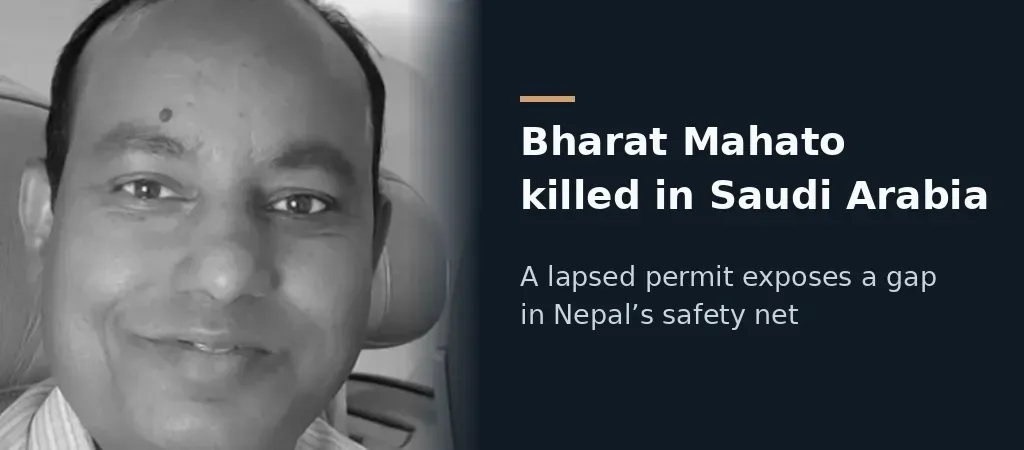
Bharat Mahato spent 14 years cleaning at Saudi Aramco project sites, returning home to Mahottari only twice. On 21 October he was killed at the Shaybah oil field in Saudi Arabia's Eastern Province, when debris from a drone intercepted by Saudi air defences fell during an attack attributed to Yemen's Houthi movement. A Filipino worker also died.
This week Nepal's embassy in Riyadh secured 181,000 Saudi riyals, more than Rs7.2 million, for Mahato's widow and four children from his employer, Abdul Wahab Mansour Al Moallam Sons Company. The settlement has also exposed a gap in the system meant to protect Nepal's overseas workers.
According to Kabiraj Upreti, labour counsellor at the embassy, the company agreed to pay 31,000 riyals in end-of-service benefits and 150,000 riyals in compensation. "The money will be sent to the family after the necessary administrative procedures are completed," he said.
Mahato's family would otherwise have received nothing from Nepal's own protection schemes. His government labour approval had expired about a year before his death. The family of a migrant worker who dies abroad with valid approval is entitled to Rs1 million from the Foreign Employment Board's welfare fund and up to Rs1.5 million under the foreign employment term life insurance scheme. Because Mahato's approval had lapsed, the family was ineligible for both.
"We informed the company about this, and it agreed to provide compensation from its own resources, recognising the financial hardship the family could face," Upreti said.
The outcome depended on the goodwill of a private employer and on the embassy's intervention, not on any guaranteed entitlement. Many long-serving workers renew contracts locally with the same employer and do not renew their approval through Nepal's Department of Foreign Employment. Their families may only discover the gap after a death.
Mahato, 45, was from Dhekaha in Pipara Rural Municipality-1. He had recently bought a small plot of land and begun building a four-room house, financed by a Rs1.1 million bank loan that his remittances repaid at Rs20,000 a month.
"Our only source of hope has been extinguished. How will I raise the children now?" his wife, Indrika, said in comments published this week. His body has been cleared for repatriation, but flight disruptions mean no date has been set.
Mahato's death is part of a wider security problem for Nepali workers in Saudi Arabia, where around 400,000 people are estimated to be employed. Since late September, Houthi drones and missiles have targeted Saudi oil sites, airports and other infrastructure. Available reports put the death toll in the kingdom from attacks and falling debris at at least 22. On the same day as the Shaybah incident, a Nepali worker was among eight people injured in an attack at Dammam airport.
On 22 October, Nepal's Ministry of Foreign Affairs condemned the Shaybah attack. The embassy in Riyadh has urged Nepali residents to follow local security alerts and avoid sharing unverified reports.
The case raises policy questions that Kathmandu has not yet answered. These include whether welfare-fund and insurance cover should continue for long-serving workers whose approval has lapsed, whether embassies should be required to identify and contact such workers, and how employers in high-risk zones can be held to a minimum standard of compensation.
For families in the UK with relatives working in the Gulf, the practical lesson is to check that labour approval and insurance are valid, and to keep the embassy's contact details at hand.


