

Nepal UK
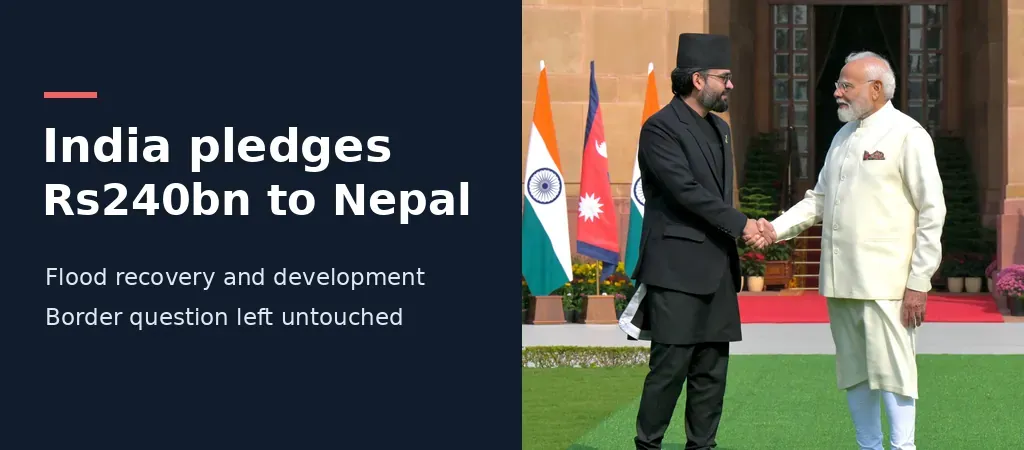
Prime Minister Balendra Shah came back from his first state visit to India with the biggest Indian aid pledge Nepal has received in years. Indian Prime Minister Narendra Modi announced Rs240 billion (about $1.6bn) for rebuilding after this year's floods and for long-term development. The two-day visit ended in New Delhi on Monday 23 November. It also produced eight memoranda of understanding, several cross-border infrastructure projects and an agreement to open up a key air route. On the issues that have strained relations for years, the two governments agreed almost nothing new.
Under the joint statement, the package is made up of Rs56 billion in grants for post-disaster reconstruction and new infrastructure, and Rs184 billion in concessional loans for energy projects. Which projects will be funded, and how the money will be released, is still to be decided by the two governments.
"To support Nepal's reconstruction, and give fresh momentum to its long-term development, we announce a development cooperation package worth 240 billion Nepali rupees," Modi said, standing beside Shah at Hyderabad House.
The leaders launched the Sarayu-Kamala Express, a train between Ayodhya in India and Janakpur in Nepal, and opened a road bridge linking Darchula with Dharchula. Work began on the 669-megawatt Lower Arun hydropower project, the Siliguri–Jhapa petroleum pipeline and an integrated check post at Banbasa. India also handed over the completed second phase of the Motihari–Amlekhgunj pipeline. The memoranda cover space technology, security training, civil service capacity building, health, traditional medicine, sustainable urban development and agriculture.
For travellers, the most practical result is aviation. The Kathmandu–Bhairahawa–Lucknow route, which currently works in only one direction, is to become two-way. Technical studies and procedures still have to be completed before that can happen.
Shah called the relationship one "as firm as the Himalayas and as vast as the ocean".
The joint statement contains no new political commitment on the boundary dispute over Kalapani, Lipulekh, Limpiyadhura and Susta. It repeats the long-standing instruction for the two foreign secretaries to settle "outstanding boundary matters". A Nepali diplomat said both sides had agreed in advance not to raise the border during this visit.
The contrast with Shah's own record is clear. As mayor of Kathmandu, he kept a "Greater Nepal" map behind his desk, and in August 2025 he publicly called the India–China agreement to trade through Lipulekh "an infringement on our sovereignty".
The 1950 Treaty of Peace and Friendship gets only a passing mention: the vision document says existing agreements "may be reviewed on the basis of mutual consent". The 2018 report of the Eminent Persons Group, which recommended replacing that treaty, has still not been formally received by India. The Pancheshwar Multipurpose Project also stays where it was, with both governments again asking officials to finish the detailed project report.
Former ambassador to India Nilamber Acharya said the political breakthrough many had hoped for did not happen. "There are boundary disputes between Nepal and India, and issues concerning the review of treaties and agreements remain pending," he said. "Talks on these matters didn't take place." Foreign policy analyst Chandra Dev Bhatta took a different view. He argued that the visit rebuilt trust after a period of tension: "Everything cannot be achieved in a single visit."
The bigger question is whether the money will actually be spent. After the 2015 earthquake, India pledged $1bn, made up of $250m in grants and $750m in concessional loans. The grants were used, but much of the loan never was. Conditions in the 2016 Exim Bank agreement required at least 75 per cent of materials, equipment and services to come from India. Officials say these terms did not suit the small schools and health posts Nepal wanted to rebuild. Nearly a decade later, dozens of Tribhuvan University buildings are still waiting to be reconstructed.
"An agreement had been signed to obtain the loan through India's Exim Bank," said Sushil Gyewali, former chief executive of the National Reconstruction Authority. "But it could not be implemented because the conditions of the agreement were not met."
This time the loans are meant for large energy projects, which former ambassador and economist Shankar Sharma said are easier to finance in this way. He warned, however, that conditions on materials and labour could still cause delays.
For Nepali communities in the UK, many of whom raised money for flood relief this autumn, the scale of the pledge matters. So does the pace at which it reaches villages along the Bhotekoshi and Trishuli. The negotiations to come will show whether the money comes on Nepal's terms.


