

Nepal UK
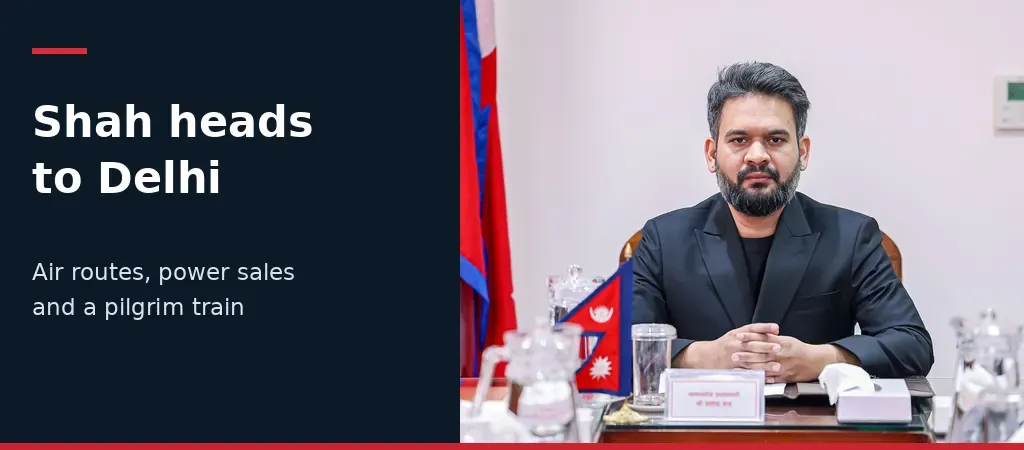
Prime Minister Balendra Shah makes his first bilateral visit to India this weekend. Beyond the ceremony of a new train service, the real test is whether he can unlock air routes and electricity sales that have stalled for years.
Prime Minister Balendra Shah will make a two-day state visit to New Delhi on 22 and 23 November at the invitation of Indian Prime Minister Narendra Modi, according to the latest itinerary described by officials involved in the preparations. It will be his first official bilateral trip abroad since he took office on 27 March after the Rastriya Swatantra Party's landslide election victory.
Earlier reports had suggested a four-day trip; the current plan is for Shah to arrive on 22 November and return to Kathmandu the next day, after a 30-minute one-on-one meeting with Modi and delegation-level talks. At the time of writing, NepalUK had not found a formal published itinerary from either foreign ministry, so details may still change.
The groundwork was laid on Monday, when President Ramchandra Paudel appointed Nischal Nath Pandey as Nepal's ambassador to India, alongside new envoys to China and Israel. The three were among ten nominees approved by Parliament's hearing committee out of 13 recommended by the Cabinet in September.
For travellers between the UK and Nepal, the most consequential item may be the least visible. Simara remains the only point at which international flights can enter Nepal through Indian airspace, according to the Civil Aviation Authority of Nepal (CAAN). Planes heading for Kathmandu, Pokhara or Bhairahawa from the west must fly east to Simara before turning back, burning extra fuel.
Devananda Upadhyaya, a former deputy director general of CAAN, has argued that this detour is one reason Nepal is an expensive aviation destination. It has also left the new international airports at Bhairahawa, near Lumbini, and Pokhara struggling to attract regular foreign airlines. A senior CAAN official said India had been theoretically willing to open further routes, including via Mahendranagar, but technical progress had repeatedly stalled without a political agreement. Tourism Minister Khadkaraj Poudel has noted that a regional airport India is building in Motihari, Bihar, may itself need Nepali airspace, which could give both sides room to trade. He pressed India's new ambassador, Sudhakar Dalela, on extra entry routes and direct flights to Pokhara and Bhairahawa last Friday.
Electricity is the more urgent commercial issue. Nepal's authorisation to export 609 megawatts to Haryana, Uttar Pradesh and Bihar under medium-term agreements expired at the end of October. The Nepal Electricity Authority (NEA) says it asked India in August to let it sell that power on the Indian Energy Exchange instead, but has had no approval. A separate 40MW seasonal arrangement with Bangladesh ended on 15 November.
With domestic generation running at 2,600–2,700MW against demand of around 2,200–2,300MW, the NEA estimates potential lost revenue of about Rs135.8 million a day. The window is short: river flows fall from late November, and the NEA expects to import power from India between mid-January and mid-March.
The most visible outcome is likely to be a weekly Ayodhya–Janakpur passenger service, which Nepal's Ministry of Infrastructure Development says the two prime ministers are expected to inaugurate on 23 November. The 604km route has only 28km inside Nepal. India will operate the 18-coach train at first, and Nepal is preparing to request grant aid to electrify its section.
Business groups want progress on trade facilitation and a Nepal–India payment gateway. Harder issues, including the Kalapani–Lipulekh border dispute and the long-stalled Pancheshwar hydropower project, are not expected to be resolved during the visit. Shah, a former mayor of Kathmandu who once hung a "Greater Nepal" map in his office, will be watched closely at home for how he handles them.
For the diaspora, the visit matters in practical ways: cheaper and more direct flights to Pokhara and Lumbini, a stronger economy from power exports, and easier pilgrim travel. Whether Shah returns with signed agreements, rather than statements of intent, will be clear by 23 November.


