

Nepal UK
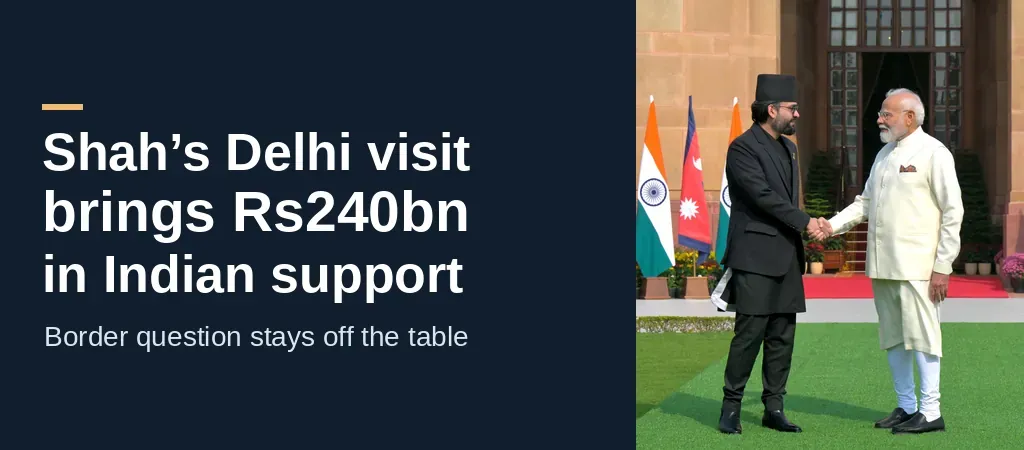
Prime Minister Balendra Shah has returned from his first state visit to India with a large development package and a string of connectivity projects, but without any fresh movement on the boundary dispute, the 1950 treaty or the long-stalled Pancheshwar scheme.
Shah, who took office in March after the Rastriya Swatantra Party's election victory, held talks with Indian Prime Minister Narendra Modi at Hyderabad House in New Delhi on Monday 23 November, at the end of a two-day visit that began on 22 November. India announced Rs240 billion in development assistance, made up of Rs56 billion in grants for reconstruction and new infrastructure and Rs184 billion in concessional loans for energy projects. The two governments still have to agree which projects will be funded and how the money will be released.
The visit produced eight memoranda of understanding covering space technology, security training, civil service capacity building, health, traditional medicine, sustainable urban development and agriculture. The leaders also adopted a ten-point joint vision document, titled "Viksit Bharat and Samunnat Nepal", setting out a framework for cooperation in trade, energy, technology, education, health, agriculture and sport.
Several projects moved from paper to ground. The prime ministers flagged off the Sarayu-Kamala Express between Ayodhya and Janakpur, opened a motorable bridge linking Darchula with Dharchula, and broke ground on the 669-megawatt Lower Arun hydropower project, the Siliguri–Jhapa petroleum pipeline and an integrated check post at Banbasa. India handed over the completed second phase of the Motihari–Amlekhgunj pipeline.
Indian Foreign Secretary Vikram Misri told reporters that India would set up an offshore campus of the Indian Institute of Technology in Nepal and provide grant support for an agro-industrial park in Chitwan. Both sides also agreed to make the Kathmandu–Bhairahawa–Lucknow air route two-way, although technical studies must be completed first.
The more sensitive files were set aside. Misri confirmed that neither the Lipulekh dispute nor the recruitment of Nepali citizens into the Indian Army was discussed. Nepal has suspended that recruitment since India introduced its Agnipath short-service scheme, which Kathmandu opposes. Misri also described the Eminent Persons' Group report on bilateral relations as a matter of the past.
On the boundary, the joint statement repeats a familiar instruction for the two foreign secretaries to settle outstanding issues — language close to that agreed after Modi's 2014 visit to Kathmandu. A Nepali diplomat told reporters both sides had agreed in advance not to raise the border. The vision document does allow existing agreements, including the 1950 Treaty of Peace and Friendship, to be reviewed by mutual consent.
The contrast with Shah's earlier stance has drawn comment. As mayor of Kathmandu he displayed a "Greater Nepal" map in his office and publicly asserted Nepal's claim to Lipulekh. Former ambassadors Nilamber Acharya and Deep Kumar Upadhyaya both argued that the visit lacked a political breakthrough on long-standing disputes, with Upadhyaya noting that commitments on boundary talks have gone unmet for decades. Others were more positive: foreign policy analyst Chandra Dev Bhatta said the visit had rebuilt trust needed for harder conversations later, and Madhendra P Lama, an Indian member of the Eminent Persons' Group, called it "a good beginning".
For the diaspora, the practical items may be felt first. Better rail and air links to Janakpur and the Lumbini region, and new investment in hydropower, bear directly on remittance-dependent households and on families planning visits home. The aid also arrives as Nepal faces a reconstruction bill after the August Bhotekoshi–Trishuli floods estimated at around $4.8 billion.
The Gurkha question carries a particular resonance in Britain. While the British Army continues to recruit Gurkhas from Nepal, recruitment to India's Gurkha regiments remains frozen, and the visit offered no sign of a resolution.
NepalUK's assessment is that the visit traded political ambition for tangible delivery. Whether that proves a sound strategy will depend on two things: how quickly the Rs240 billion becomes funded projects, and whether the promised foreign secretary talks on the boundary actually take place.


