

Nepal UK
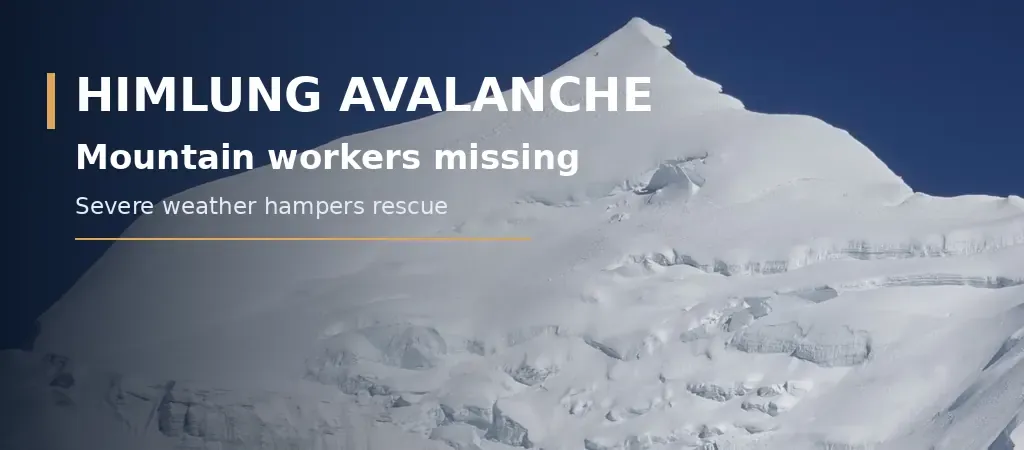
An avalanche has buried an advance expedition camp on Himlung Himal in Manang, leaving 14 Nepali Sherpas and support staff unaccounted for since Sunday morning. Rescue helicopters are grounded in Kathmandu and Pokhara by the same storm system that has battered Nepal for days, and officials say the number missing has risen through the day as verification continues.
At least 14 Nepali mountain workers — Sherpas, kitchen staff and expedition-support crew — are unaccounted for after an avalanche struck an advance base camp on Himlung Himal (7,126 metres) in Manang district's remote Nar Phu region on Sunday morning, 27 September 2026. Contact was lost shortly after the crew placed a call requesting emergency helicopter evacuation. No foreign climbers were with the group, which was working ahead of clients due to arrive within the week. Rescue helicopters and experienced high-altitude guides are on standby in Kathmandu and Pokhara, but persistent rain, snowfall and low cloud over the mountain have prevented any aircraft from reaching the site, according to expedition operators and Nepal's Department of Tourism.
What Is Confirmed
The Kathmandu Post, citing expedition operators and government officials, reports that the number of missing has been revised upward twice since the incident was first reported: from an initial 8, to 10, to the current figure of 14 as of the outlet's 1.12pm update on 27 September. The missing are drawn from two operators: Himalayan Holidays Nepal, whose founder Bibhuti Chand Thakur told the Post, "I have been on the phone continuously. The weather was fine, and they called asking us to send a rescue helicopter" before contact was lost; and Imagine Nepal, whose general manager Dawa Futi Sherpa said the company's rescue team, including guide Mingma Gyalzen and seven others, was "all on standby, but the weather at the airport is not allowing them to fly." Ram Krishna Lamichhane, Director General of the Department of Tourism, confirmed the government was coordinating rescue efforts and monitoring the situation, though he offered no timeline for when aircraft might reach the mountain. The Expedition Operators Association Nepal separately confirmed the incident and said it was still verifying details on the ground.
Why the Team Was Still at Base Camp
Nepal's Department of Tourism had issued a formal advisory ahead of the weekend warning of "heavy rainfall, thunderstorms, strong winds and possible snowfall at high elevations" between 25 and 27 September, and the Trekking Agencies' Association of Nepal had urged operators and travellers to avoid trekking and mountaineering activity during that window. According to reporting reviewed by NepalUK, most expedition and rope-fixing teams on Himlung had already withdrawn from the higher slopes after that warning was issued the previous week; the group now missing was among those who remained at or near base camp as conditions worsened. No source has yet explained why this particular crew stayed behind, and NepalUK has not seen any suggestion of wrongdoing by the operators — both companies appear to have responded immediately once contact was lost, and this remains an active rescue operation rather than a completed investigation.
What Remains Unconfirmed
The fate of the 14 missing workers is not known. No bodies, survivors, or wreckage have been reported found at the time of writing, and NepalUK has seen no official casualty figure — the group's status should be described as missing, not presumed dead. It is not yet clear whether any communication has been re-established with the group since the initial distress call, what triggered the avalanche, or when weather conditions are expected to improve enough for helicopters to fly. This is a fast-moving story and figures may change again as verification continues.
The Wider Context
The incident comes as Nepal continues to grapple with an unusually severe spell of autumn weather: the same storm system has disrupted roads and trekking routes nationally and forced the suspension of expeditions on Manaslu and Dhaulagiri, and follows weeks in which the country has been absorbing the toll of August's catastrophic Bhote Koshi flood. For Nepal's mountaineering industry — and for the Nepali guides, porters and support crews whose labour underpins it, including many with family in the UK diaspora — the incident is a stark reminder that the greatest risks of the Himalayan expedition economy are most often borne by local workers rather than the foreign clients they serve.
NepalUK will continue to monitor this story and will publish updates as rescue access improves, contact is re-established, or authorities confirm the fate of those missing.


