

Nepal UK
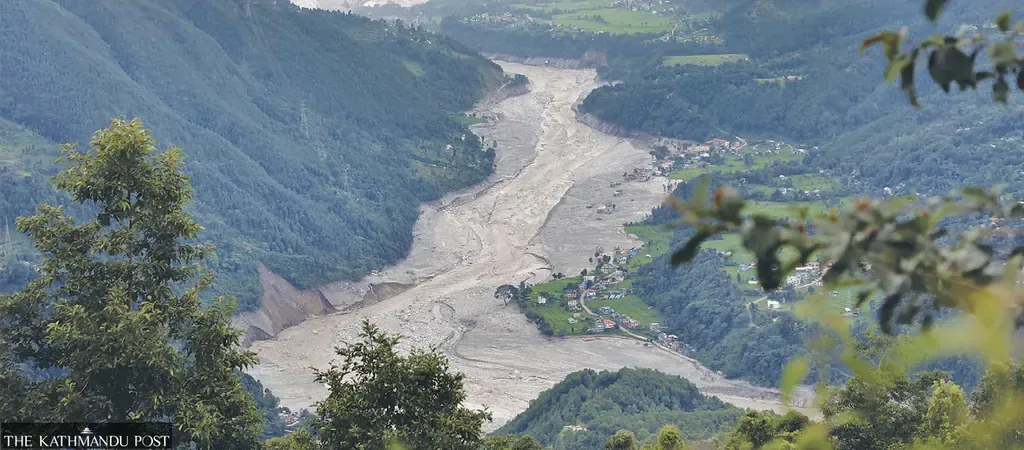
Photo: Kathmandu Post
Six weeks after the 26 August disaster, the financial damage is spreading from the valley to lenders, borrowers and importers. With Dashain days away, the effects reach households and diaspora families sending money home.
The human toll of the Bhotekoshi flood is well documented. The National Disaster Risk Reduction and Management Authority (NDRRMA) figures reported by the Kathmandu Post on 12 September were 1,386 bodies recovered and 5,130 people missing. Less visible is the financial fallout. By 4 October, Nepal News reported that around Rs 5 billion in microfinance loans were exposed, and by late September all three major Nepal-China crossings had closed, delaying festival stock.
Lenders and borrowers
Onlinekhabar reported on 31 August that sixteen branches of twelve banks in Rasuwa were affected, fifteen of them destroyed. They served 78,204 depositors and had lent Rs 2.43 billion to 2,125 borrowers, excluding hydropower. Nepal Bankers' Association CEO Anil Sharma said cash holdings were insured, but warned that some loans were secured on land that may no longer exist.
Nepal News's 4 October economic brief reported that about 30,000 microfinance borrowers were directly affected across 38 branches of 14 institutions, with roughly Rs 5 billion at risk and about 30 per cent of the affected portfolio (about Rs 1.5 billion) at high risk. I could not locate the underlying source for these microfinance figures, so they should be read as reported by one outlet. An opinion piece in Onlinekhabar by a Tribhuvan University academic, published 7 September, argued that households without insurance risked turning to informal moneylenders, as happened after the 2015 earthquake. That is the author's argument, not a finding.
Trade and prices
Onlinekhabar reported all three crossings (Tatopani-Khasa, Rasuwagadhi and Korala) closed on 29 September, with 150-plus vehicles waiting at customs and 300 to 400 electric vehicles stranded. An RB Complex Business Association president said at most 30 per cent of Dashain-targeted goods had arrived. Business leaders warned prices could rise by 25 to 30 per cent, which is a warning, not a forecast. Nepal News reported hundreds of trucks backed up at Bhairahawa and customs hours extended to 1am.
Why it matters abroad
Many diaspora families send remittances at festival time, when household costs rise. If goods remain scarce, higher prices will erode the value of that money. Relatives affected by the flood may also face debt pressure. The sources do not quantify either effect, so this is analysis rather than reported fact.
Uncertainties and what comes next
Damage estimates differ: the Kathmandu Post cited a preliminary figure of Rs 408 billion, with reconstruction costs of US$4 to 5 billion. Death and missing figures also vary between outlets (1,377 to 1,403 deaths reported in September; Wikipedia gives 1,451, which I have not verified against a primary source). A post-disaster needs assessment was expected within five weeks of 8 September. Watch for regulators' guidance on loan restructuring and for the Tatopani road repair, which Nepal News says could allow around 500 containers to move within ten days of reopening.


